49 works in this view — arrow keys or swipe to move between them.
Dance in Art · 1879
PUNCH1879p241
Unknown
- Medium:
- Oil Painting
- Era:
- Late 1800s (Victorian Ballroom)
- Source:
- Wikimedia Commons
- Rights:
- Public domain — free to use, share and adapt.
- Recorded as:
- Public Domain
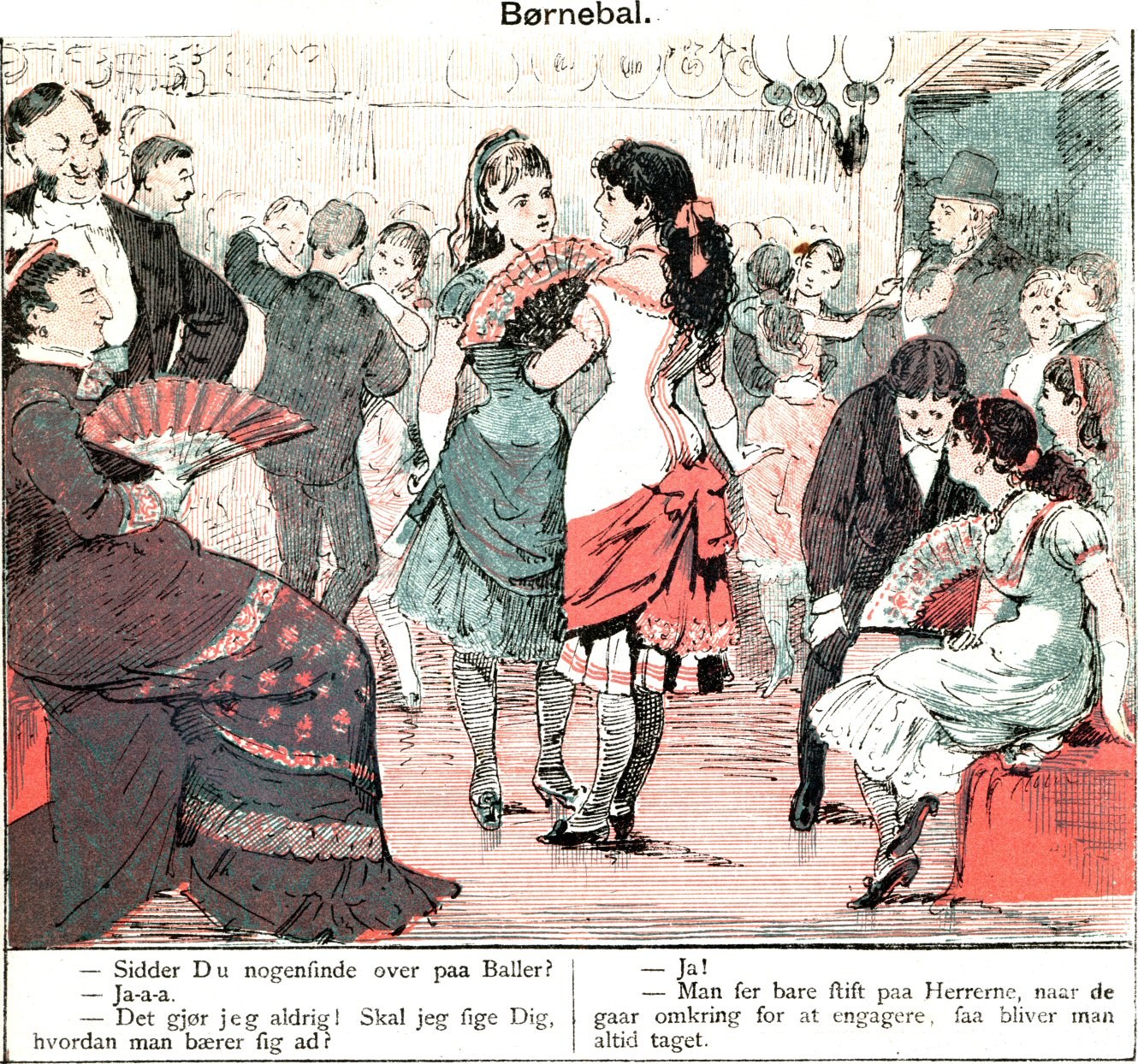
This image reveals how social dancing functioned as a space of gender performance and social competition among young Victorians, documented not in an etiquette manual or dance instruction book but in satirical commentary aimed at the reading public. It shows that dance historians must look beyond formal dance records to understand how ordinary people actually danced and what dancing meant in their social lives.
What you are looking at
This is a satirical engraving depicting a children's ball or young people's dance party, rendered in the sharp linear style characteristic of Victorian periodical illustration. The scene is crowded and animated: at least twenty figures fill an indoor space with wooden flooring, arranged in loose clusters around two girls in the center who appear to be demonstrating or performing a dance. The girl on the left wears a teal-blue dress with coral-red trim and a pink bow; the girl on the right wears similar coral-red skirts with decorative details. Both have their skirts hiked up slightly—shorter than the ankle-length dresses of adult women visible in the background—revealing stockinged legs and black boots, which was the convention for young unmarried girls in Victorian dress. The adult women seated and standing at the margins wear full-length skirts and hold fans; men in dark suits and hats frame the composition. The setting is interior and domestic, likely a parlor or ballroom, with hooks or decorative elements visible on the upper walls. The tone is comic: the children's exaggerated gestures, the crowding, the adults' amused expressions, and the hand-written caption all suggest this is a gentle satire on courtship rituals and social climbing among the young.
The dancing
The two central girls stand close together, their bodies angled toward each other and the surrounding crowd in a way that suggests they are either dancing together or one is instructing the other. Neither figure shows the formal closed hold or frame of ballroom partners; instead, their posture is loose and social, with arms relatively free. Their legs are positioned for what appears to be walking or simple step-movement rather than the technical footwork of trained dance. The surrounding children and adults are arranged in an audience formation, watching intently—this is a moment of social display and observation rather than synchronized group dancing. The overall body language is upright and socially conscious rather than abandoned or technically accomplished.
The dance depicted
This is not a depiction of a trained or formal dance style, but rather a satirical scene of social dancing among young people in Victorian society. The caption, translated from Danish ("Børnebal" = "Children's Ball"), confirms this is a dance party for adolescents. The dance being shown appears to be an informal social waltz or promenade—the kind of movement taught in dancing schools for young people of genteel background. The satire turns on the caption's suggestion that girls can ensure they are asked to dance by affecting a certain distant expression ("staring stiffly") to appear more desirable. The image documents not a specific named dance, but the social conventions and gender dynamics of Victorian courtship conducted through dance.
How it was made
This is a hand-colored engraving or wood engraving, characteristic of mid-to-late Victorian periodical illustration. The fine linear hatching, the sharp contrast between inked lines and white paper, and the hand-applied watercolor washes in teal, coral, and flesh tones are all typical of the production method for weekly satirical magazines of the period. The technique allowed for rapid reproduction in periodicals with wide circulation—this particular image comes from Punch magazine, a leading venue for social satire. The linear precision and the capacity for fine detail in faces and costume enabled the artist to convey both social observation and comic exaggeration simultaneously.
About this work
This is a page from the Danish or English satirical press (likely Punch, given the styling), probably from 1879 according to the catalogue, depicting a children's or young people's social dance party. It is not a record of professional dance training or performance, but rather a document of the social rituals by which Victorian adolescents, particularly girls, navigated courtship and social acceptance through dancing. The work exemplifies how dance imagery in the nineteenth-century periodical press served as a vehicle for social commentary: the humor lies not in the dance itself, but in the behavior and pretense surrounding it. For historians of dance and social customs, this image captures the intersection of dance, gender, and social climbing in Victorian culture.
How to look at it
Pay attention to the contrast between the two central figures—who are actually dancing or performing—and the surrounding adults and children, who form an audience. The artist has frozen a moment of social display: the girls are not dancing for the pleasure of movement, but to be seen and evaluated. Notice the shortness of the girls' skirts compared to the adult women's full-length dresses; this costume distinction marks social status and marital eligibility. The adults' attentive postures and the way they frame the scene suggest that this is a ritual of observation and judgment. Finally, read the caption carefully: the satire depends on the reader understanding that the girls' 'performance' is actually a calculated social strategy.
The artist
Unknown. The style and content suggest a professional illustrator working for a major British or European satirical periodical in the 1870s–1880s. The hand-coloring and the social observation are characteristic of the best periodical illustration of the period, but attribution is not recorded.
The period
This image dates to the height of Victorian ballroom culture and the formalization of dance education for young people of the gentry and middle classes. By the 1870s, dancing schools and "coming out" balls were standard rites of passage for girls. The waltz, which dominated social dancing from the 1820s onward, was fully established as the primary couple dance of respectability. At the same time, satirical periodicals like Punch were at their peak of influence, using social humor to comment on gender roles, courtship, and the anxieties of an increasingly urbanized and class-conscious society. The image sits at the intersection of these trends: it documents the formality of Victorian dance culture while gently mocking the emotional and strategic calculation that underlay it.
Where it lives
This image comes from Punch magazine, a weekly satirical periodical published in London. The Punch collection is held in various archives; this particular image has been digitized and made available through Wikimedia Commons. Such images were produced in large numbers for mass circulation and were meant to be topical, humorous, and disposable—yet they provide irreplaceable documentary evidence of social customs and attitudes.
Dance in this work
Questions about this work
What is a 'children's ball'?
A children's ball or young people's ball was a social dance event organized for unmarried adolescents of genteel background in the Victorian period. These events were important rites of passage, particularly for girls, who were introduced into society and given opportunities to meet eligible young men. Dancing schools prepared them for these occasions.
Why are the girls' skirts shorter than the women's?
In Victorian dress custom, the length of a girl's skirt signaled her marital and social status. Unmarried girls wore skirts that fell to mid-calf or knee, revealing stockings and boots, while married women and mature widows wore full-length skirts that swept the floor. The distinction was immediately legible and enforced strict social boundaries.
Is this satire mocking the girls or the social system?
Both, gently. The satire is primarily aimed at the social system: the idea that young women must 'perform' availability and attractiveness according to rules that have nothing to do with genuine feeling or agency. The girls themselves are depicted with sympathy as clever navigators of an absurd system.
What dance is being shown here?
The movement is too simplified in the illustration to identify a specific named dance with certainty, but it is most likely a waltz or a simple promenade or quadrille figure—the standard social dances taught in Victorian dancing schools. The focus of the image is social behavior, not dance technique.
More dance artwork