49 works in this view — arrow keys or swipe to move between them.
Dance in Art · 2015
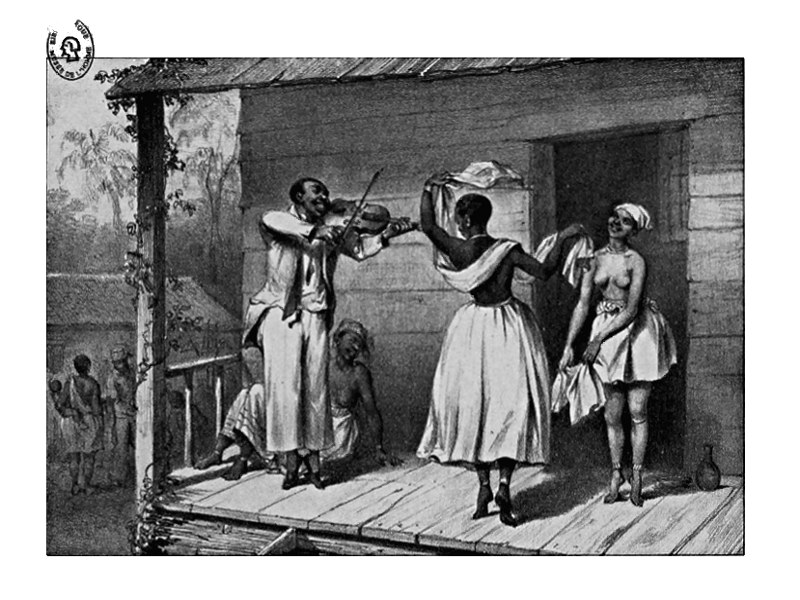
Pierre Jacques Benoit.- La leçon de danse au violon Surinam, 1839
Pierre Jacques Benoît
- Medium:
- Oil Painting
- Source:
- Wikimedia Commons
- Rights:
- Public domain — free to use, share and adapt.
- Recorded as:
- Public Domain
This is primary visual evidence of creole dance practice in the early 19th-century Caribbean, a period and region where such documentation is scarce. The image's embedding in a colonial travel narrative reminds us that dance history in the diaspora is often mediated through the records of colonizers, and that reading such sources requires critical attention to power, perspective, and what remains invisible or silenced in the frame.
What you are looking at
A creole dance master plays violin while instructing two female dancers in an open-sided wooden structure, likely a plantation house or slave quarters in Surinam. The violinist stands at left, instrument raised, wearing light clothing and a head covering. The two dancers—identified in the original caption as an enslaved Black woman and a creole woman—face each other in the center, their bodies angled toward one another in what appears to be a lesson or demonstration. A third figure, a young boy, crouches at lower left, while a standing figure in minimal dress observes at right. The wooden floor and simple architectural frame suggest a domestic or semi-domestic space. The composition is crowded and intimate, with figures compressed into the shallow stage-like space. The engraving is rendered in fine detail with careful cross-hatching to establish shadow and volume.
The dancing
The two central female figures are positioned close together, their upper bodies leaning inward in an attitude of attention or engagement. The dancer on the left (identified as enslaved) appears to mirror or follow the dancer on the right. Their arms are positioned informally at their sides or slightly raised; neither adopts the rigid posture of European formal dance. The violinist's raised instrument and engaged posture suggest active musical direction. The crouching boy at left and standing observer at right frame the scene as witnesses or learners.
The dance depicted
This is a depiction of creole dance instruction in early-19th-century Surinam, likely a form of social or recreational dance blending African and European influences that would have been practiced in colonial plantation settings. The image documents a teaching moment rather than a performance. The violin as the primary instrument and the informal stance of the dancers suggest this is neither European ballroom dance in the formal sense nor a ceremonial African form, but rather a syncretic creole practice adapted to the colonial Caribbean context. The specific dance form cannot be determined from the image alone, but the scene captures an intimate moment of cultural transmission in a slave society.
How it was made
This is an engraving, rendered with fine lines and careful cross-hatching to create tonal depth and texture. The technique allowed for precise detail in the dancers' dress and the architectural setting, and required careful composition to compress multiple figures into a legible shallow space. Engravings of this period circulated widely in illustrated travel narratives aimed at European audiences curious about colonial life and 'exotic' customs. This work appears as plate 12 in a lavishly illustrated travel book published in Brussels, indicating it was intended for a educated, commercially-minded readership interested in ethnographic documentation.
About this work
This engraving documents a scene of dance instruction in early-19th-century Surinam, part of a larger illustrated travel narrative by Pierre Jacques Benoît. It captures a moment of creole cultural practice in a colonial plantation setting, with a violin-playing instructor demonstrating or teaching steps to two female dancers. The work exists at the intersection of art, ethnography, and the colonial archive: it purports to record a lived social practice while inevitably filtering that practice through European artistic conventions and the voyeuristic gaze of the travel book. The scene is neither a formal European dance nor a documented African ceremony, but rather a hybrid creole form that emerged under conditions of colonial violence and cultural encounter. For dance historians, the image raises difficult questions about how colonial-era visual documentation both preserves and distorts the history of diaspora dance practices.
How to look at it
Pay attention to the violin: it establishes that this is a taught, musically directed practice, not an improvised or ceremonial form. Notice the informal posture of the dancers compared to European ballroom or ballet conventions—there is no rigid frame, no turned-out positions, no formalized hold. The cramped, shallow stage and the placement of observers suggest this is an interior, quasi-domestic scene, not a public spectacle. The engraving's clarity and detail invite close looking, but remember that this is a European artist's interpretation of a colonial scene, filtered through travel-book conventions about how 'exotic' practices should be rendered legible to a European eye.
The artist
Pierre Jacques Benoît (1813–1894) was a Belgian painter, lithographer, and travel writer who undertook an expedition to Surinam in the late 1830s. His *Voyage à Surinam* (1839) was illustrated with engravings after his own drawings, combining artistic documentation with ethnographic and naturalistic observation. Benoît's practice exemplifies the 19th-century European fascination with colonial territories and the aestheticization of colonial life in illustrated travel literature.
The period
The 1830s saw an expansion in illustrated travel narratives as a commercial and intellectual genre, driven by European curiosity about colonial possessions and non-European peoples. In dance history specifically, this period marks the height of Romantic ballet in Europe—emphasizing ethereal, formally trained female bodies—while dance in the Caribbean colonies remained unrecorded except through such oblique visual documents as this. The image was made in the final decades before the abolition of slavery in the Dutch colonies (1863), capturing a moment of colonial plantation society at its apex. The choice to document 'the creole dance lesson' suggests Benoît understood dance as a marker of cultural identity and social hierarchy worth recording for European audiences.
Where it lives
This engraving appears as plate 12 in *Voyage à Surinam. Description des possessions néerlandaises dans la Guyanne*, illustrated by Pierre Jacques Benoît, engraved by P. Lauters and Madou, and published by the Société des Beaux-Arts in Brussels in 1839. It is a commercial publication intended for a European readership interested in colonial documentation and ethnographic curiosities.
Dance in this work
Questions about this work
What dance is being taught in this picture?
The specific dance form cannot be identified with certainty from the image alone. The violin accompaniment, informal posture of the dancers, and the colonial Caribbean setting suggest a creole social dance that blended African and European influences. Such dances were part of everyday life in plantation communities but remain poorly documented in written or visual sources.
What does the caption mean by 'esclave négresse' and 'créole'?
These are the French colonial terms used in the 1839 original caption. 'Esclave négresse' refers to a woman enslaved in the colony; 'créole' in this context means a person of European descent born in the colonies. The caption's explicit racial and social categories reflect the hierarchies of 19th-century colonial society and shape how the artist and intended viewers understood the scene.
Why is this in a travel book rather than a dance history?
Illustrated travel narratives were the primary medium through which Europeans encountered information about colonial life and non-European practices in the 19th century. Dance in the diaspora went largely unrecorded except through such oblique sources. This reflects a historical bias: European ballroom and theatrical dance were documented extensively, while Caribbean and African diaspora dance practices were invisible to written dance history unless recorded by colonial observers.
Is this a reliable historical document?
It is valuable but requires critical reading. The image documents that violin-accompanied social dance existed in Surinam and was considered noteworthy enough to record for European audiences. However, it is filtered through European artistic conventions, the voyeuristic framing of the travel book, and the artist's interpretations. It tells us as much about what colonial observers found exotic or picturesque as it does about the dance itself.
More dance artwork