30 works in this view — arrow keys or swipe to move between them.
Dance in Art
PinelliNapoli
Unknown artist
- Medium:
- Oil Painting
- Dance:
- Folk/Country
- Source:
- Wikimedia Commons
- Rights:
- Public domain — free to use, share and adapt.
- Recorded as:
- Public Domain
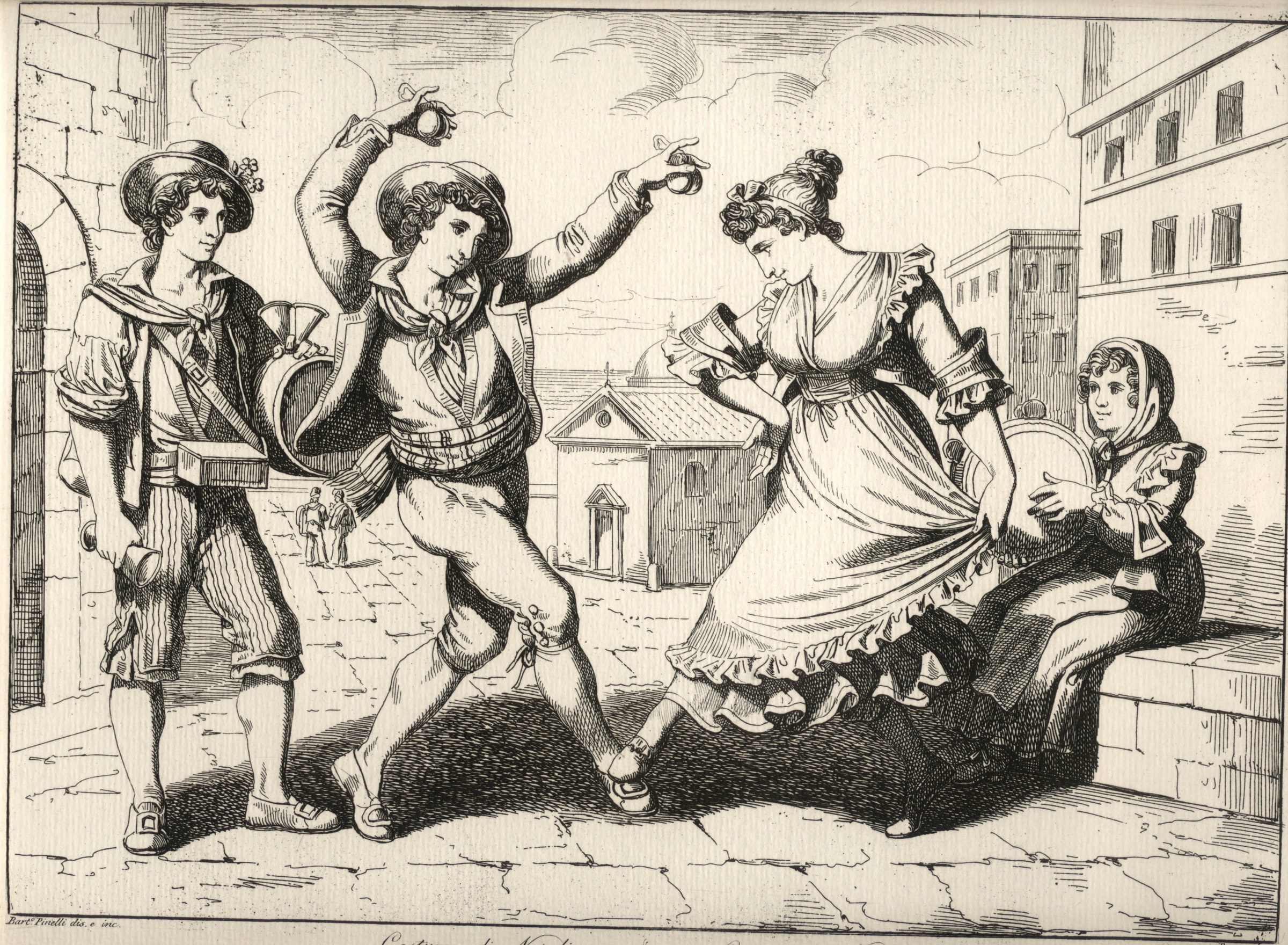
This image is rare evidence of how non-elite people actually danced and moved in the early 1800s, unmediated by theatrical convention or ballroom formality. It captures the explosive physicality and use of percussion that define Southern Italian folk forms, and it places that dancing in its true social context: a public street performance for an informal, mixed audience. For dancers and choreographers researching folk traditions or the history of the body in performance, it offers direct visual testimony.
What you are looking at
A lively street or courtyard scene with five figures in early 19th-century dress. Two young men in tight breeches, short jackets, and hats dominate the composition: the central figure springs upward with arms raised, holding what appear to be small objects (possibly castanets or similar percussion), while his companion to the left watches. Two women in high-waisted Empire dresses look on—one seated on steps to the right, cradling an infant, the other standing nearby holding a fan. A small child sits at the lower right. The setting is urban: paved ground, stone buildings with regular windows, and a small chapel or shrine visible in the background. The engraving technique renders the scene with fine parallel lines defining fabric texture, musculature, and shadow, creating a sense of spontaneous street performance or domestic celebration.
The dancing
The male dancer at center is captured mid-leap, his legs in a wide split or straddled position, torso upright, both arms raised to shoulder height or above holding small hand instruments. His posture is athletic and uninhibited—the kind of exuberant, virtuosic movement that reads as folk or popular rather than formal. His companion stands relaxed, observing. The women's poses are static and decorous; they are audience rather than dancers. The composition emphasizes the explosive energy of the male performer against the composed stillness of the onlookers.
The dance depicted
This appears to document a folk or popular street dance, likely Southern Italian (the record suggests Naples, and the urban vernacular setting supports this). The dancer's exuberant, acrobatic movement—the high elevation, wide split, and use of hand percussion—suggests tarantella, a Neapolitan folk form known for its energetic, improvisatory character and use of tambourines or similar instruments. The castanets or percussion held aloft are consistent with regional folk practice. The scene captures the social context of such dancing: spontaneous performance in a public space, with family members and strangers as witnesses. This is not ballroom or theatrical dancing but street culture.
How it was made
This is an engraving or etching, not an oil painting as the catalogue states. The parallel hatching lines, fine detail, and tonal range created through line density rather than paint are characteristic of intaglio print techniques. The skill with which the artist renders fabric movement, muscular definition, and spatial depth through line alone suggests a trained printmaker working from or after a drawing. Engravings of this type were relatively inexpensive to produce and circulate, making them ideal for documenting popular manners, costumes, and street life for a broad audience.
About this work
This print documents a moment of popular dance in early 19th-century Naples, capturing an exuberant male dancer performing a folk form—likely tarantella—in a street or courtyard setting before an audience of women and children. The engraver has frozen the dancer at the apex of a leap, arms raised with percussion instruments, conveying both the technical virtuosity and the uninhibited joy of vernacular dancing. The work belongs to a tradition of social documentation through printmaking: it records not just the dance itself but the context in which it occurred—urban, public, familial, spontaneous. For historians of dance and social customs, it is valuable evidence of how ordinary people danced in the early 19th century, the role of performance in street life, and the social hierarchy between performer and audience that persisted even in casual settings.
How to look at it
Watch the dancer's body: note the impossibly wide split, the spring-loaded quality of the pose, the raised arms with held objects, the freedom of movement. This is not the controlled frame or closed position of ballroom; it is athletic and exuberant. Notice also where the artist chose to freeze the action: not at the moment of landing or the preparation, but at the peak of flight, when the body is most fully extended and most impossible to hold. This choice tells you that what the artist wanted to convey was not the dance as a series of steps, but the pure energy and spectacle of the leap itself. The onlookers' composed stillness makes that energy read even louder.
The artist
Unknown. The engraver's hand is skilled and precise, suggesting professional training, but no signature or identifying mark is visible in the image. The work may be attributed to a Neapolitan print workshop or a visiting artist documenting Italian life for a European audience—a common practice in the early 19th century. The record title 'PinelliNapoli' may refer to a collection or publisher rather than an artist's name.
The period
This print was made during the Romantic era, when European artists and writers were intensely interested in folk culture, national character, and 'authentic' popular life as a counterpoint to industrialization and refined manners. Italian folk dance and costume were frequent subjects for printmakers and painters serving both local and international markets. The early 19th century also saw the rise of social dance in formal settings (quadrille, cotillion, waltz), making popular street dancing—already associated with lower classes and southern regions—appear increasingly remote and 'authentic' to educated viewers. The image captures this moment of fascination with disappearing vernacular forms.
Where it lives
The work is sourced from Wikimedia Commons. The record title 'PinelliNapoli' is unclear in origin and may refer to a collection, publisher, or subject category rather than an artist name. Collection, accession number, and current location are not recorded.
Dance in this work
Questions about this work
Is this tarantella or a different Southern Italian dance?
The image is consistent with tarantella—the exuberant leap, the hand-held percussion, the street setting, the social context. But engravers of this period often did not distinguish rigorously between regional folk forms, and the artist may have been more interested in capturing a generic 'popular Neapolitan moment' than a specific choreography. The movement vocabulary strongly suggests a tarantella family dance, but certainty is not possible from the image alone.
Was this actually how people danced in Naples, or is it an idealized image?
Likely both. Early 19th-century prints documenting 'popular life' were often made for educated audiences and carried romantic or satirical intent. This image may exaggerate the athleticism, naïveté, or exuberance of the dancer for effect. But it is also evidence: the artist had seen people move this way, and chose these forms as legible and believable to the viewer. It is a filtered record, but a record nonetheless.
Why are the women not dancing?
In early 19th-century Southern Italian folk dance, gender roles in performance varied by context and region. This image may reflect a moment in which a male dancer is performing for onlookers, or it may reflect a convention of printmaking in which male bodies are portrayed as active and female bodies as decorative. The presence of the woman with the child suggests a domestic or family context, where the female role was spectatorship and care.
More Folk/Country artwork