46 works in this view — arrow keys or swipe to move between them.
Dance in Art · 1340
Reigentanz laster
Unknown artist
- Medium:
- Oil Painting
- Era:
- Pre-1700 (Renaissance/Baroque)
- Source:
- Wikimedia Commons
- Rights:
- Public domain — free to use, share and adapt.
- Recorded as:
- Public Domain
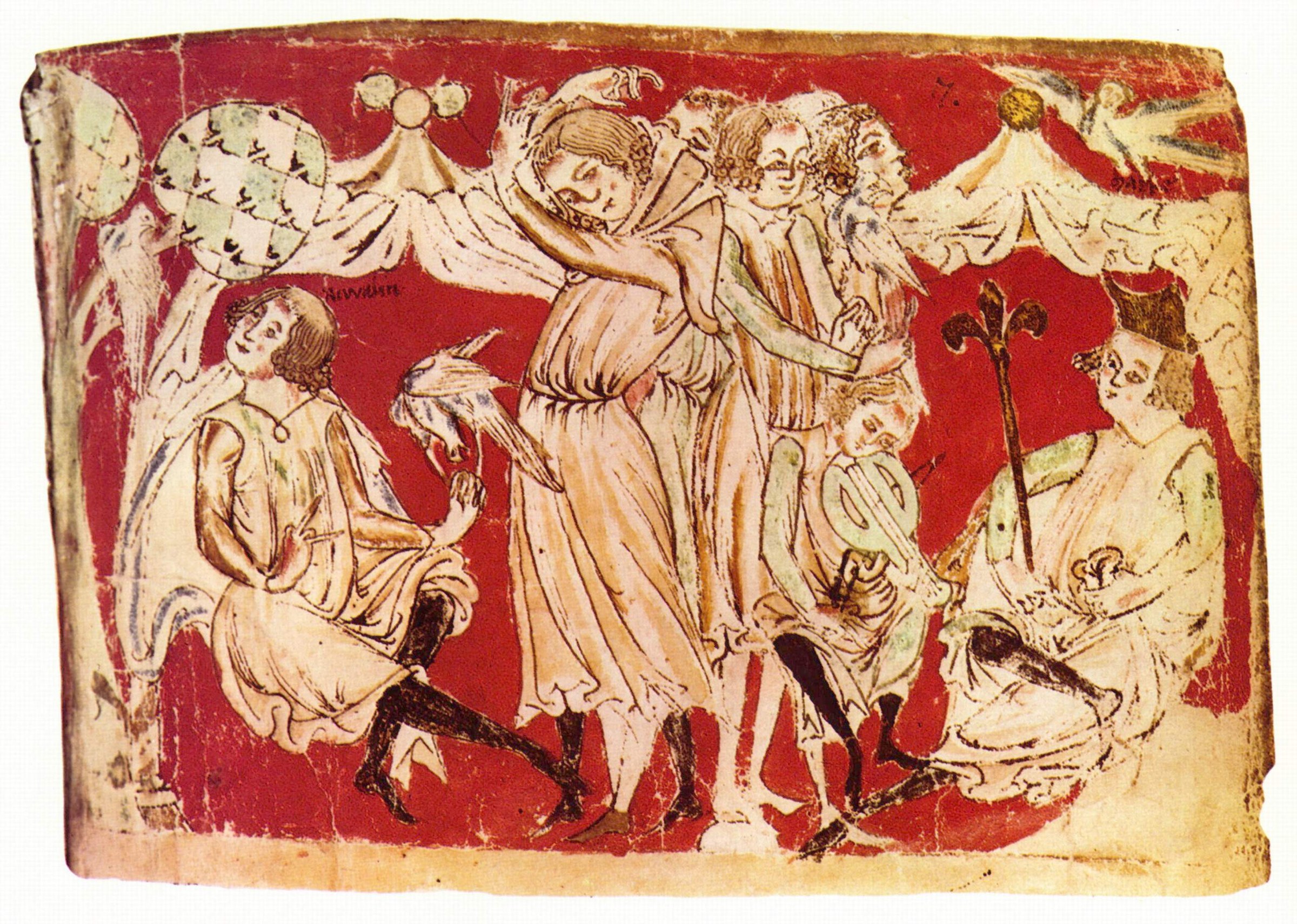
The *Reigentanz der Laster* demonstrates the deep integration of dance imagery into medieval moral teaching and shows that dance was understood not merely as entertainment but as a legible language of bodily order and disorder. This tradition of using grotesque or chaotic movement to signify vice was influential across Northern Europe and persists in later art; understanding this image helps explain why dance became a persistent metaphor in Renaissance and Reformation visual culture for both virtue and sin.
What you are looking at
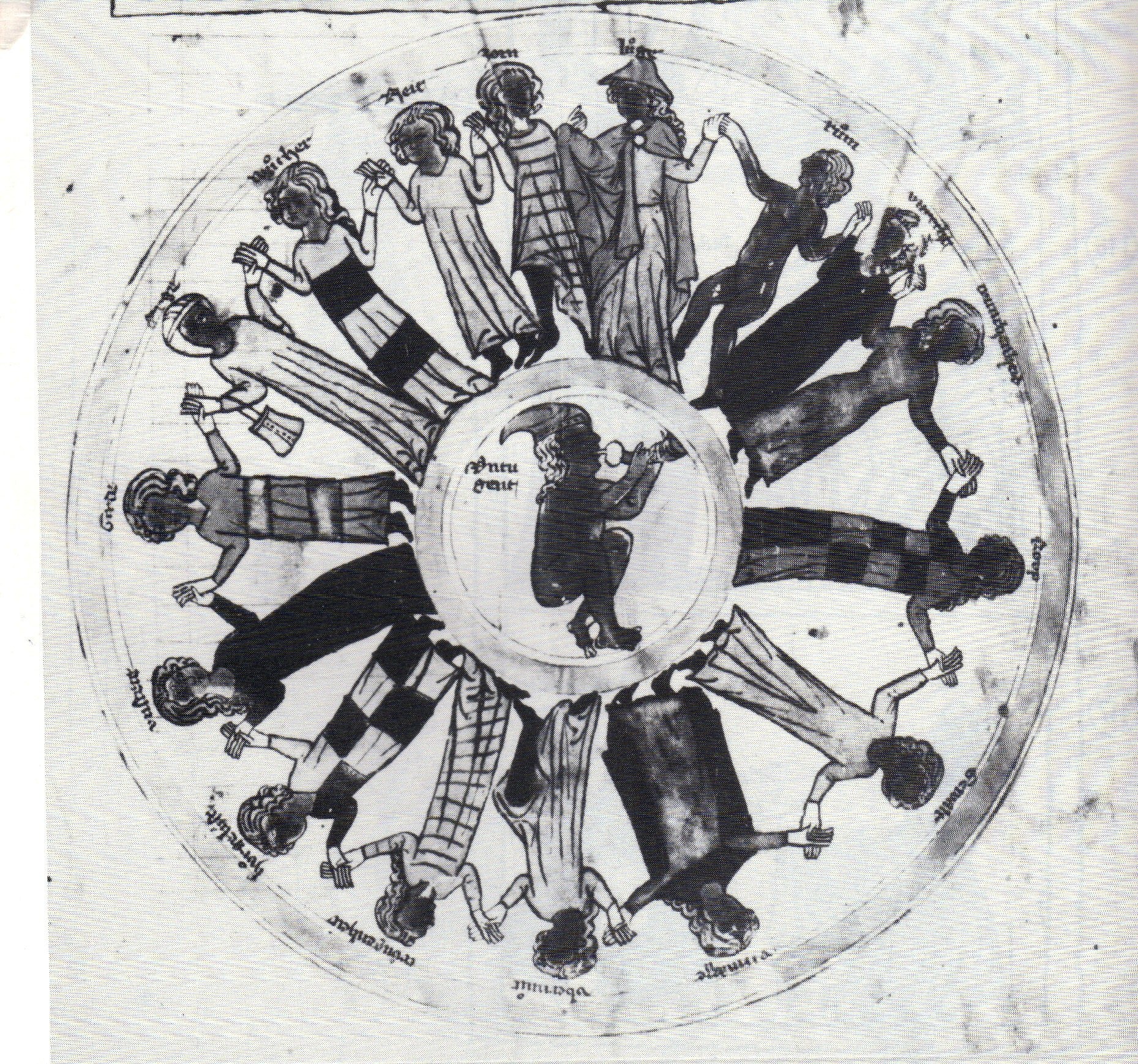
A circular composition organized around a central medallion shows figures arranged in a wheel-like pattern, radiating outward from the center. At the hub is a smaller circular scene depicting two figures; around this are approximately fourteen human figures, mostly nude or partially draped, in dynamic poses that suggest vigorous movement. The outer figures appear to be in various stages of exertion—some leap, others crouch or twist, a few reach upward or outward with their limbs. The style is a fine linear engraving or woodcut, rendered in black on a pale ground with careful cross-hatching for shadow. The composition suggests a morality play or pedagogical diagram: the central scene appears to depict a vice or folly, with the surrounding figures embodying consequences or related sins. The figures' musculature is emphasized through line work, and their poses are theatrical rather than naturalistic.
The dancing
The bodies exhibit energetic, exaggerated poses characteristic of Northern European Renaissance graphic art—twisted spines, splayed limbs, and upraised arms dominate. Several figures appear to be in mid-leap or mid-stumble; weight is distributed asymmetrically and dynamically across the composition. The anatomical rendering shows some understanding of musculature and skeletal structure, though limbs are often attenuated and poses are contorted for expressive rather than balletic effect. The figures vary in their degree of undress and in the orientation of their bodies to the viewer, creating a sense of chaotic, uncontrolled movement.
The dance depicted
This appears to be a *Reigentanz* (literally 'circle dance' or 'chain dance'), a didactic German woodcut or engraving tradition from the 14th–16th centuries depicting vice and folly through grotesque or chaotic group movement. The title *Reigentanz der Laster* ('Circle Dance of Vices') confirms this is a morality image in which vicious behavior is represented through a distorted parody of the ronde or chain dance—a popular social form in medieval and Renaissance Europe. The poses are deliberately uncontrolled and undignified, signaling moral disorder rather than ordered courtly or folk choreography. The composition itself—the radiating circle—mimics the physical form of a ronde or round dance while inverting its social meaning through grotesquerie.
How it was made
This is a finely executed engraving or possibly a woodcut, rendered in black line with careful stippling and cross-hatching to model form and create tonal variation. The technique allowed for precise anatomical detail and complex composition, and the scale and finish suggest this was a relatively expensive, carefully executed work intended for educated viewing. The medium's capacity for fine line and intricate detail enabled the artist to render the chaotic, expressive movement convincingly while maintaining compositional clarity through the organizing geometry of the circle. Such works were created on paper or vellum and could be copied, distributed, and bound into manuscripts or collected albums.
About this work
This is a morality engraving from the medieval German tradition, showing the *Reigentanz der Laster* ('Circle Dance of Vices'). It uses the visual language of the ronde or round dance—a familiar social form—and inverts it through grotesque, uncontrolled bodily movement to condemn vice and folly. The work belongs to a rich tradition of didactic Northern European graphics in which dance becomes a metaphor for social disorder and moral transgression. It survives in a manuscript held at the Gotha Library (Thomas-Handschrift, FB Gotha Cod. memb. I, 120, fol. 100v), suggesting it was part of a larger illustrated moral or spiritual text. For dancers and historians, the work is significant as evidence of how closely dance imagery was tied to moral and social instruction in the late medieval period, and how the formal properties of dance—the circle, the chain, the ronde—could be deliberately distorted to signify disorder.
How to look at it
Attend to the contrast between the geometric, orderly outer circle (which organizes and contains the figures) and the chaotic, contorted poses within it. The artist is exploiting the viewer's familiarity with actual chain dances and round dances—social forms that represent order, community, and shared joy—and showing their perversion into a swirl of individual excess. Notice how few figures touch or relate to one another; instead, each seems absorbed in private frenzy. The central medallion, though small, is the visual and moral anchor; the surrounding figures radiate outward from it, as if vice spirals outward from a central source. The work asks the viewer to read movement not as abstract beauty but as moral content.
The period
The *Reigentanz* tradition flourished in German-speaking lands during the 14th and 15th centuries, a period of intense moralizing fervor and didactic art production. These works often appeared in manuscripts and as broadsheet engravings aimed at clergy, educated laity, and scholars. The tradition peaked in the decades before the Reformation, when anxiety about bodily excess, sexuality, and social disorder found expression in grotesque imagery. The form combines medieval allegory with a new precision in anatomical and compositional rendering made possible by advances in engraving technique. Such works circulated in networks of educated collectors and were sometimes bound into larger manuscript compilations on moral or spiritual themes, as appears to have happened with this example in the Gotha codex.
Where it lives
This work is known from a single recorded instance in the Thomas-Handschrift (Thomas Manuscript) held in the Gotha Research Library, Erfurt, Germany, catalogued as Cod. memb. I, 120, fol. 100v. The manuscript appears to be a bound collection of moral and spiritual texts and images, suggesting the engraving was integrated into a larger pedagogical or devotional program.
Dance in this work
Questions about this work
What is a Reigentanz?
A *Reigentanz* is a circle dance or chain dance, a common medieval and Renaissance social form. In these morality engravings, the term is used as a title for didactic compositions showing the chaotic, uncontrolled movement associated with vice, folly, or sin. The artist uses the familiar form of the dance to make moral disorder visually legible.
Why are the figures so grotesque and distorted?
The exaggeration and contortion serve a moral purpose: they signal that the dancers are governed by vice or sin rather than by reason and virtue. In medieval and Renaissance moral thought, the body's disorder reflects the soul's disorder. Grotesque movement was a visual vocabulary for inner corruption.
Is this actually depicting a real dance?
It is depicting a real social form—the ronde or circle dance—but deliberately distorting it. The actual dances were orderly, communal, and often virtuous; here the form is inverted to show how vice corrupts even the most basic human activities. It is a moral commentary on the dance rather than a realistic representation of it.
What does the central medallion show?
The central scene, though small and difficult to read clearly in reproductions, likely depicts the source or embodiment of the vice being illustrated—possibly a temptress, a demon, or a personification of sin. The surrounding figures radiate outward from this center, suggesting that vice spreads or multiplies from a single source.
More dance artwork