49 works in this view — arrow keys or swipe to move between them.
Dance in Art · 1901
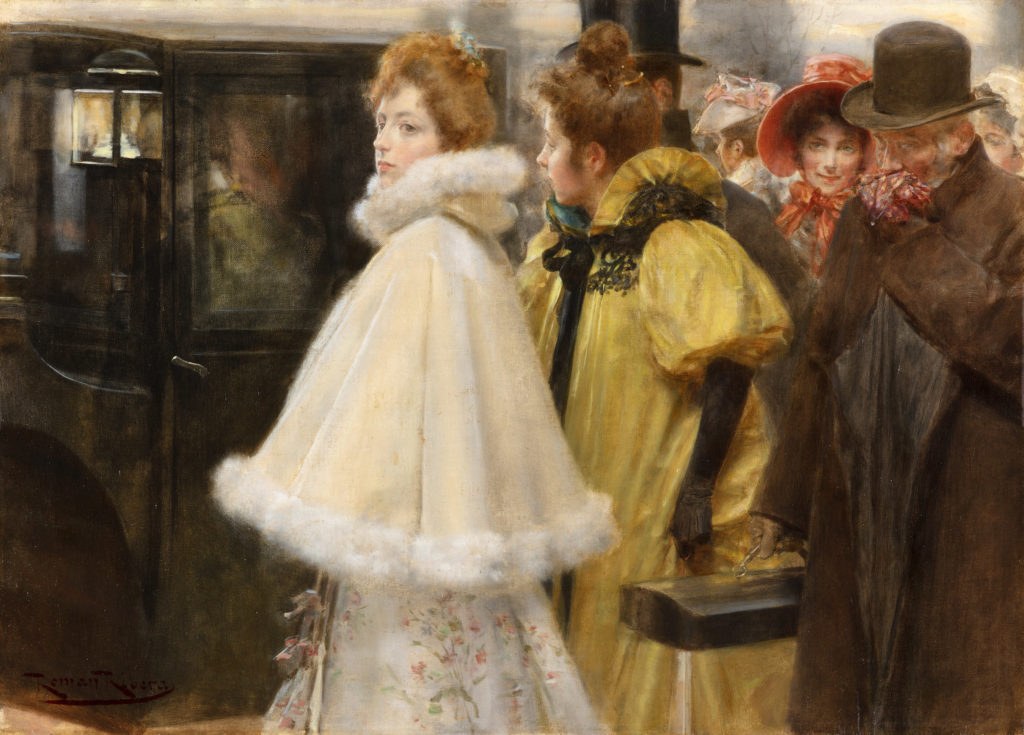
Román Ribera Cirera - Saliendo del baile
Romà Ribera i Cirera
- Medium:
- Oil Painting
- Era:
- 1900-1920 (Ragtime/Early Jazz)
- Source:
- Wikimedia Commons
- Rights:
- Public domain — free to use, share and adapt.
- Recorded as:
- Public Domain
This work documents not dance itself but the social theater surrounding it—the moment when one enters or leaves the dance floor. For historians of dance and society, it is valuable evidence of how the ball functioned as a space of social surveillance and status display, and of how important the transition in and out of the dance space was to the rituals of the evening. It shows that for Gilded Age painters, the meaningful subject was often the social frame rather than the choreography.
What you are looking at
A moment of social arrival or departure at a formal dance, captured in an interior setting with warm amber light. A woman in an elegant cream-colored gown with white fur stole stands at the center-left, her reddish hair styled high, turning her head to regard the assembled company with a composed, contemplative expression. She has just arrived or is about to leave—her posture suggests transition. Behind and around her cluster five or six other figures: a woman in a striking yellow coat with black trim and dark feathered hat; a woman in a red hat; men in dark formal wear and top hats; and figures in muted browns and grays. The composition pushes these companions slightly into shadow, making the woman in cream the focal point. A dark doorway is visible on the left—the portal through which she has come or will pass. The palette is restricted and atmospheric: creams, warm ochres, blacks, and deep browns, with touches of saturated color in the accessories. The light falls unevenly, creating a sense of interior theater under gas or electric lamps.
The dancing
The primary figure stands upright with composed carriage, her weight evenly distributed, her shoulders relaxed but her expression serious rather than animated. There is no hold or embrace visible; the figures are grouped in social proximity rather than in dance formation. The gestures of the attendants are minimal—slight turns of the head, a hand near the face. The woman's elaborate costume—particularly the voluminous fur stole and the formal cut of the gown—suggests this is a portrait of display and status rather than a capture of physical action. The bodies are stationary or barely moving; no footwork, no frame, no partnering is evident.
The dance depicted
This painting does not depict dance in motion but rather a social moment adjacent to dance—the custom of arriving at or departing from a ball. The title "Saliendo del baile" (Leaving the Ball) makes this explicit. The work captures the formal social ritual of the Gilded Age, in which one's entry and exit from a dance venue were occasions for display and observation. It belongs to the tradition of social documentation—showing the fashions, manners, and hierarchies of urban society rather than choreography or movement. The painting is ethnographic of social custom rather than a dance image per se.
How it was made
Oil painting, worked with careful attention to fabric texture and the interplay of light on different surfaces. The artist has used a restrained palette and soft, almost photographic rendering of faces and clothing to create an atmosphere of documentary realism. The technique allows for subtle modeling of flesh and careful capture of the quality of different materials—silk, fur, wool, cotton—which is central to the work's social content. This is the work of a painter trained in late 19th-century academic salon practice, concerned with finish, legibility, and the representation of contemporary social life.
About this work
Romà Ribera i Cirera's 1901 oil painting captures a moment of social ritual at a formal dance in the Gilded Age: a woman in elegant evening dress, attended by companions, at the threshold of departure. The work is not a choreographic document but an image of social custom—the coded, hierarchical space of arrival and exit. It belongs to a genre of social-scene painting that flourished in the late 19th century, showing fashionable society at leisure, and is one of many such works depicting the ballroom as a space of display and social negotiation. The painting demonstrates how dance venues and ball attendance were occasions for the performance of class and gender in urban Europe.
How to look at it
Attend to the woman's expression and posture: she is not smiling, not animated, not engaged with her companions. Her gaze is directed inward or away. This is a portrait of social performance under constraint—the expectation that one behave with composed dignity even as one navigates the hierarchies of the ballroom. Notice also how the other figures are rendered slightly less sharply, slightly more absorbed into shadow and background, making the woman's moment of transition the true subject. The painting captures not the joy or abandonment of dance but the formal, almost solemn protocols of fashionable society.
The artist
Romà Ribera i Cirera (1848–1927) was a Catalan painter known for society portraits and scenes of fashionable urban life. He trained in the academic tradition and exhibited widely in Barcelona and Madrid. His work is characterized by careful attention to contemporary dress, interior lighting, and the documentation of social hierarchies and customs. He was particularly attentive to the role of fashion and display in defining social identity, and his oeuvre includes many scenes of balls, salons, and public leisure.
The period
In the 1890s and early 1900s, the European ballroom was at the height of its social significance—a carefully choreographed space in which courtship, marriage negotiation, and class reproduction took place. Painters like Ribiera documented these scenes as part of a broader fascination with modern urban leisure. The Gilded Age saw the rise of commercial dance halls and private balls as sites of social aspiration and anxiety. Simultaneously, ballet as a theatrical form was undergoing radical transformation in Paris and Russia, but this painting belongs to the genre of social realism rather than theatrical dance documentation. The work is contemporary with the early emergence of modern dance but entirely indifferent to it—its subject is the ballroom as a social institution.
Where it lives
The work is recorded as oil on canvas, dated 1901. The current holding collection is not recorded in the catalogue. The image is sourced from Wikimedia Commons, which typically holds works in public collections or those in the public domain.
Questions about this work
Is this a painting of a dance?
Not exactly. The title makes clear it depicts the moment of leaving a ball—a social ritual rather than dancing itself. The figures are stationary or barely moving, and the artist's interest is in fashion, social hierarchy, and the formal protocols of arrival and departure rather than choreography or movement.
What can this painting tell us about 1900s ballroom society?
It shows the importance of display, costume, and composed behavior in upper-class social life. The woman's elaborate gown and fur, the formal dress of the men, and the careful staging of the moment all suggest that the ball was a space in which one's appearance and manner were subject to scrutiny. The woman's serious, inward expression suggests social constraint beneath the glamour.
Why is the woman in cream the focus?
Her placement, her elaborate costume, and her direct engagement with the viewer's gaze mark her as the subject of social interest and observation. The other figures are more dimly lit and less detailed—they are there to witness and contextualize her moment of transition.
What does the doorway on the left represent?
It is the threshold between the dance floor and the outside world. The painting captures the moment of crossing that threshold—neither fully inside the social space nor outside it. This liminal moment is the painting's true subject.
More dance artwork