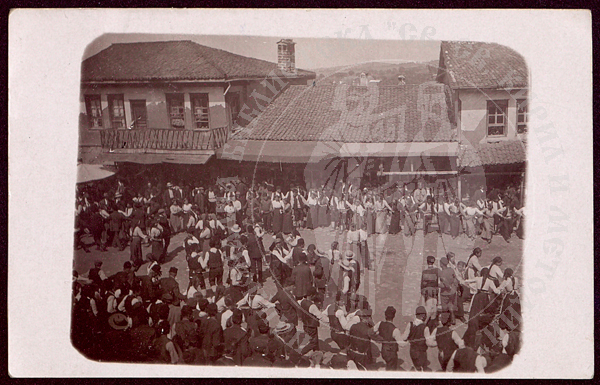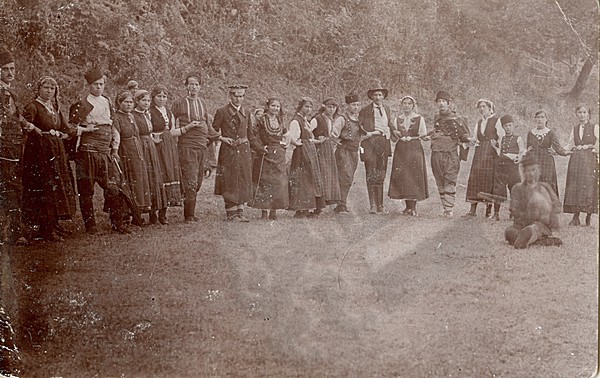
31 works in this view — arrow keys or swipe to move between them.
Dance in Art
Folk dance in Dolna banya
Unknown artist
- Dance:
- Folk/Country
- Rights:
- Not recorded. Do not assume this image is free to reuse — check the source record.
The image is one of few surviving photographs of Bulgarian folk dance in its social context before the mid-twentieth century, showing the horo as a communal and ceremonial practice rather than a performance genre. For dance historians and ethnographers, it documents the scale, setting, and social function of a regional tradition that remains central to Bulgarian cultural identity. The photograph also exemplifies the role of early photography in preserving folk practices at a moment of cultural transition.
What you are looking at
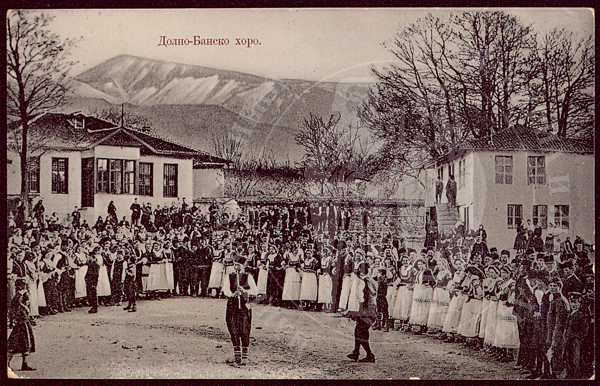
This sepia-toned photograph documents a large gathering of people arranged in concentric circles within an open courtyard, with two figures visible in the center space. The setting appears to be a rural or provincial town, with simple two-story buildings flanking the square and bare winter trees along the perimeter. Mountains rise in the distance beyond the settlement. The crowd—comprising men, women, and children in early twentieth-century dress—forms a dense, watching throng. The Cyrillic text at the top identifies the location as Dolna Banya (Долна-Баньо хоро), a spa town in Bulgaria. The photograph captures what appears to be a public gathering or celebration, with the arrangement of spectators suggesting an organized event rather than casual assembly.
The dancing
Two figures occupy the center of the circle, positioned several meters apart as if engaged in a structured exchange or performance. Their poses suggest active movement rather than stillness, though the photographic medium freezes the moment. The surrounding crowd stands at varying distances, creating depth through the concentric arrangement. The spectators appear to range from standing children at the front to adults at the rear, all orientated toward the central action. Without closer detail, the specific body positions of the central figures cannot be read precisely, but their spacing and the crowd's focused attention suggest they are the subjects of directed observation.
The dance depicted
The image most likely documents a performance or demonstration of Bulgarian folk dance, specifically the horo (хоро)—the traditional circle dance named in the photograph's caption. The horo is a communal line or circle dance performed at celebrations, gatherings, and ritual occasions throughout the Balkans, characterized by linked hand-holding and a distinctive step pattern. The presence of a watching crowd and the formal arrangement suggest a public performance or ceremonial occasion rather than informal social dancing. The date cannot be established from the image alone, but the photographic style and the dress of the spectators place it in the early twentieth century, when ethnographic documentation of folk traditions was becoming common practice across Central and Eastern Europe.
How it was made
This is a black-and-white photograph, likely a gelatin silver print or similar early photographic process, that has been toned or has aged to sepia. The image exhibits the soft focus and tonal compression characteristic of early twentieth-century photography, with detail loss in both the brightest and darkest areas. The wide view and elevated or distant vantage point suggest the photographer was positioned to capture the full assembly and surrounding landscape; the composition prioritizes documentation of the gathering's scale and setting over close examination of individual dancers. The photograph's circulation through Europeana indicates it entered a museum or archive collection, likely as an ethnographic or regional cultural document.
About this work
This photograph documents a public horo dance gathering in Dolna Banya, Bulgaria, captured in the early twentieth century when European ethnographers and local photographers were beginning to record folk traditions before modernization transformed rural culture. The image is valuable not as a technical study of the dance itself—the scale and distance prevent close reading of footwork or hand positions—but as evidence of how and where the horo was performed: outdoors, as a community event, with formal spectatorship and ceremonial intent. The photograph sits at the intersection of dance history, regional ethnography, and the early history of documentary photography in the Balkans.
How to look at it
The photograph's value lies not in frozen movement but in context: note the crowd's density and attention, the formal arrangement of the circle, the rural setting with mountains and simple architecture, and the integration of the dance into community life. The two central figures are too distant to read clearly, but their positioning at the focus of a large, assembled audience tells us the horo was a significant public event, not private recreation. Look for how the photographer chose to frame the gathering—from enough distance to show the full assembly and landscape—which reflects an interest in documenting the social and spatial scale of the tradition rather than technical analysis of the dance itself.
The artist
The photographer is not recorded. The image entered the Europeana collection through institutional holdings, suggesting it was preserved as part of a regional or national cultural archive. The photographic style and composition suggest either an amateur local photographer or an itinerant or professional ethnographic documentarian active in the Balkans in the early twentieth century.
The period
The photograph dates to a period of intense ethnographic interest in European folk traditions, when museums, scholars, and photographers were systematically recording regional dances, costumes, and customs before industrialization and world wars transformed rural society. In Bulgaria specifically, the early twentieth century saw the consolidation of national identity and growing interest in folk culture as an expression of Slavic heritage. The horo had long been central to Bulgarian social and ritual life; by this period it was increasingly being framed as a national tradition worthy of documentation and preservation. Photography was becoming an established tool for ethnographic work, and the image's composition—the emphasis on numbers, setting, and social context—reflects contemporary documentary practices.
Where it lives
The image is held in Europeana, the pan-European digital archive of cultural heritage. It entered the archive as part of institutional collections concerned with regional history and folk culture, likely from a Bulgarian museum or local heritage repository. The photograph is identified only by its location and subject; no photographer, date, or accession number is recorded.
Dance in this work
Questions about this work
What is the horo?
The horo (хоро) is a traditional circle or line dance found throughout the Balkans, performed at celebrations, weddings, and community gatherings. Dancers typically hold hands or arms and move in a continuous circle or chain, following a stepped rhythmic pattern. It remains central to Bulgarian, Macedonian, Serbian, and other Balkan folk traditions and is often performed as a marker of cultural identity.
When was this photograph taken?
The catalogue record does not provide a date. The photographic style, the dress of the spectators, and the sepia toning are consistent with the early twentieth century (roughly 1900–1930), but this cannot be confirmed from the image alone.
Where is Dolna Banya?
Dolna Banya is a spa town in western Bulgaria, in the Pazardzhik Province, known for its mineral springs. The town's name translates as 'Lower Bath.' The mountains visible in the photograph are part of the Rhodope range.
Is this a performance or a social gathering?
The formal arrangement of spectators and the central positioning of two figures suggest this was a public event or demonstration, possibly at a seasonal celebration, fair, or gathering. The scale of the assembled crowd indicates it was a significant community occasion rather than informal social dancing.
More Folk/Country artwork