49 works in this view — arrow keys or swipe to move between them.
Dance in Art · 1904
Russian dance
Richard Caton Woodville Jr.
- Medium:
- Oil Painting
- Era:
- 1900-1920 (Ragtime/Early Jazz)
- Source:
- Wikimedia Commons
- Rights:
- Public domain — free to use, share and adapt.
- Recorded as:
- Public Domain
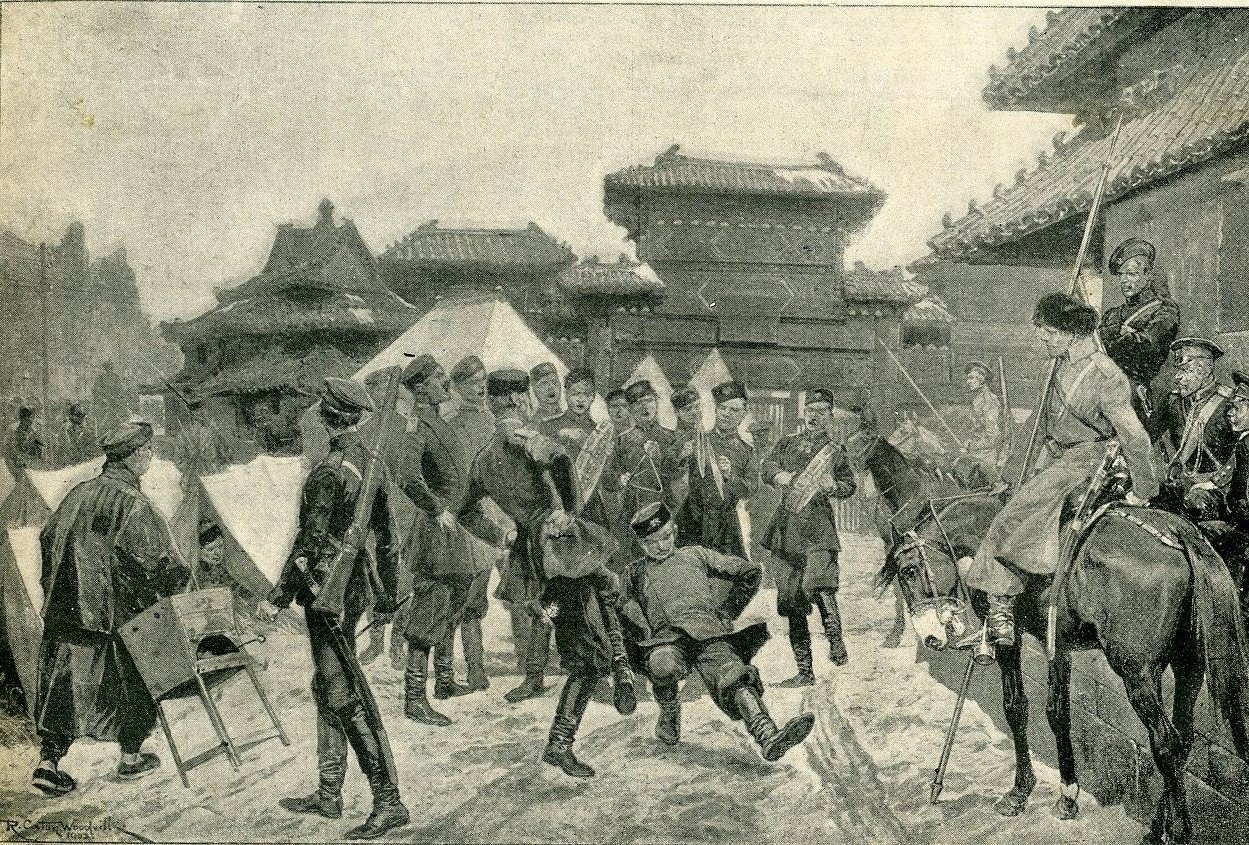
This painting is one of relatively few visual records of Russian military dance practices in the early 20th century, and it documents the troika or related folk form in a context—wartime Manchuria—where cultural performance carried political and morale-building weight. For historians of Russian dance and military culture, it offers evidence of how traditional forms were adapted and deployed outside their social origins. For students of dance documentation, it exemplifies the early-20th-century tradition of military and war artists recording cultural practices as part of the historical record.
What you are looking at
A military parade or ceremonial gathering in a snowy courtyard fills the composition, with ornate East Asian architecture—tile-roofed buildings with distinctive curved eaves—rising behind the figures. The setting appears to be Manchuria during the Russo-Japanese War or its aftermath, as suggested by the French caption. Several dozen soldiers in heavy winter greatcoats and military caps stand or move across the snow; a mounted officer on the right oversees the scene, while uniformed men frame the left side. The mood is documentary but staged—the soldiers' body language and positioning suggest they have been assembled for the artist or photographer to record. The lighting is diffuse and cool, consistent with an overcast winter day, and the monochromatic palette—greys, blacks, and whites—creates a somber formality appropriate to military ceremony.
The dancing
The central figures are engaged in a coordinated, synchronized movement across the snowy ground. Their bodies move in loose file or column formation, legs extended in rhythmic steps, arms at their sides or slightly raised. The posture is upright and regimented rather than relaxed—shoulders back, heads held level. This is not the free-flowing movement of social dance but the disciplined, collective motion of soldiers following a learned pattern. The mounted officer and standing soldiers create a frame of authority and observation around the dancers, positioning this as a performance witnessed and managed rather than freely chosen.
The dance depicted
The image depicts what the French caption identifies as 'la danse nationale moscovite'—Moscow's national dance—performed by Russian soldiers in Manchuria. This is almost certainly the troika, a traditional Russian group dance for three, or a variant adapted for military performance. The collective, file-based formation and the synchronized stepping visible here are consistent with Russian folk tradition, though the military context and heavy winter uniforms make this a distinctly hybridized performance: folk dance rendered as military ceremony. The inclusion of mounted and standing officers suggests this was part of morale-building, cultural display, or diplomatic gesture during or after the war—a moment where military discipline and national cultural identity overlap.
How it was made
This is an oil painting rendered in a controlled, realistic style with fine detail in architectural elements and uniform texture. The artist has used a cool, restricted palette and worked with careful attention to atmospheric recession—the buildings fade slightly with distance, and the snow recedes in measured perspective. The technique suggests the work was executed from studies or photographs taken on site, or composed from written descriptions: the specificity of the architecture and costume detail argues for direct observation or strong documentary sources. The painting's finish is smooth and academic, appropriate to its apparent purpose as a historical record for educated audiences in Russia or Western Europe.
About this work
This 1904 oil painting documents a performance of traditional Russian dance (the troika or a related form) by uniformed soldiers in Manchuria during the Russo-Japanese War. The work sits at the intersection of military history, ethnographic documentation, and dance practice—a moment where folk tradition was pressed into service as cultural statement and morale reinforcement in wartime. The artist, Richard Caton Woodville Jr., was an American military painter and illustrator known for detailed scenes of conflict and soldiery; his interest in this scene reflects broader late-19th- and early-20th-century fascination with martial culture and national character expressed through movement.
The work belongs in a dance archive because it captures an actual historical practice—the adaptation and performance of Russian national dance as military ceremony—and because it reveals how dance functioned as cultural representation in colonial and wartime contexts. The formal rigor and synchronized, file-based formation visible here differ significantly from concert or ballroom variants of the same dance, offering evidence of how folk forms were transformed through institutional and military practice.
How to look at it
Attend first to the formation and synchronization of the dancers' bodies: note how their legs, arms, and torsos move in unison despite the loose spacing, and how this collective discipline differs from the irregular, freely spaced movement of social dance. Look at the framing device—the officers and standing soldiers who create a proscenium around the dancers—and ask what this positioning tells us about who owned and controlled this performance. Notice how the military uniform and the winter setting transform what might be a joyful folk dance into something ceremonial and constrained. Finally, consider what the artist chose to include: not intimacy or individual expression, but formation, regulation, and the presence of authority.
The artist
Richard Caton Woodville Jr. (1856–1927) was an American painter, illustrator, and military historian specializing in scenes of conflict, siege, and military life. He was known for detailed, historically informed paintings of battles, camp scenes, and soldier life, often based on travel and reportage. His work combined journalistic precision with academic painting technique and found audiences in illustrated journals, museums, and private collections in Europe and America. He was particularly active in documenting scenes from late-19th- and early-20th-century wars and colonial campaigns, positioning himself as a visual historian of martial events and military culture.
The period
This painting dates to 1904, during or immediately after the Russo-Japanese War (1904–1905). In this period, Russian and Western interest in ethnographic documentation—the recording of traditional practices, costume, and movement before they were believed to vanish—was at its height. Simultaneously, military establishments across Europe and Asia were developing formalized, choreographed displays of national culture as morale-building and diplomatic tools. The appearance of folk dance in military settings was not unique to Russia: structured group dancing had long been part of military training and ceremony, and the early 20th century saw increased formalization of these practices as nations competed to display cultural strength and social cohesion. The Manchurian setting also reflects the period's imperial competition in East Asia and the presence of European and American observers documenting colonial and military encounters.
Where it lives
The work is recorded as an oil painting dated 1904 by Richard Caton Woodville Jr., currently held in an unspecified collection. It was sourced from Wikimedia Commons, which typically hosts images from public collections or items in the public domain, though the specific institutional origin is not documented in the available record.
Dance in this work
Questions about this work
Is this a real historical event or an invented scene?
The painting appears to document an actual practice—the performance of Russian national dance by soldiers in Manchuria during or after the 1904–1905 war. The specificity of the architecture, uniforms, and formation, combined with the French caption's geographical and historical precision, suggests the artist was working from eyewitness accounts, photographs, or study. However, the painting is a composed historical reconstruction rather than a direct record; it may combine elements from multiple performances or observations.
What is the 'national Moscow dance' mentioned in the caption?
The caption refers to the troika or a related Russian group dance, likely a choreographed adaptation for military performance. The troika traditionally involves three dancers, but military versions could be expanded to any number. The synchronized, file-based formation visible here is consistent with 19th- and early-20th-century adaptations of folk dances for collective, regimented performance.
Why would soldiers perform folk dances during wartime?
Dance served multiple functions in military culture: morale-building, the assertion of national or ethnic identity, and diplomatic display. Performances like this one were often arranged for officers, dignitaries, journalists, or international observers, and they reinforced soldiers' connection to home culture during foreign deployment. The practice also reflected broader early-20th-century interest in ethnographic performance and the use of culture as evidence of national strength.
How reliable is Woodville as a source for dance history?
Woodville was a trained military painter and illustrator known for accurate detail and often worked from direct observation or strong documentary sources. However, he was an artist, not a dance specialist; his primary interest was military and historical narrative rather than dance technique or cultural authenticity. The painting should be read as a historical document about how and where dance was performed, not as a detailed technical record of the movement itself.
More dance artwork