49 works in this view — arrow keys or swipe to move between them.
Dance in Art · 1840
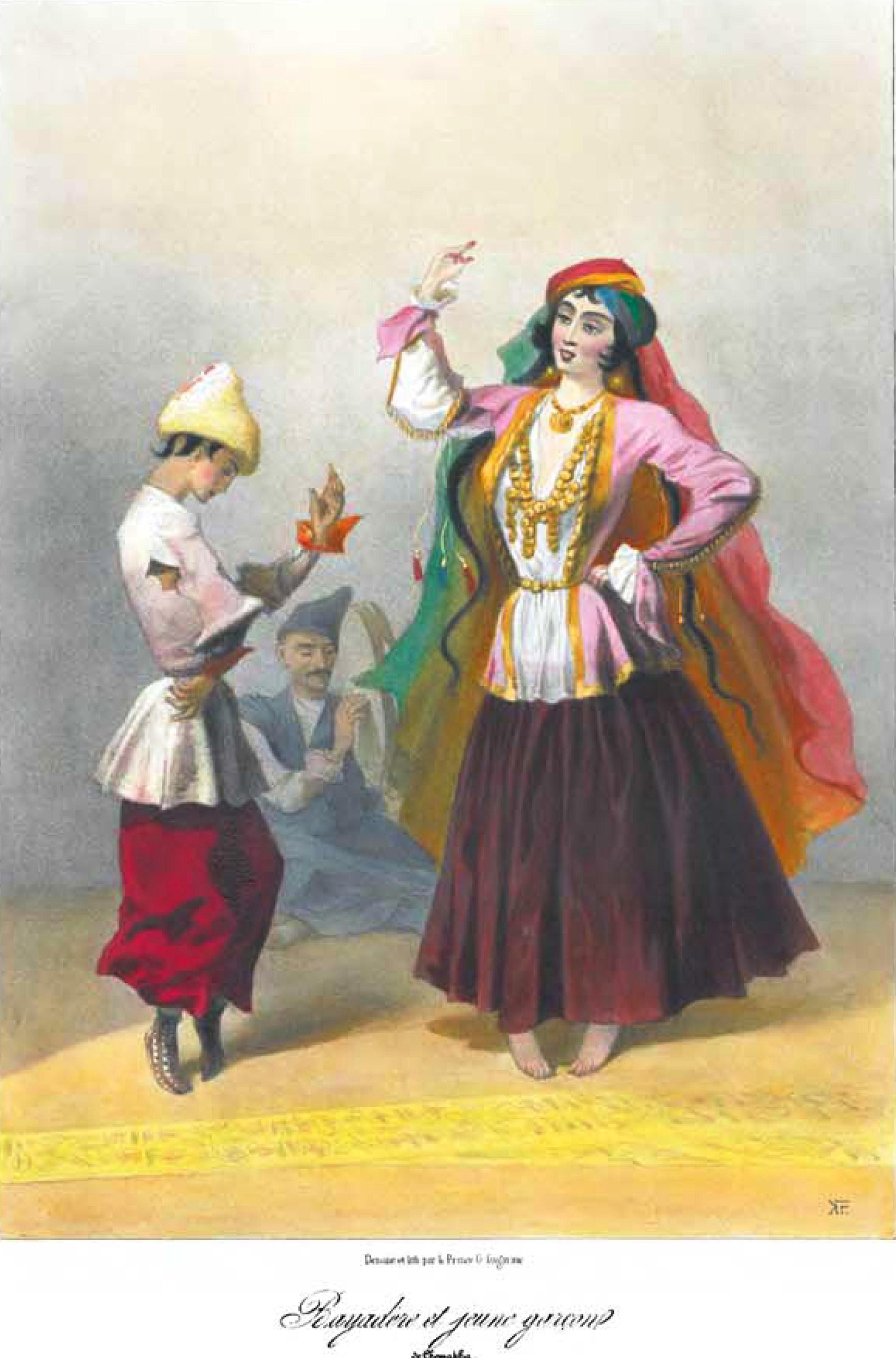
Scènes, paysages, moeurs et costumes du Caucase dessinés d'aprés nature par le prince G. Gagarine.31
Grigory Gagarin
- Medium:
- Oil Painting
- Era:
- Mid 1800s (Polka Era)
- Source:
- Wikimedia Commons
- Rights:
- Public domain — free to use, share and adapt.
- Recorded as:
- Public Domain
The image documents how European artists of the 1840s perceived and staged non-European dance and gesture, collapsing living performance into the framework of ethnographic portraiture. For scholars of Caucasian dance history and of Orientalism in nineteenth-century visual culture, it shows the translation of regional movement into European aesthetic conventions and the costume-centered bias of ethnographic representation.
What you are looking at
A woman in elaborate Caucasian dress stands at center stage, gesturing expressively with a handkerchief held aloft in her right hand. She wears a striking ensemble: a white chemise under a sleeveless green overrobe edged in gold, a pink jacket, a dark pleated skirt to mid-calf, and a rainbow-striped headcloth draped as a veil. Her dark hair falls loose to her shoulders. Two smaller figures flank her—a boy in a yellow hat and pink tunic to the left, and a seated or crouching man in blue-gray to the right. The background is plain and neutral, and the ground is rendered in sandy yellow tones, suggesting an outdoor setting. The composition is arranged almost as a formal portrait, with the woman dominating the frame and the attendant figures subordinate. This appears to be a colored lithograph or hand-colored print, part of a larger ethnographic or travel series documenting the dress and customs of the Caucasus region.
The dancing
The central woman's posture is upright and frontal, with her weight evenly distributed. Her right arm is raised to shoulder height, the wrist articulated to display the handkerchief as an ornamental gesture rather than a functional one. Her left hand rests on her hip, a pose of ease and authority. The two attendants are much smaller in scale and appear to be observers or supporting figures rather than co-dancers. Neither the boy nor the man adopts a dance position; they seem positioned to frame or contextualize the woman's display.
The dance depicted
The raised arm and waving handkerchief suggest a gesture from Caucasian folk dance traditions, possibly from Georgia, Circassia, or neighboring regions, but the static, frontal arrangement and the presence of subordinate figures make this more a pose or moment of display than an actual dance in motion. The woman is showing off her dress and the regional ornament (the handkerchief) rather than executing a recognizable choreography. This is ethnographic illustration in the mode of costume documentation rather than a record of a dance performance.
How it was made
The work is a hand-colored lithograph or colored engraving, evident from the flat color application, the crisp outlines, and the style of rendering folds and ornament. The technique allowed rapid reproduction and hand-coloring for individual prints, making it suitable for a commercial ethnographic series. The pale background and careful delineation of costume detail suggest the primary purpose was to document regional dress for a European audience unfamiliar with Caucasian material culture.
About this work
This is one plate from Grigory Gagarin's *Scènes, paysages, moeurs et costumes du Caucase* (Scenes, Landscapes, Customs and Costumes of the Caucasus), a 1840 ethnographic series documenting the peoples of the Caucasus region through their dress, bearing, and domestic arrangements. Rather than capturing dance as performance, the image presents a woman in full regalia as a standing figure of display, with minimal narrative or movement. The raised handkerchief and frontal pose hint at a gesture rooted in Caucasian social practice, but the composition prioritizes documentation of costume over the kinetics of dance.
The work sits at the intersection of Romantic-era travel literature, ethnographic curiosity, and commercial print culture. For dance historians, it offers evidence of how European artists of the period encountered and translated regional movement practices into static, costume-centered representations. The woman's posed gesture survives in the image, but the social and kinetic context—the occasion, the music, the other dancers—is flattened into a schema of display.
How to look at it
Attend to the handkerchief gesture and the woman's frontal stance: she is posed as if for a portrait, not captured mid-movement. The tiny scale of the attendants and the neutral background strip away social context—there is no music, no other dancers, no occasion. Notice how the costume dominates the image; the dress, headcloth, and ornament are rendered with far more care than any indication of how the body moves. This is a portrait of a costume, with a gesture appended to suggest regional identity.
The artist
Grigory Gagarin (1810–1893) was a Russian aristocrat, military officer, and artist who served in the Caucasus during the imperial expansion into the region. He produced drawings and paintings of Caucasian landscapes, peoples, and military scenes, which were then lithographed and published in Paris as a commercial series for the European market. His work bridges military documentation, Romantic landscape, and ethnographic curiosity; he was both a participant in colonial conquest and a visual chronicler of the cultures being subjugated.
The period
The 1840s were the height of European Romanticism and of ethnographic tourism. Travel narratives, illustrated books, and colored lithographic series fed middle-class hunger for exotic imagery from the Caucasus, which was simultaneously a site of Russian imperial military activity and of aesthetic fascination. The region's cultures were represented as picturesque, martial, and sensual—a trope visible in dance imagery of the period. This series was published in Paris, the center of lithographic production and the market for such works.
Where it lives
The work comes from Gagarin's published series *Scènes, paysages, moeurs et costumes du Caucase dessinés d'après nature*, issued circa 1840 in Paris as a commercial lithographic portfolio. The source of this image is Wikimedia Commons. The holding collection is not recorded in the catalogue.
Dance in this work
Questions about this work
Is this a real dance or a posed costume study?
It is a posed costume study. The woman's raised arm and handkerchief suggest a gesture from Caucasian folk dance, but she is frozen in a frontal display position, not captured mid-movement. The composition is that of an ethnographic portrait, not a record of performance.
What is the white cloth she is holding?
It appears to be a handkerchief, which may have been used in Caucasian social dances and social display. Here it is held aloft as an ornamental attribute of her dress and regional identity, much like a fan might be held in a European court portrait.
Who are the two smaller figures?
They appear to be attendants or observers meant to provide scale and context—possibly a servant and a musician or family member. Their small scale and passive poses subordinate them to the central woman and suggest a hierarchical representation of Caucasian society as the artist imagined it.
Why is she shown alone if this is about dance?
Because the primary purpose of the series was ethnographic documentation of costume and regional identity, not the recording of actual dance performance. The gesture is appended to suggest cultural authenticity, but the static, portrait-mode composition is dictated by the commercial and scientific aims of the series.
More dance artwork