49 works in this view — arrow keys or swipe to move between them.
Dance in Art · 1881
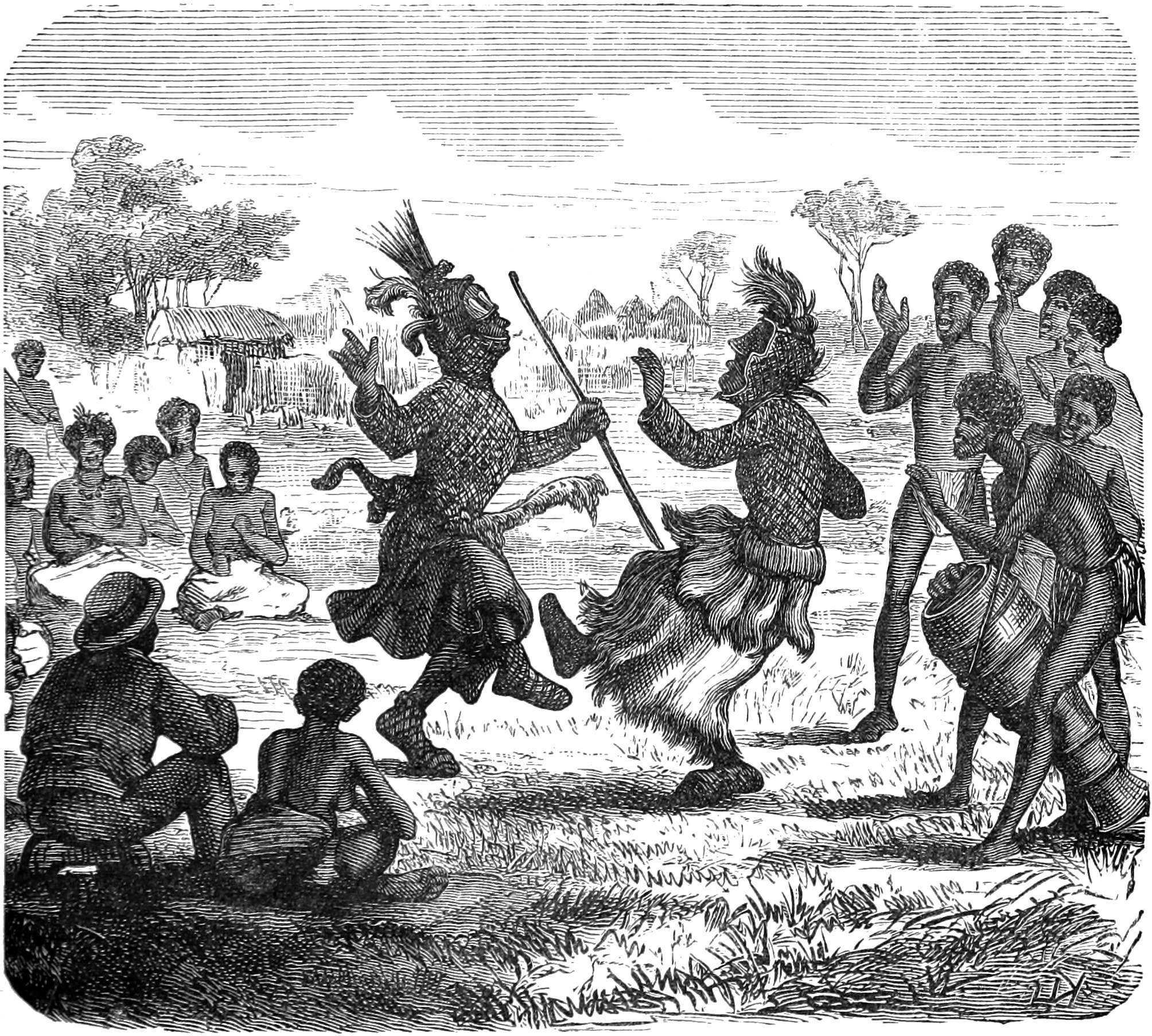
Seven Years in South Africa, page 169, Kishi dance
Karel Liebscher
- Medium:
- Oil Painting
- Era:
- Late 1800s (Victorian Ballroom)
- Source:
- Wikimedia Commons
- Rights:
- Public domain — free to use, share and adapt.
- Recorded as:
- Public Domain
Dance historians have few visual records of 19th-century southern African performance practices. This engraving preserves not only a specific dance form — the Kishi — but also contextual information about how it was performed: communally, outdoors, with particular costume elements and implements, and with visible spectator participation. For historians of African dance and of European ethnographic representation, the image reveals both the dance itself and the conventions through which a European illustrator chose to depict it.
What you are looking at
This engraving depicts a festive gathering in a South African village, with thatched-roof structures visible in the background and open grassland in the foreground. Two figures dominate the center: both appear to be dancers wearing patterned clothing with elaborate headdresses featuring long plumes or quills that rise dramatically upward. They are captured mid-movement, bodies angled toward each other in an energetic pose. One figure holds a staff or stick, while the other gestures expressively. A large audience of seated and standing onlookers — men, women, and children — surrounds them in a semicircle, watching intently. The crowd wears minimal clothing and appears relaxed and engaged. The scene conveys spontaneous celebration rather than formal performance, with the dancers' exaggerated postures and the spectators' rapt attention suggesting this is a moment of high energy and communal participation.
The dancing
The two central dancers stand upright with knees bent and bodies leaning forward dynamically toward each other. Their arms are raised and extended; one dancer holds a long stick or staff at an angle across the body. Both wear substantial headdresses — plumed or quilled structures that extend vertically, adding significant visual height and drama to their silhouettes. Their torsos rotate and twist, suggesting rapid weight shifts. The posture is neither balletic nor controlled; instead it reads as earthy, grounded, and expressively emphatic. The surrounding spectators sit or stand in relaxed attitudes, indicating this is participatory rather than staged performance.
The dance depicted
This is identified in the source as the Kishi dance. The image shows what appears to be a celebratory or ritual communal dance from southern Africa, performed in daylight in a village setting. The dancers' exaggerated upper-body movement, high-rising headdresses, and use of implements (the staff) are consistent with many African ceremonial and festive dances that emphasize dramatic display and audience participation. The Kishi dance itself is not widely documented in English-language dance histories, making this engraving a rare visual record. The setting — outdoor, communal, with mixed-age spectators — and the dancers' dynamic, uninhibited movement suggest this was a living social or ceremonial practice rather than a staged entertainment.
How it was made
This is an engraving (not an oil painting as the catalogue record states), created using fine parallel lines to build form, shadow, and texture. The technique allows crisp, readable detail and was ideal for book illustration — this print comes from page 169 of a two-volume travel narrative, *Seven Years in South Africa*. Engravings circulated widely through printed books and made ethnographic and travel imagery accessible to European readers in the 19th century. The linear, almost crosshatched rendering of the figures and landscape is characteristic of mid-to-late 19th-century wood or steel engraving for publication.
About this work
This engraving is a page illustration from Karel Liebscher's *Seven Years in South Africa* (1881), documenting the Kishi dance as performed in a South African village community. The work captures a moment of public celebration or ritual, showing two elaborately dressed and adorned dancers in vigorous movement, watched by an attentive crowd. As a travel narrative illustration, it represents a specific moment in 19th-century European visual ethnography — a period when illustrated travel books shaped European understanding of African life and culture. The image is valuable precisely because it is embedded in a specific publication, location, and moment in history, offering material evidence of a dance practice that is little documented elsewhere.
How to look at it
Attend to the dancers' posture and the vertical axis created by their headdresses — the artist has chosen a moment of upright, explosive energy rather than a flowing or grounded pose. Notice how the engraver uses line weight and density to suggest the three-dimensionality of the plumes and the muscularity of the dancers' bodies. The crowd's framing — surrounding but not pressing in — emphasizes that this is a communal ritual with its own spatial rules. The outdoor setting and natural light are rendered through sparse, gestural lines, keeping the focus on the dancers themselves.
The artist
Karel Liebscher was a 19th-century German author and travel writer who spent time in southern Africa and published illustrated accounts of his experiences. The engravings in his work were produced for a European reading public interested in colonial-era narratives and ethnographic curiosity.
The period
The 1880s were a period of intense European colonial expansion into Africa, accompanied by a flood of illustrated travel narratives aimed at home readers. Dance and ritual were common subjects in such publications, often rendered through a European picturesque lens that emphasized the exotic and dramatic. At the same time, many African performance traditions were undergoing disruption and transformation due to colonial contact. This engraving thus sits at a crossroads: it may document a genuine living practice, but it does so through the medium and aesthetic conventions of European print culture, shaped by the illustrator's eye and the publisher's expectations.
Where it lives
This engraving is a page illustration from *Seven Years in South Africa*, volume 2, page 169, by Karel Liebscher, published in 1881. The source copy is held on Wikimedia Commons. The work is a component of a larger published travel narrative rather than a standalone artwork.
Dance in this work
Questions about this work
What is the Kishi dance?
The Kishi dance is identified in Liebscher's account as a South African ceremonial or celebratory dance. Beyond this engraving, detailed documentation of the practice is limited, making this visual record particularly valuable. The dance appears to involve vigorous upper-body movement, elaborate headdresses, and communal participation.
Is this a historically accurate depiction?
As a 19th-century travel narrative illustration, the image was created by a European engraver for a European audience and is therefore subject to the aesthetic and representational conventions of that context. It likely preserves genuine elements of the dance — the headdresses, the energetic movement, the communal setting — but the rendering itself is filtered through the artist's eye and the medium's demands.
Why is this in a dance gallery?
This is a rare documented image of an African dance practice from the colonial era, created before widespread photography. It serves as both a historical record of a specific tradition and as an artifact of how European audiences encountered African culture in the 19th century.
More dance artwork