49 works in this view — arrow keys or swipe to move between them.
Dance in Art · 1881
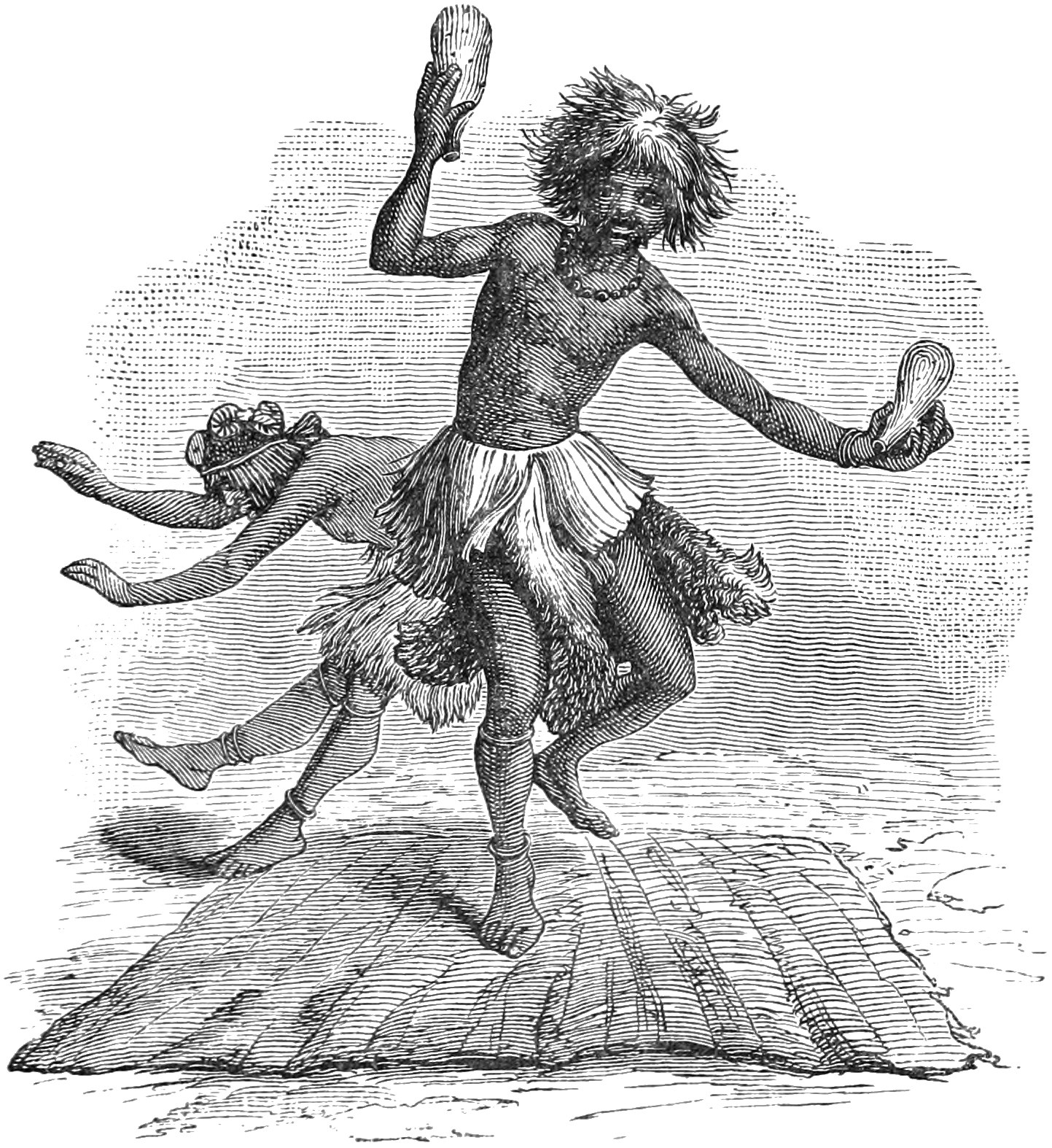
Seven Years in South Africa, page 229, the prophetic dance of the masupias
Unknown
- Medium:
- Oil Painting
- Era:
- Late 1800s (Victorian Ballroom)
- Source:
- Wikimedia Commons
- Rights:
- Public domain — free to use, share and adapt.
- Recorded as:
- Public Domain
The image offers evidence of how European visual culture represented African sacred and ceremonial movement in the late nineteenth century—not with ethnographic accuracy but with a fascination for the body in extreme postures. For dancers and historians, it raises questions about the relationship between documentation, exoticism, and authenticity in cross-cultural representation.
What you are looking at
A figure with wild, wind-swept hair and dark skin executes a dynamic leap across what appears to be a woven or thatched surface, arms raised in an expressive gesture of exuberance or prophecy. The dancer wears a light-colored skirt or wrap around the hips and appears bare-chested, with muscular definition rendered through careful hatching. The composition captures a moment of intense physical release—the body is airborne, one leg extended, the torso twisted in mid-movement. The background is rendered in dense crosshatching that suggests an undefined interior or ceremonial space. The technique emphasizes muscularity and dynamic tension; every line conveys movement and energy.
The dancing
A single dancer, unpartnered, in a ballistic vertical or near-vertical ascent. The right arm is raised high and open; the left arm gestures outward or downward. One leg is extended in space while the supporting leg drives upward. The posture is neither balletic nor constrained—the torso twists freely, and the gesture reads as uninhibited and ecstatic rather than codified. The artist has prioritized expressive extension over formal line.
The dance depicted
The title identifies this as 'the prophetic dance of the masupias,' but the masupias remain unidentified in the standard ethnographic record—the term may be a transcription error, a localism specific to the region, or a reference lost to time. The image depicts what appears to be a sacred or ceremonial leap rather than social dance. The ecstatic, airborne posture and the prophetic framing suggest trance, spirit possession, or ritual invocation. Without additional documentation, the specific dance tradition cannot be named with confidence, but the visual evidence points toward sub-Saharan African sacred or ceremonial practice.
How it was made
This is a wood engraving or steel engraving, executed in the tradition of Victorian illustrated travel writing—indicated by the fine crosshatching, the precision of line, and the method of reproduction suitable for book illustration. The technique required skilled hand-work and allowed for wide circulation through printing. The dense, controlled linework creates volumetric form and suggests the engraver was familiar with anatomical convention and worked from detailed source material or detailed description.
About this work
An engraved illustration from an 1881 travel narrative documenting a prophetic or ceremonial dance from southern Africa. The work captures a moment of ecstatic movement—a single dancer in violent upward flight, captured mid-gesture. The image is part of the Victorian era's complex engagement with African cultures: documenting, exoticizing, and often misrepresenting practices encountered through colonial contact. The work is valuable precisely because it represents how European audiences encountered and visualized African sacred dance at a moment when such images were rare and often mediated through written travel accounts rather than direct observation.
How to look at it
Attend to the violence and freedom of the leap—this is not a controlled or restrained movement but an explosion upward. The artist chose to capture the moment of maximum height and extension, maximizing the sense of power and abandon. The open-armed gesture and raised head suggest rapture or invocation rather than social courtship or entertainment. Compare this to contemporary European dance imagery of the period: the absence of corsetry, the freedom of the limbs, and the upward thrust all signal difference and otherness to the Victorian viewer.
The period
The 1880s saw a proliferation of illustrated travel narratives from Africa, driven by colonial expansion, missionary activity, and growing appetite among European readers for accounts of 'exotic' cultures. Engraved illustrations were the primary technology for reproducing images in books and periodicals; photography was slow to appear in books. Dance was often presented in these narratives as evidence of 'primitive' spiritual or emotional life—fascinating but implicitly inferior to European rationality. The figure here—muscular, ecstatic, unclothed—embodies the period's investment in depicting African bodies as natural, instinctive, and exotic.
Where it lives
This engraving appears in 'Seven Years in South Africa,' volume 2, page 229. The book is a published travel narrative; the image is a mass-produced illustration integrated into a commercial text. The work was created for a Victorian reading public with interests in natural history, colonialism, and the exotic.
Dance in this work
Questions about this work
What is a masupias?
The term is not established in ethnographic literature. It may be a transliteration, a regional or linguistic variant, or a term specific to the author's sources. Without the original text or further documentation, the reference cannot be clarified from the image alone.
Is this a real dance or a Victorian fantasy?
The image almost certainly documents or is based on a real practice, but it is filtered through the expectations and biases of the European illustrator and author. The choice of moment—the leap, the ecstasy—reflects Victorian assumptions about African spirituality more than it may reflect how the dance was actually performed or understood by practitioners.
Why is the figure unclothed?
In the context of 1880s travel writing, the depiction of unclothed or minimally clothed African bodies was standard practice, serving both documentary and voyeuristic purposes. It signaled otherness and 'naturalness' to European viewers and reflected colonial power dynamics.
More dance artwork