49 works in this view — arrow keys or swipe to move between them.
Dance in Art · 1892
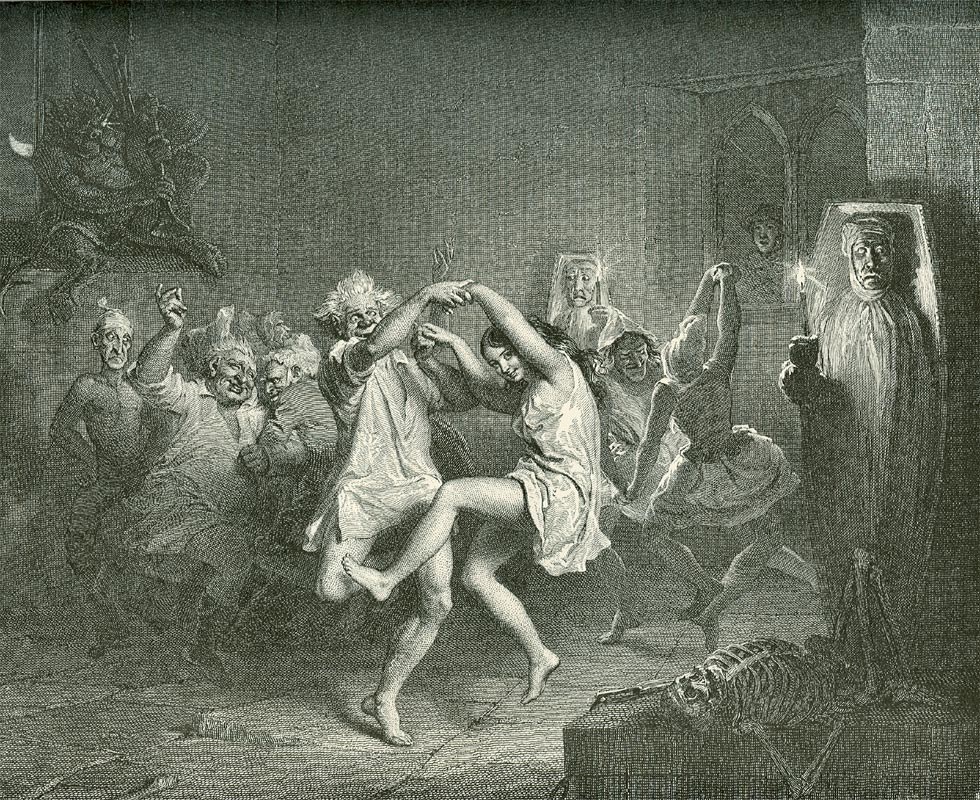
Tam O'Shanter and the Witches - John Faed
John Faed
- Medium:
- Oil Painting
- Era:
- Late 1800s (Victorian Ballroom)
- Source:
- Wikimedia Commons
- Rights:
- Public domain — free to use, share and adapt.
- Recorded as:
- Public Domain
This work documents how 19th-century visual artists interpreted the dance of witchcraft and transgression in Romantic literature, translating Burns's verbal descriptions into a moment of kinetic drama. It also reveals contemporary anxieties about female desire, supernatural power, and the body—anxieties expressed through the representation of a woman's uncontrolled, ecstatic movement. For dance historians, the image raises questions about how literary imaginings of dance (particularly transgressive or supernatural dance) shaped visual culture and public understanding of movement itself.
What you are looking at
A woman in a diaphanous white shift dances alone in the center of a dimly lit interior, her body arched backward in an ecstatic pose with one arm raised and the other across her torso. She is surrounded by a circle of ghostly, spectral figures—witches and supernatural beings rendered in pale, sketchy tones—who watch intently from the shadows. The setting appears to be a dark chamber or hovel, with rough stone walls suggested by the engraving's cross-hatching. The witches display a range of expressions and gestures: some lean forward with interest, others gesture with gnarled hands, and one figure on the right wears what appears to be burial wrappings or a shroud. The lighting concentrates on the dancing woman, leaving the surrounding figures in murky shadow, creating a vivid contrast between the living body in motion and the supernatural audience.
The dancing
The central dancer's body is thrown into a dramatic backbend, with her weight appearing to be on one foot while her torso arches and her free arm reaches upward in an attitude of abandon or ecstasy. Her legs are visible beneath the thin fabric, suggesting active, energetic movement rather than stillness. The surrounding figures are rendered in various poses of observation and reaction—some upright, others hunched or contorted, their postures and gestures conveying fascination, malice, or supernatural animation. The composition creates a clear spatial and moral distinction between the solitary human dancer and the assembled otherworldly presences.
The dance depicted
This illustration depicts a moment from Robert Burns's 1791 poem 'Tam o' Shanter,' in which the titular character witnesses witches dancing in a haunted kirk (church). The central figure is one of the supernatural dancers—most likely the beautiful young witch who captivates Tam—caught in a moment of wild, unrestrained movement. The dance itself appears to be an ecstatic, trance-like performance rather than a choreographed social dance, reflecting the poem's portrayal of witchcraft as a supernatural inversion of human society and morality. The image captures the moment of transgression and danger that defines the narrative: a living person (Tam, implied to be viewing this scene) witnessing forbidden supernatural activity.
How it was made
This is an engraving, a medium well-suited to the dissemination of literary illustration in the 19th century. The technique of cross-hatching and fine parallel lines builds tone and shadow, allowing the artist to create the dramatic contrast between the brightly lit dancer and the dark, atmospheric surroundings. Engravings of this type were typically published as illustrations within editions of poetry or as separate prints for collectors, making them accessible to a wide middle-class audience. The rendering of the witches as barely-defined, gestural forms demonstrates how engraving could convey supernatural or dreamlike content through formal ambiguity.
About this work
John Faed's engraving illustrates a climactic moment from Robert Burns's 'Tam o' Shanter,' one of Scotland's most celebrated Romantic poems. The work depicts the supernatural dance scene that forms the narrative's moral and aesthetic center: a beautiful young witch dances in ecstatic, abandoned movement while surrounded by a circle of grotesque, otherworldly spectators. The image sits at the intersection of Romantic literature, Scottish cultural identity, and the tradition of literary illustration that dominated 19th-century printmaking. Faed's interpretation emphasizes the transgressive nature of the witches' dance—a performance that breaks every social and moral boundary—while using the formal properties of engraving to render the supernatural realm as something both seductive and horrifying.
How to look at it
Observe how Faed has chosen to freeze the moment of maximum movement and ecstasy: the dancer's body is arched in a pose of apparent abandon, captured mid-gesture rather than in a stable, posed moment. Notice how the engraver uses light and shadow to create a hierarchy of attention—the dancer glows while the witches remain shadowy and indistinct, yet their gazes and gestures all direct focus back to her body. The composition suggests simultaneity: we see the dancer's movement as if in real time, while the surrounding figures react with the intensity of an audience. Pay attention to the rendering of the supernatural: Faed does not make the witches monstrous or comic, but rather treats them as a serious, credible threat, which makes the transgressive power of the dance scene more unsettling.
The artist
John Faed (1819–1902) was a Scottish painter and engraver known for historical and literary subjects, particularly scenes drawn from Scottish literature and history. He was part of a broader 19th-century tradition of illustrating canonical literary works, especially those with nationalist or Romantic themes. Faed worked across multiple media—oil painting, engraving, and etching—and was highly regarded during the Victorian era for his ability to capture dramatic narrative moments with technical precision and emotional intensity.
The period
This engraving was created in the Victorian era, a period of intense interest in literary illustration and in the Romantic legacy of Burns. 'Tam o' Shanter' had become a canonical text of Scottish culture, and multiple artists produced illustrations of its scenes throughout the 19th century. The Victorian fascination with witchcraft, the supernatural, and Romantic transgression found expression in visual culture through works like this one. At the same time, the figure of the dancing woman—particularly when associated with transgression or supernatural power—was a subject of considerable anxiety in Victorian art and culture, reflecting broader concerns about female sexuality and social order.
Where it lives
The work is documented in Wikimedia Commons and is attributed to John Faed, dated 1892. The current holding collection is not recorded. As a 19th-century engraving of a literary subject, this work would have been intended for circulation as a print and likely appeared in illustrated editions of Burns's poetry or as a separate publication for collectors of Scottish cultural material.
Questions about this work
What is the 'Tam o' Shanter' dance in the poem?
In Burns's poem, Tam o' Shanter stumbles upon a witch coven dancing inside a haunted church. The witches' dance is wild, unrestrained, and explicitly associated with transgression and supernatural power. The dance is not described as any recognizable social form, but rather as ecstatic and frenzied movement. The central figure—a beautiful young witch—is the most compelling dancer and the one who nearly captures Tam.
Why would Burns's supernatural dance be illustrated as ecstatic backbend?
The backbend and raised arm convey abandonment, loss of control, and a state beyond ordinary social constraint—precisely what makes the witches' dance transgressive and dangerous. The pose emphasizes the body's vulnerability and intensity rather than technique or propriety. This visual language was common in Romantic art for depicting states of inspiration, possession, or transgression.
Is this engraving part of a larger illustrated edition?
The catalogue record does not specify whether this engraving was published as part of an illustrated edition of Burns's poetry or as a standalone print. It is dated 1892, well after the poem's 1791 publication, suggesting it may represent a Victorian-era renewed interest in illustrating Burns's canonical works.
What does the engraving technique tell us about the work's audience?
Engravings were the primary means of reproducing images for mass distribution in the 19th century, before photographic reproduction. This technique suggests the work was intended for middle-class viewers—readers of illustrated poetry editions, collectors of prints, and those interested in Scottish literature and culture. The fine detail and high technical skill reflect both Faed's reputation and the status of literary illustration as a serious art form.
More dance artwork