49 works in this view — arrow keys or swipe to move between them.
Dance in Art · 1900
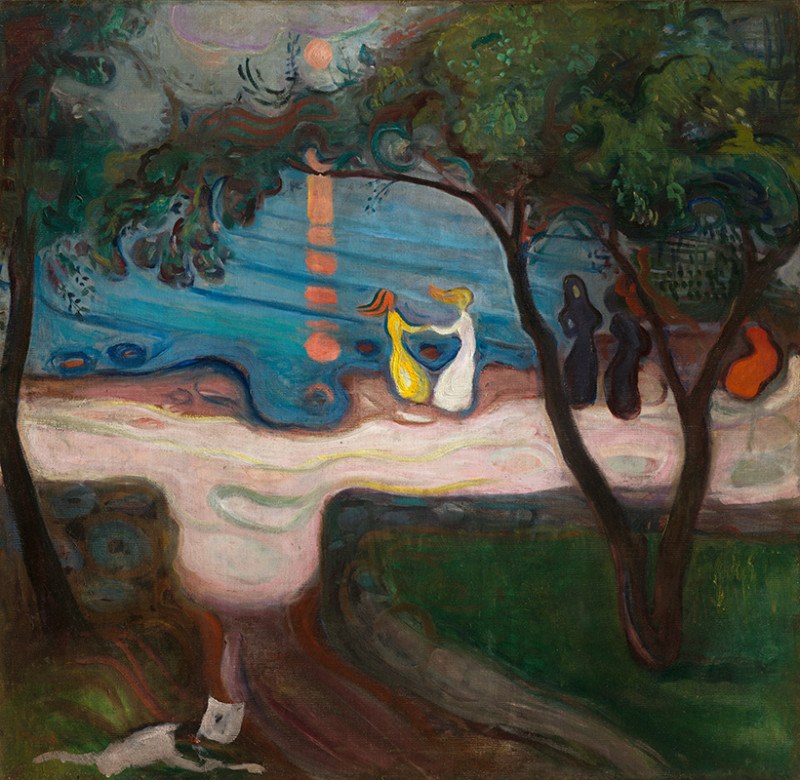
Tanec na břehu CZE NG.O 3349
Edvard Munch
- Medium:
- Oil Painting
- Era:
- 1900-1920 (Ragtime/Early Jazz)
- Source:
- Wikimedia Commons
- Rights:
- Public domain — free to use, share and adapt.
- Recorded as:
- Public Domain
This work represents the early modernist reclamation of dance as a symbol and subject for serious visual art, moving away from the documentary and toward the emotional and psychological. It testifies to the power of dance imagery in the early 20th century to express states of feeling that realist or academic painting could not reach, and it shows how artists working outside the theatre found in dance a language for modernism itself.
What you are looking at
A moonlit scene on a shoreline where two figures in pale dress embrace or dance at the water's edge, their forms luminous against dark water marked with orange reflections of moonlight. The composition frames them within a natural amphitheatre of gnarled, dark trees—some with twisted trunks rendered in deep browns and blacks—that arch overhead and flank both sides of the canvas. In the background, a crescent moon glows at the top of the canvas, and the middle distance shows other figures in dark clothing standing apart from the dancing couple. The palette is dominated by cold blues and greens in the water, warm flesh tones for the dancers, and the stark charcoal of the vegetation. The painting employs flattened perspective typical of early modernist work, with the trees and landscape elements arranged almost decoratively around the central pair rather than receding convincingly into depth.
The dancing
Two figures dominate the foreground: one in pale yellow or cream, the other in white. Their bodies lean toward each other in an attitude of intimacy or mutual support, with limbs intertwined or touching. Their forms are simplified and somewhat fluid, without the anatomical specificity that would allow precise identification of arm position or footwork. The frame appears close rather than formal ballroom hold. In the middle ground, additional figures in dark clothing stand or sit—a woman in dark dress to the right, and what may be another figure to the left—suggesting witnesses or companions rather than active dancers.
The dance depicted
This is almost certainly not a representation of any specific ballroom or theatrical dance form. The embrace and shoreline setting suggest either a modernist symbolic treatment of romance or courtship, or possibly a representation of folk or social dancing in an informal setting. The pale dress and moonlit context evoke Romantic-era painting conventions, but the simplified forms and emotional intensity of the composition—the way the figures cling to each other—suggest the artist was more interested in expressing a feeling of connection or longing than in documenting actual steps or technique. The setting removes the dance from any formal dance hall context.
How it was made
This is an oil painting on canvas, executed in the early modernist style associated with Expressionism. The paint is applied with visible brushwork, the forms are simplified and sometimes distorted for emotional effect, and the colour palette is chosen for its symbolic or emotional resonance rather than naturalistic accuracy. Oil on canvas allowed the artist to build atmospheric effect through layered colour and to emphasise the psychological rather than documentary dimension of the scene. The work circulated as a gallery painting, not a popular print, and was aimed at an educated viewing public familiar with modernist practice.
About this work
This is an oil painting of two figures in pale dress dancing or embracing at a moonlit shoreline, surrounded by dark, twisted trees and observed by other figures in the middle distance. Executed in the early 1900s in an Expressionist idiom, it treats the motif of dance as a vehicle for emotional expression rather than a record of actual movement. The work belongs to a modernist interest in dance as a subject that could convey longing, connection, and psychological states—an interest that ran in parallel to the development of modern dance as a performance form and to the Symbolist and Romantic traditions in visual art that used dancing couples to express transcendent or transgressive feeling.
How to look at it
Attend first to the embrace itself: the way the two figures in pale dress are drawn together, their forms nearly merged into one another. This is not a moment of established dance movement but of approaching or cleaving, of two bodies seeking union. Notice how the artist has used colour to isolate the dancers—their pale forms glow against the dark water and the charcoal of the trees—and how the simplified, almost abstracted forms of the couple contrast with the more densely rendered vegetation. The twisted, organic trees frame the couple almost protectively, or else imprison them; the ambiguity is deliberate. The other figures in dark dress, barely indicated, suggest the social or temporal distance of the witnesses from the intensity of the central pair. The orange reflections of moonlight on water create a vertical line that passes through and unites the dancers.
The artist
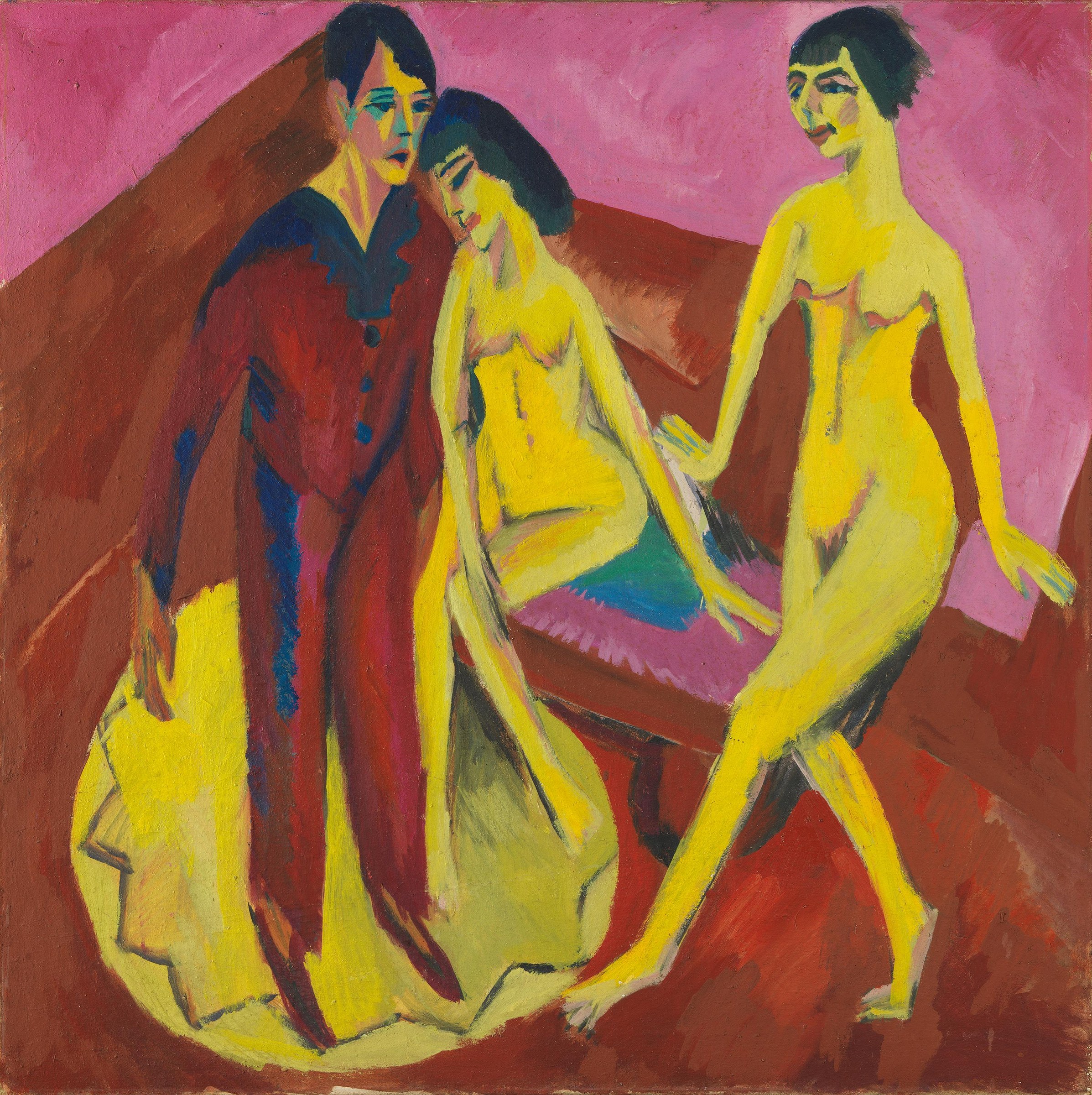
Edvard Munch (1863–1944) was a Norwegian painter and printmaker and a pioneering figure in Expressionism. He is best known for works like *The Scream* (1893) that use distorted forms, vivid colour, and simplified composition to convey intense emotional or psychological states. Munch worked across painting, printmaking, and sculpture, and dance and the human figure were recurring subjects throughout his career. He was deeply interested in representing interior emotional life through the deformation of the body and the manipulation of colour and line. This painting sits within his broader exploration of intimacy, desire, and human connection.
The period
In 1900, Munch was at the height of his powers and Expressionism was emerging as a major force in European modernism. The early 1900s saw a radical shift in how visual artists approached dance: no longer primarily the preserve of academic historical painting or naturalist illustration, dance became a vehicle for modernist experiment. At the same time, Isadora Duncan and the pioneers of modern dance were reimagining movement itself as a vehicle for personal and artistic expression rather than technical virtuosity. In visual art, Symbolism and the movements that followed it used dancing figures to express transcendent or transgressive feelings—states of ecstasy, loss, desire, or spiritual communion. The moonlit, intimate scale of this painting reflects that wider cultural investment in dance as a language of interiority.
Where it lives
The work is catalogued in the collection as *Tanec na břehu* (Dance on the Shore), accession number NG.O 3349. The title is given in Czech, suggesting that the work entered a Czech collection at some point in its history, though it is by a Norwegian artist and was likely created in the Scandinavian or broader European context.
Questions about this work
What dance is being shown here?
This is not a representation of a specific ballroom or theatrical dance form. The artist was using dance—specifically the gesture of two people embracing or moving together at the water's edge—as a vehicle for expressing emotion and connection rather than documenting actual steps or technique. The shoreline setting, the moonlight, and the formal simplification of the figures all signal that the work is more symbolic than literal.
Why are there other figures in the background?
The other figures in dark dress suggest witnesses or companions, and their distance from the central pair underscores the emotional intensity and separateness of the dancing couple. They create a sense of social context or observation without breaking the focus on the intimate embrace at the water's edge.
What is Expressionism and why does it matter for dance imagery?
Expressionism was an early modernist movement that prioritised emotional or psychological expression over accurate representation. For dance, this meant that artists could deform, simplify, or stylise the body not to document how people actually moved, but to convey how movement could express feeling. Munch's work is a key example of this new possibility.
More dance artwork