49 works in this view — arrow keys or swipe to move between them.
Dance in Art · 1873
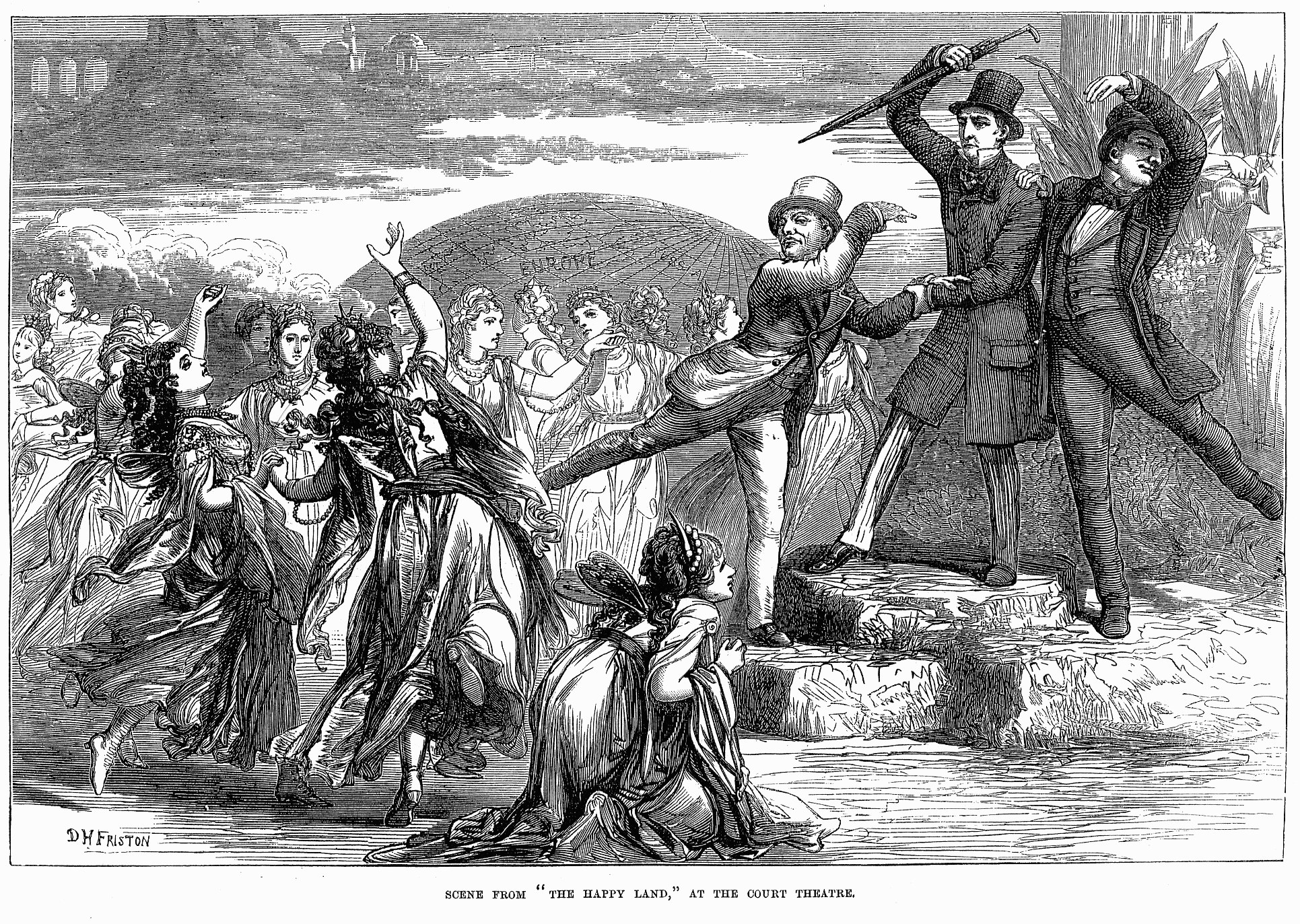
The Happy Land - Illustrated London News, March 22, 1873
David Henry Friston
- Medium:
- Oil Painting
- Era:
- Late 1800s (Victorian Ballroom)
- Source:
- Wikimedia Commons
- Rights:
- Public domain — free to use, share and adapt.
- Recorded as:
- Public Domain
For dancers and historians, this image documents how Victorian theatre used classical costume and graceful female bodies as a framework for political satire and social commentary. It shows the conventions of mid-nineteenth-century theatrical spectacle—the use of allegorical processions, classically draped figures, and the visual subordination of women's movement to male political authority—revealing the gendered and political work performed by theatrical display in the period.
What you are looking at
This wood engraving depicts a theatrical scene of political satire, crowded with figures in Victorian dress arranged across a shallow stage or platform. At the center-right, three men in top hats and formal coats stand elevated on a rocky outcrop, one wielding what appears to be a telescope or surveying instrument held aloft in a gesture of command or revelation. Below and to the left, a procession of elegantly dressed women in flowing classical gowns and headdresses moves from left to right across the composition, their bodies angled in dynamic poses. The women wear the diaphanous, high-waisted dresses of the period, some with elaborate hair ornaments and wreaths. The setting is theatrical and allegorical—a landscape with cliffs and horizon suggesting a liminal space between the earthly and celestial. The sky is rendered in fine parallel lines creating atmosphere and depth. The whole scene reads as a burlesque or operatic fantasy, with the formally dressed politicians presiding over a parade of classical or allegorical female figures.
The dancing
The three men occupy the dominant vertical axis, with the central figure's arm extended upward in an emphatic, proclamatory gesture that commands the entire composition. The women below move in a loose, processional arrangement rather than in unified formation—some face forward, others turn in profile, creating a sense of varied movement and animation. Their bodies are positioned in contrapposto or three-quarter turns, with arms and drapery caught mid-motion. The women's flowing skirts and light posture suggest movement across the stage, while the men's planted stance and commanding gestures establish hierarchy and control over the scene.
The dance depicted
No formal, choreographed dance is depicted here. This is theatrical tableau vivant or operatic spectacle using classical allegorical female figures (likely representing abstract concepts such as Justice, Liberty, or the Graces) as a satirical backdrop to a political scene. The women's movement is processional and decorative rather than danced, following the conventions of mid-Victorian theatrical spectacle in which classical-costumed choruses paraded on stage to frame dramatic action. The scene belongs to the world of burlesque or political extravaganza theatre rather than dance proper, though it uses the visual vocabulary of classical costume and graceful female movement that theatrical dance of the period also drew upon.
How it was made
This is a wood engraving, a technique in which an image is cut into the end grain of a wooden block and printed. The fine parallel hatching visible throughout the composition—particularly in the sky, fabrics, and shadow areas—is characteristic of Victorian wood-engraved illustration. This technique allowed for high-quality reproduction in periodicals and books and was the standard vehicle for illustrated journalism in Britain during the 1870s. The work appeared in the Illustrated London News, one of the most widely circulated illustrated periodicals of the era, meaning this image reached a mass audience across Britain and was consumed as current political commentary embedded in weekly news coverage.
About this work
This is a wood-engraved theatrical illustration from an 1873 production of *The Happy Land*, a political satire by W. S. Gilbert and Gilbert à Beckett. The print shows a scene in which contemporary politicians (represented here as Gladstone, Lowe, and Ayrton) preside over an allegorical procession of classically dressed women—a common visual strategy in Victorian operetta and burlesque theatre to satirize political events and figures. The work is both a document of theatrical production and a political cartoon, using the conventions of theatrical spectacle to mock the subjects depicted. As an engraved illustration in a mass-circulation periodical, it represents the intersection of theatre, print culture, and political discourse in Victorian Britain.
How to look at it
Observe the vertical hierarchy of the composition: the men elevated and active in gesture, the women below in processional arrangement. Notice how Friston has captured the movement of drapery and the varied turning of bodies among the women, suggesting choreographed or semi-choreographed movement without depicting any recognizable dance form. The fine hatching in the background and the careful rendering of Victorian dress details show the level of specificity Friston brought to theatrical illustration—this is not a generic theatre scene but a record of a particular production with identifiable figures and costumes.
The artist
David Henry Friston (1820–1901) was a prolific Victorian illustrator specializing in theatrical and social scenes. He worked extensively for the Illustrated London News and other periodicals, establishing himself as a leading visual chronicler of contemporary British theatre and society. His wood engravings were characterized by careful attention to costume, gesture, and the architecture of theatrical space, making him a valued illustrator of theatrical reviews and productions.
The period
The 1870s saw a flourishing of theatrical burlesque and political satire in London, where contemporary events and figures were mocked through exaggerated theatrical costume and spectacle. *The Happy Land* was part of this tradition of topical theatre that offered commentary on Gladstone's government. Simultaneously, Victorian theatre was increasingly investing in elaborate classical and allegorical pageantry, often featuring large female choruses in diaphanous dress. The Illustrated London News, founded in 1842, had by the 1870s become the primary vehicle for bringing theatrical images to a mass public, and theatrical wood engravings like this one shaped public understanding of what was happening on London stages.
Where it lives
This engraving was published in the Illustrated London News on 22 March 1873 as an illustration accompanying coverage of the theatrical production. It appeared as part of the periodical's theatre review section, making it a primary document of theatrical history captured and circulated to a national audience in weekly installments.
Questions about this work
Is this a scene of actual dance?
No. This is a theatrical tableau or allegorical procession—a common feature of Victorian operetta and burlesque in which classically costumed choruses paraded across the stage to frame political satire. While the women's movement is graceful and choreographed-looking, it follows the conventions of theatrical spectacle rather than a recognizable dance form. The scene uses the visual language of classical costume and female beauty as a satirical foil to the male political figures.
Who were Gladstone, Lowe, and Ayrton?
These were prominent British politicians of the 1870s. The play *The Happy Land* was a topical satire that mocked their policies and public behavior, and the theatrical scene shown here positions them in an absurdist or fantastical landscape—a typical strategy of Victorian political burlesque. Contemporary audiences would have recognized these figures immediately and understood the satirical intent.
What is a wood engraving and why does it matter?
A wood engraving is made by cutting an image into the end grain of a hardwood block, which is then inked and printed. The technique allowed for fine detail and high-quality reproduction in periodicals and books. This image, engraved by Friston, could be printed alongside text in the Illustrated London News and seen by hundreds of thousands of readers across Britain—making it a powerful vehicle for political commentary and a primary means by which the public encountered theatre in the nineteenth century.
What does this tell us about Victorian theatre?
It shows the importance of visual spectacle, allegorical pageantry, and the use of classical costume in mid-Victorian theatre. The subordination of the gracefully posed female figures to the commanding male politicians also reflects the gendered hierarchies of Victorian theatrical production and political culture. Theatre was a central site of political satire and social commentary, and theatrical imagery was a crucial way that current events were represented to the public.
More dance artwork