49 works in this view — arrow keys or swipe to move between them.
Dance in Art · 1895
The Juba Dance
H. Hemlick
- Medium:
- Oil Painting
- Era:
- Late 1800s (Victorian Ballroom)
- Source:
- Wikimedia Commons
- Rights:
- Public domain — free to use, share and adapt.
- Recorded as:
- Public Domain
The Juba is a foundational African American dance form whose influence extends through tap, jazz vernacular, and contemporary African diaspora movement vocabularies; yet visual documentation of its actual practice is extremely scarce. This engraving is one of the few published images from the 19th century that attempts to show the dance's technical content—the posture, footwork dynamics, and musician-dancer relationship—rather than merely naming it. Understanding how artists of the period visualized Black dance practices, and what details they chose to emphasize or omit, is crucial for reconstructing the lost kinetic history of African American performance.
What you are looking at
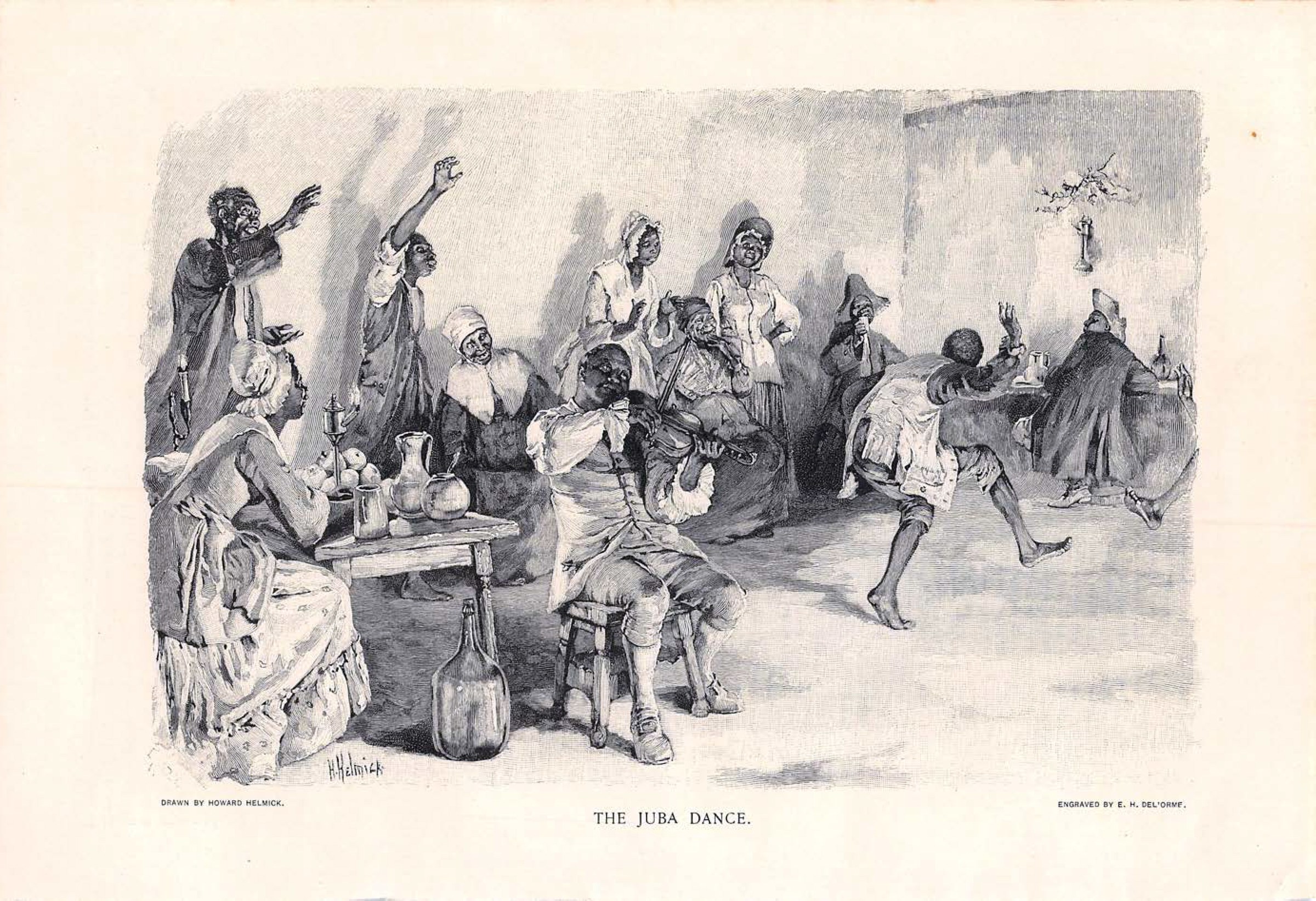
An engraved scene of the Juba dance depicts a lively gathering in what appears to be a modest interior space, with figures arranged across the composition in active, expressive poses. The central figure is a dancer captured mid-movement, bent forward with arms extended and legs in vigorous motion, while a musician plays a stringed instrument (likely a banjo or similar) seated nearby. Around the edges of the scene stand spectators in various attitudes of engagement—some clapping, some gesturing animatedly, others watching intently. The dress is plain and functional: loose shirts, simple trousers, and head wraps suggest an antebellum or early post-bellum American setting. The background is sketched with hatching to suggest depth and shadow, and the composition emphasizes the spontaneity and energy of the moment, with figures leaning in and responding to the central dancer's movement.
The dancing
The primary dancer exhibits a forward-bent posture with knees flexed and arms raised away from the body in an open, expansive frame—a posture suggesting rapid footwork and articulation of the lower body. The musician sits with instrument raised, engaged with the dancer rather than facing forward, creating a direct performer-musician relationship. Surrounding figures use their whole bodies in response: several have arms raised in clapping or gesturing positions, some lean toward the action, and the overall group shows the kind of informal, participatory spacing typical of social dance rather than staged performance. The energy is centripetal, with all gazes and bodies oriented toward the center.
The dance depicted
The Juba (also known as the 'juba' or 'patting juba') was an African American social dance that emerged in the antebellum United States, combining West African rhythmic and movement traditions with European folk dance forms. It was performed primarily by enslaved and free Black people, both as a social dance and as part of minstrelsy entertainment. The image captures the dance's characteristic features: rapid, complex footwork emphasizing lower-body percussion and articulation, call-and-response interaction between dancer and musician, and a participatory audience context. The forward-bent posture and arm positions are consistent with descriptions of Juba as a dance that prioritized rhythmic complexity in the feet and knees while allowing the upper body relative freedom.
How it was made
This is an engraving (as indicated by the signature 'drawn by Howard Helmick' and 'engraved by E. H. Delorme'), a reproductive printmaking technique that allowed wide circulation in periodicals and illustrated publications of the late 19th century. The medium's reliance on linear hatching for tone and its black-and-white palette creates strong contrast and graphic clarity suited to periodical reproduction. The technique required the artist to work in reverse and demanded precision in capturing gesture through line rather than tonal subtlety, which encouraged bold, readable poses. The credit line indicates publication in 'The Century,' a major American illustrated monthly magazine, meaning this image reached a broad educated audience across the United States.
About this work
This engraving documents the Juba dance, a vital African American social and performance tradition of the 19th century. Created for *The Century* magazine in 1895, the image captures both the technical vocabulary of the dance—the bent posture, articulate footwork, and responsiveness to percussion—and its social context as a participatory, musician-centered practice. The work exists at the intersection of documentary and artistic representation: it is neither a formal staged portrait nor ethnographic field recording, but rather an illustrated magazine scene meant to inform and entertain a largely white, educated readership about African American cultural practices. As such, it is a valuable (if mediated) visual record of how Juba was performed and understood in the post-Reconstruction era.
How to look at it
Attend to the posture and weight placement of the central dancer: the forward bend and flexed knees indicate that the dance's primary vocabulary lies in the feet and lower body rather than in upper-body styling or formation, which distinguishes it from European ballroom forms. Notice the musician's direct engagement with the dancer—his body is oriented toward her rather than facing an audience—suggesting that the dance is structured around call-and-response and rhythmic coordination rather than separate performer and audience roles. The spectators' gestures (raised arms, leaning postures) show that participation through clapping and vocalization was integral to the social context. Finally, observe that no two figures occupy quite the same pose or spatial plane; the engraver has worked to suggest motion, response, and moment rather than static arrangement.
The artist
Howard Helmick was an illustrator active in the late 19th century; E. H. Delorme was the engraver who translated Helmick's drawing into the reproductive print medium. Both names appear on the plate, following the standard practice of periodical and book illustration in this era, where the original artist and the reproductive engraver shared credit. The style is consistent with American magazine illustration of the 1890s—narrative, clear in its gesture, and designed to work at small scale on a printed page. No substantial biographical information about Helmick is widely available, which is typical for magazine illustrators of this period whose work was prolific but often uncredited in art history.
The period
The image was created in 1895, during a period of intense racial segregation and constraint for African Americans following Reconstruction. Yet it was also a moment when African American performance—particularly in minstrelsy, vaudeville, and the emerging musical theater—was increasingly visible in American popular culture and commercial media. *The Century* was a prestigious, progressive magazine for its time, and its inclusion of images of Black vernacular dance reflects both genuine cultural curiosity and the complex, often exploitative dynamics of how African American culture was circulated and consumed in the white mainstream. The Juba itself, though rooted in earlier traditions, was by this period primarily documented through its incorporation into minstrelsy and staged performance; images of it in 'authentic' social contexts were rare. This engraving thus occupies an ambiguous space: it may represent either an actual social dance occasion or a theatrical or posed recreation for the purposes of illustration.
Where it lives
This engraving was published in *The Century: Illustrated Monthly Magazine*, a major American periodical based in New York that ran from 1881 to 1930. The image was accessible to the magazine's subscription base, which included educated, affluent, primarily white readers across the United States. The work is now held in Wikimedia Commons, suggesting it is in the public domain or has been digitized for open access.
Dance in this work
Questions about this work
What is the Juba dance?
The Juba is an African American social dance that emerged in the antebellum United States, blending West African rhythmic traditions with European folk forms. It is characterized by complex, rapid footwork that emphasizes percussion and articulation of the lower body, paired with handclapping and call-and-response interaction with musicians. The dance was performed both in social contexts and incorporated into minstrelsy and vaudeville; it had significant influence on tap dance and jazz vernacular movement.
Why is an 1895 engraving of this dance important?
Visual records of 19th-century African American vernacular dance are extremely sparse. Most documentation comes from minstrelsy programs and theatrical contexts, which often distorted and caricatured authentic practices. This magazine illustration, while mediated through the lens of a white publication and illustrator, captures specific technical details—posture, footwork emphasis, and musician-dancer relationship—that are otherwise lost to history. It is one of the few published images that attempts to show how Juba was actually performed.
What does the engraving technique tell us?
Engraving was a reproductive medium that allowed wide circulation through mass-market magazines and books. The technique required bold, clear line work and strong contrast, which encouraged artists to emphasize readable gesture and composition. The fact that this image was engraved and published in *The Century*—a prestigious national magazine—indicates it was intended for an educated, affluent audience, reflecting the complex ways African American cultural practices were both celebrated and exoticized in the mainstream press.
Is this a documentary image or a staged recreation?
That remains uncertain. The image may document an actual social dance gathering, or it may be a posed or theatrical recreation made specifically for magazine illustration. The caption does not specify, and the context—publication in an illustrated magazine rather than an anthropological or archival source—suggests it may be theatrical. Either way, it represents how the Juba was understood and visualized by American illustrators and editors of the 1890s.
More dance artwork