49 works in this view — arrow keys or swipe to move between them.
Dance in Art · 1844
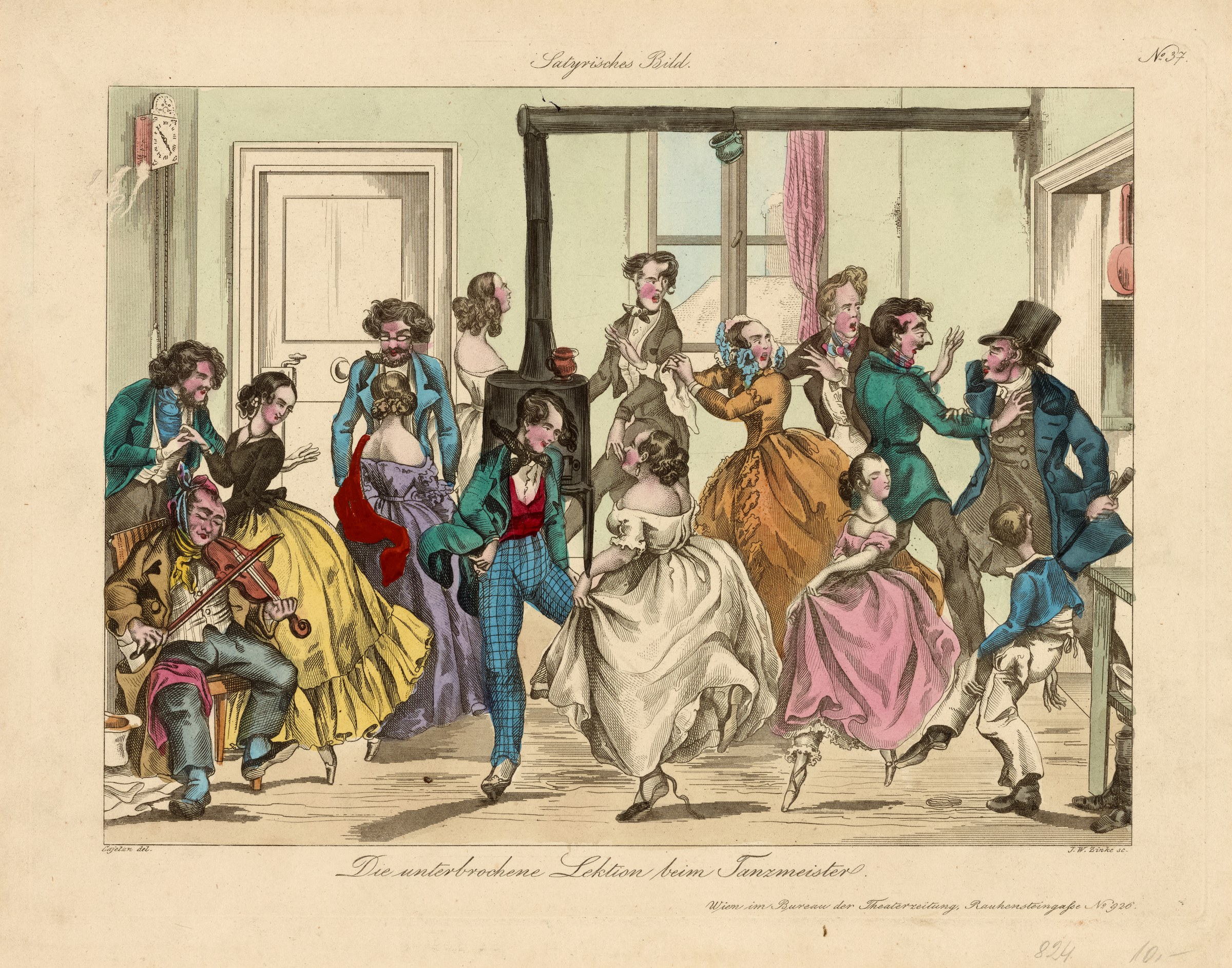
The interrupted dance lesson
Anton Elfinger / Johann Wenzel Zinke
- Medium:
- Oil Painting
- Era:
- Mid 1800s (Polka Era)
- Source:
- Wikimedia Commons
- Rights:
- Public domain — free to use, share and adapt.
- Recorded as:
- Public Domain
The print is a valuable record of how the waltz and formal dance instruction were perceived socially and visually in the 1840s, particularly the anxiety around women's bodily freedom and the impropriety of close partner contact. It documents the actual appearance of ballroom dress and the postures expected in social dancing of the period, while the satire reveals the gap between prescriptive manuals and the exuberance of actual dancers.
What you are looking at
A crowded drawing room erupts in chaos during what should be a formal dance lesson. A musician in a yellow coat plays violin while seated at left; in the center, a woman in a white gown dances with exaggerated, energetic movement, her skirts billowing, while a man in dark coat and top hat gestures in apparent protest or alarm. Around them, fashionably dressed onlookers in jewel-toned silks and blue coats mill about in disarray—some conversing, some gesturing wildly, some appearing to laugh or react with scandal. A dance master or instructor in green coat stands at center-right, seemingly attempting to restore order. The setting is a high-ceilinged room with large windows draped in pink silk, doors visible in the background, and classical architectural details. The lighting is clear and even, typical of a German or Central European drawing room of the mid-19th century. The entire composition suggests a moment of social disruption: the dance lesson has descended into farce.
The dancing
The primary dancer at center is in an open, expansive stance with arms raised and positioned asymmetrically—not the controlled frame of a formal ballroom dance. Her body appears to lean and pivot dynamically, with weight shifting through the movement. The violinist maintains a seated performance position. The other figures surrounding the dancers adopt various postures of reaction: some lean inward with animated gestures, others draw back or gesture outward in expostulation. The overall impression is of uncontrolled, spontaneous movement rather than the practiced alignment and frame expected of trained dancers.
The dance depicted
This is a satirical depiction of a ballroom dance lesson, most likely a waltz lesson given the period (1844) and the formal dress evident in the scene. The satire lies in the contrast between what a proper lesson should be—controlled, restrained, instructional—and what is actually occurring: enthusiastic but chaotic dancing that has lost all decorum. The woman's exuberant movement and the onlookers' reactions suggest the piece is mocking both the pretensions of formal dance instruction and the social anxieties surrounding the waltz, which was still considered somewhat scandalous in conservative circles for its close embrace and rapid turning. The title 'The interrupted dance lesson' suggests the lesson has been disrupted by the dancer's excessive enthusiasm or by some social transgression.
How it was made
This is a hand-colored engraving or lithograph, as evidenced by the linear hatching visible in the architectural elements and figures, combined with applied watercolor or gouache in discrete color areas. The technique allowed for precise linear detail in the composition while permitting the colorist to add visual liveliness through the bright greens, pinks, yellows, and blues of the costumes. The print's satire would have circulated widely in satirical journals or as standalone broadsheets; the numbered reference 'N°37' visible in the top right corner indicates this is one print in a series.
About this work
This is a German or Austrian satirical print from 1844 depicting the social comedy of a fashionable dance lesson gone awry. The work belongs to a rich tradition of 19th-century genre satire that used the ballroom and dance instruction as vehicles for social commentary—lampooning the pretensions of the rising bourgeoisie, anxieties about new dances like the waltz, and the gap between prescriptive etiquette and actual human behavior. The 'Satyrical Bild' label (Satirical Picture) places it squarely within a visual discourse about manners, propriety, and the comic potential of formal social rituals. For dance history, it documents both the appearance of mid-century waltz costume and the cultural anxiety the dance provoked: even in a comic frame, the woman's uninhibited movement and the onlookers' shocked reactions reveal how transgressive a 'loose' dancing body could appear to mid-Victorian sensibilities.
How to look at it
Observe the contrast between the dance master's controlled posture (at right) and the primary dancer's expansive, uninhibited movement. The artist has frozen a moment of maximum chaos: note how the surrounding figures' gestures radiate outward from the dancer, their hands and bodies recoiling or gesticulating in reaction. The woman's skirts, rendered with particular detail, are captured mid-swirl, emphasizing the bodily freedom that the satire is both celebrating and mocking. The crowded composition and the overlapping figures intensify the sense of disruption. Pay attention to the architectural framing—the large windows and classical doorways establish this as a respectable drawing room, making the disorder all the more comedic.
The artist
The print is attributed to Anton Elfinger and/or Johann Wenzel Zinke, identifying it as part of the German-speaking satirical print tradition of the mid-19th century. Satirical prints were a major visual medium for social commentary in this period, distributed through print shops and periodicals. The artistic strategy of exaggerating physical gesture and composing a chaotic scene to mock social pretension was well-established in this tradition, drawing on earlier Hogarth and Gillray precedents but adapted to Continental European bourgeois society.
The period
The 1840s were a moment of intense cultural debate about the waltz. While the dance had been fashionable since the Napoleonic era, it remained controversial, especially in conservative and aristocratic circles that viewed its close hold and rapid turning as morally suspect. Formal dance instruction manuals proliferated in this period, attempting to codify proper technique and behavior. Simultaneously, the rise of the bourgeoisie created new anxieties about social distinction: the ability to dance 'correctly' became a marker of class aspiration. Satirical prints capitalized on these tensions, mocking both the rigidity of etiquette-mongers and the enthusiastic but ungainly efforts of the newly genteel.
Where it lives
The work is catalogued as a satirical print and appears to be from a numbered series ('N°37'), suggesting it was published as part of a suite of satirical scenes, possibly in a German or Austrian journal or as a bound collection. The source is listed as Wikimedia Commons.
Dance in this work
Questions about this work
What is being mocked in this print?
The print satirizes both the pretensions of formal dance instruction and the social anxiety surrounding the waltz. The 'interruption' appears to be the dancer's loss of control—her enthusiastic, uninhibited movement has disrupted the lesson and shocked the onlookers, suggesting that despite (or because of) instruction, the body's natural exuberance breaks through the constraints of propriety.
Is this a waltz?
Almost certainly. The period (1844), the formal dress, the presence of a dance master, and the satire about 'improper' bodily freedom all point to waltz instruction. The waltz was the new, controversial dance of the era, and satirists frequently used it as a vehicle to discuss anxiety about women's bodies and social change.
Why would a dance lesson be satirized?
Dance instruction was a site of class anxiety in the 1840s. Learning to dance 'correctly' was essential for bourgeois social aspiration, but the process was also comic: the rigid rules of etiquette manuals often collided with the messy reality of human bodies trying to follow them. The print's humor lies in this collision.
What does the print tell us about how people actually danced?
Beneath the satire, the image documents real costume, posture, and the apparent energy of social dancing. The woman's expansive movement, the musician's placement, and the onlookers' engagement all suggest how waltz dancing actually looked and felt—enthusiastic, involving the whole room, and potentially transgressive to conservative sensibilities.
More dance artwork