49 works in this view — arrow keys or swipe to move between them.
Dance in Art · 1849
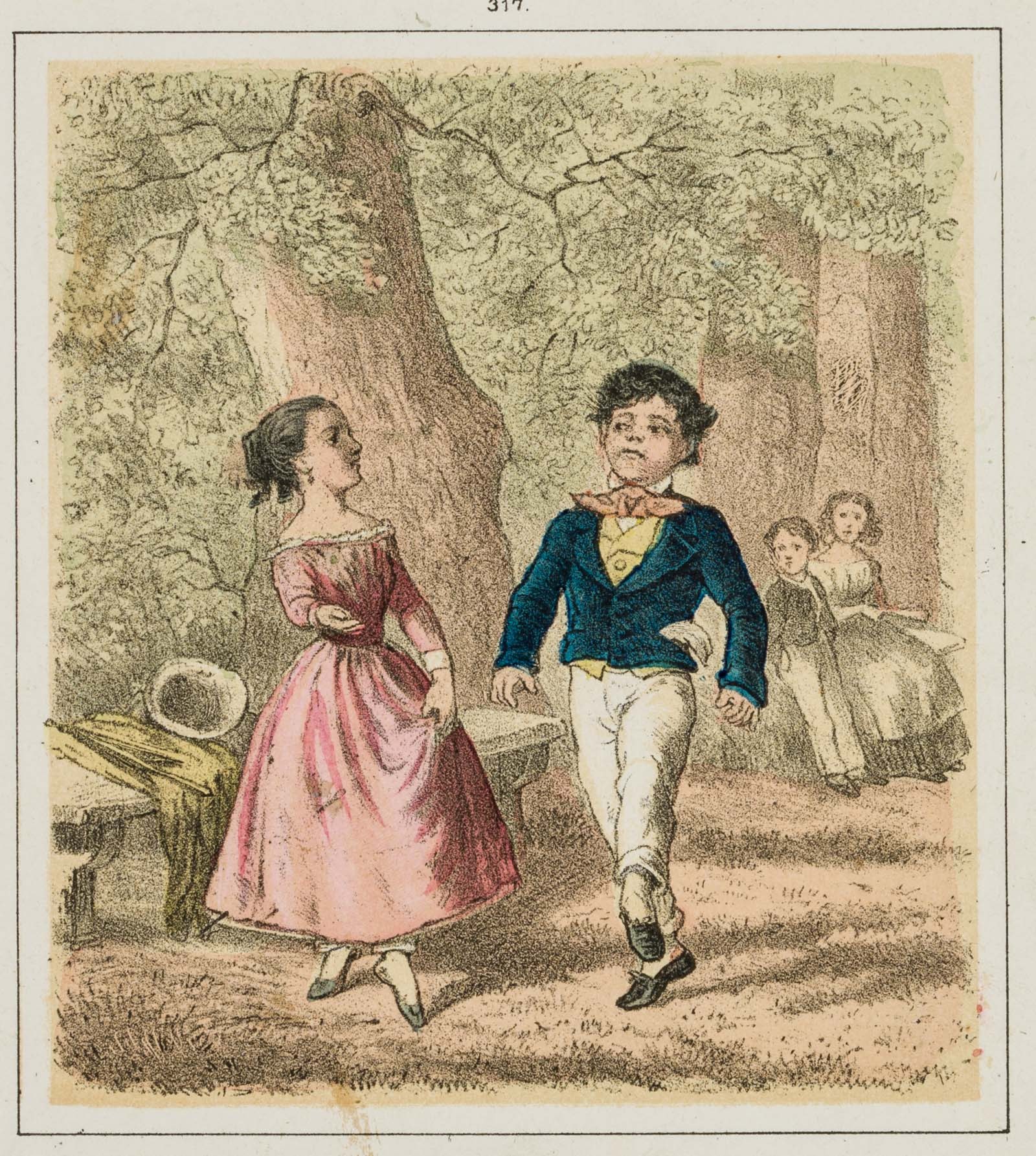
Theodor Hosemann - Der kleine Kavalier, c. 1849
Theodor Hosemann
- Medium:
- Lithograph
- Era:
- Mid 1800s (Polka Era)
- Source:
- Wikimedia Commons
- Rights:
- Public domain — free to use, share and adapt.
- Recorded as:
- Public Domain
This image reveals what dance looked like outside the ballroom: unstructured, playful, and learned by imitation rather than instruction. For historians of social dance and childhood, it offers evidence of how children acquired movement vocabulary and courtship behavior through unsupervised woodland play, and it shows that the "little cavalier"—performing gallantry for an audience of peers—was a recognized social type worthy of an artist's attention.
What you are looking at
A young boy and girl dance together in a wooded forest setting, surrounded by tall trees with detailed foliage rendered in fine stippling and cross-hatching. The boy, dressed in a dark blue jacket with yellow collar and white breeches, moves with animated energy—his body angled forward, one leg extended in a sprightly step. The girl, in a pink dress with darker pink underskirt, stands with her body turned toward him, her posture upright and attentive. Behind them, barely sketched but present, two smaller figures—possibly younger children—watch from deeper in the forest. The ground is indicated by sparse hatching; the atmosphere is one of informal, unsupervised play rather than formal instruction. The title *Der kleine Kavalier* (The Little Cavalier) suggests this is a portrait of youthful courtship or gallantry enacted in nature rather than a ballroom.
The dancing
The boy's frame is open and forward-leaning, with his weight shifted onto his front leg in what appears to be a walking or skipping step rather than a closed ballroom position. His arm extends naturally at his side. The girl faces him with an upright carriage, her arms at rest, her expression attentive but not actively engaged in the boy's movement. There is no hand-hold or closed dance frame; the two are separated by a small space. The gestural language is conversational and social rather than technically balletic or formally choreographed.
The dance depicted
This depicts informal social dancing or courtship play between children in the early 19th century, likely a folk or popular social dance of the period rather than classical ballet. The open frame, woodland setting, and absence of formal technique suggest a promenade, walk, or simple country dance—possibly a Deutscher (German dance) or similar popular form of the Biedermeier era. The image captures a moment of flirtation or demonstration rather than synchronized partnering, and the small audience of watching children suggests this was a common social pastime among the young.
How it was made
This is a hand-colored lithograph, a medium that allowed for mass reproduction and wide circulation among the middle classes. The subtle color work—pink and blue clothing set against the ochre-toned paper and sepia lithographic line—is characteristic of 1840s-50s German domestic prints. Lithography's precision in capturing fine detail is evident in the delicate cross-hatching of the foliage and the careful definition of costume; the coloring appears to be applied by hand after printing, a common practice for affordable popular prints.
About this work
Theodor Hosemann's *Der kleine Kavalier* is a genre scene of youthful courtship set in nature, capturing the informal social dances of the Biedermeier period. It belongs to a tradition of German popular prints depicting everyday life and child behavior, one of Hosemann's familiar subjects. The work documents not a professional or staged dance, but the improvised social dancing through which young people of the era learned courtship and social confidence—a side of 19th-century dance practice rarely visible in paintings of the ballroom.
How to look at it
Notice the boy's weight and forward momentum—he is not standing but moving through space, captured mid-gesture rather than in a formal pose. The girl's stillness and turned head suggest she is observing or responding to his display rather than initiating movement. The watching children in the background establish this as a social performance, a moment when the boy demonstrates his courtly manners to peers. The woodland setting, far from the city ballroom, suggests this is a more instinctive, less rule-bound form of dancing than what one would see in a formal dance instruction book.
The artist
Theodor Hosemann (1807–1875) was a Berlin-based painter, lithographer, and illustrator specializing in genre scenes of middle-class and working-class life. He was celebrated for his sharp observation of domestic interiors, street scenes, and moments of childhood play. His works circulated widely as colored lithographic prints, making him one of the most commercially successful genre painters of the German Biedermeier period.
The period
The 1840s-50s in German-speaking Europe saw a flowering of Biedermeier culture—domestic, sentimental, and focused on family and modest pleasures. This was the era of the Waltz Revolution in ballrooms, yet much actual social dancing happened outside formal settings, in gardens and forests. Children's behavior and education were becoming subjects of artistic and literary interest, partly under the influence of Romantic ideals of childhood innocence and natural development. Hosemann's print sits at the intersection of these trends: documenting childhood, nature, and the social dances of the emerging middle class.
Where it lives
The work is recorded as a colored lithograph from c. 1849, held in an unspecified collection and sourced from Wikimedia Commons. It is a popular print—a work of mass production intended for domestic display rather than a unique artwork or museum acquisition piece.
Dance in this work
Questions about this work
Is this children dancing or children at play?
Both. The boy is performing a social dance or promenade step, demonstrating courtly behavior to the girl and the watching children. But it is happening in a woodland setting without music or formal instruction, so it is social play rather than a dance lesson or performance. This was how children of the era learned to dance.
What dance is the boy doing?
The open frame and walking step suggest a simple promenade or a Deutscher (a popular German social dance of the period). Without music or a clearer view of the footwork, it is impossible to be precise, but the image shows an informal, learned-by-imitation courtship dance rather than classical technique.
Who was Theodor Hosemann?
A prolific Berlin genre painter and lithographer (1807–1875) who specialized in domestic and street scenes of middle-class life. His colored prints were commercially successful and widely circulated, making him one of the most visible artists of the Biedermeier period.
More dance artwork