49 works in this view — arrow keys or swipe to move between them.
Dance in Art · 1854
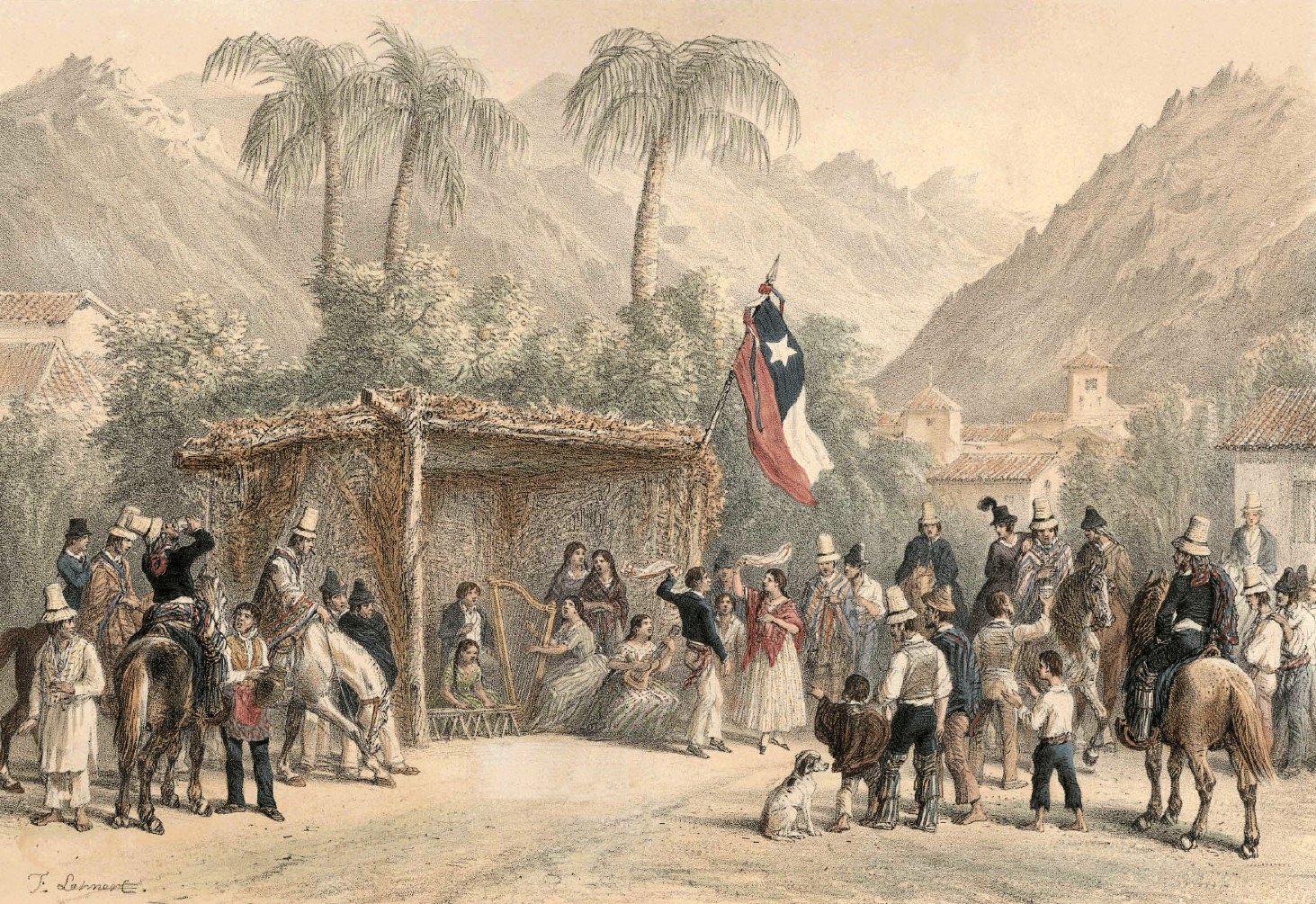
Una chingana - Chile
Gay, Claudio, 1800-1873
- Medium:
- Oil Painting
- Era:
- Mid 1800s (Polka Era)
- Source:
- Wikimedia Commons
- Rights:
- Public domain — free to use, share and adapt.
- Recorded as:
- Public Domain
This is one of the few visual records of the chingana and early-nineteenth-century Chilean social dance in its actual context of performance. For historians of dance in the Americas, it provides evidence of how cueca and related dances were embedded in festive social practice rather than formalized or professionalized. The work documents a cultural institution that defined Chilean national identity at a moment of political transition.
What you are looking at
A festive gathering in a mountain valley during what appears to be a Chilean Independence Day celebration (September 18). A wooden structure with a thatched roof—a chingana, or traditional Chilean tavern and dance hall—serves as the focal point, its entrance framed by two tall palm trees that rise dramatically against steep canyon walls. The scene pulses with activity: dozens of figures in period dress mill about the plaza, some seated on benches inside the structure, others standing or moving through the space. A large flag—the Chilean tricolor—hangs from a pole above the gathering, its red, white, and blue clearly visible. The light is warm and diffuse, casting the distant mountains in soft tones while the foreground figures stand in sharper relief. The composition draws the eye from the gathered crowd through the chingana's open entrance and outward toward the distant landscape, suggesting both intimacy and expansiveness.
The dancing
The figures are rendered in varied dress typical of mid-nineteenth-century Chile—some wear formal hats and jackets, others display looser, more casual attire. Several dancers appear to be moving in informal, social patterns rather than formal ballroom holds. A woman in a patterned dress stands near the center of the gathering; others sit on benches or stand in clusters. The postures suggest animated conversation and movement rather than structured choreography. A horse and riders appear at the right edge, suggesting the festive, social nature of the gathering. The overall impression is of loosely organized, spontaneous movement and celebration rather than precise partner work.
The dance depicted
This depicts a chingana—a distinctly Chilean social institution combining tavern, dance hall, and celebration space—during what the inscription identifies as September 18, the date of Chilean Independence Day. The chingana was a working-class and rural gathering place where huaso (cowboy) culture mixed with urban social dancing. The image suggests the cueca, a Chilean national dance that pairs men and women in a flirtation-like movement, though no formal dance frame is evident here. The scene captures the social and festive context of dance rather than a moment of technical execution, reflecting how dance functioned in Chilean rural and working-class life as part of broader celebration and social gathering rather than as performance.
How it was made
This is a hand-colored engraving or lithograph, identified in the record as an oil painting but appearing from its qualities to be a print medium with watercolor or gouache hand-coloring. The technique allows fine detail in the architectural and landscape elements while maintaining a somewhat flattened, illustrative quality to the figures. The soft coloring and atmospheric perspective (distant mountains fade into pale tones) suggest aquatint or stippled engraving enhanced with color. This was a common format for travel documentation and ethnographic illustration in the mid-nineteenth century, allowing for multiple impressions and wide circulation among educated audiences interested in American landscapes and customs.
About this work
This is a documentary illustration of a chingana—a Chilean festive gathering and traditional dance hall—captured during Independence Day celebrations. It records a moment of social dance and celebration in nineteenth-century Chilean rural life, showing how dance functioned not as formal performance but as embedded social practice within community gatherings. The work sits at the intersection of travel art, ethnographic documentation, and dance history, preserving visual evidence of a cultural practice that was central to Chilean identity and working-class life.
The image is significant because it shows dance in its lived social context rather than on a stage or in a ballroom, and because it documents the chingana specifically—an institution that was foundational to Chilean popular culture. The attention to setting, costume, and the mixing of social classes and formal dress codes reflects genuine interest in capturing how this society actually danced together.
How to look at it
Attend first to the setting rather than individual dancers: the chingana structure itself is the protagonist, and the gathering is meant to be read as a complete social scene rather than a sequence of dance moments. The artist has chosen to show preparation, gathering, and informal movement rather than a climactic dance moment, which is historically accurate—these were social spaces where dancing was one among many activities. Notice the variety of dress and the mixing of formal and informal clothing, which tells you about the social heterogeneity of these spaces. The distant mountains and the framing through the chingana's entrance emphasize that this is a local, rooted practice embedded in the Chilean landscape.
The artist
Claudio Gay (1800–1873) was a French botanist, naturalist, and artist who spent three decades in Chile (1828–1842), where he conducted systematic natural history research and created extensive visual documentation of Chilean landscapes, peoples, and customs. His work combined scientific observation with artistic skill, and his illustrated publications on Chile were influential in introducing Chilean geography and culture to European audiences. This painting or print is part of that larger documentary project, reflecting both Gay's role as naturalist and his function as cultural interpreter for a European readership.
The period
The 1850s were a period of consolidation for Chilean independence (achieved in 1810), and public celebration of national identity through holidays like September 18 was becoming formalized. Rural and working-class social dances like the cueca were being recognized as markers of national character distinct from European ballroom dance. Simultaneously, European and European-trained artists were documenting the Americas with new attention to indigenous and mestizo culture, often framed through a scientific or ethnographic lens. Gay's work reflects this moment when travel documentation and nationalism intersected, and when Chilean popular culture was being recorded for posterity and for foreign audiences.
Where it lives
The work is recorded as sourced from Wikimedia Commons. It appears to be part of Gay's documented record of Chile, likely from his publications on Chilean geography and society issued in the 1850s.
Dance in this work
Questions about this work
What is a chingana?
A chingana was a Chilean tavern, dance hall, and social gathering space that was particularly associated with rural and working-class culture. It functioned as a space for eating, drinking, socializing, and dancing, particularly during festivals and celebrations. The chingana was central to the expression of huaso (Chilean cowboy) culture and popular national identity.
What dance would have been performed at a chingana?
The cueca, Chile's national dance, would have been the primary dance form. It is a courtship dance performed by pairs in which partners face each other and move in a flirting, playful manner. Other forms like the zamacueca and tonada were also danced in these settings. These were social dances rather than formal choreography, allowing for improvisation and regional variation.
Who was Claudio Gay and why did he paint this?
Gay was a French naturalist and artist who spent decades documenting Chile's geography, flora, fauna, and people. He was commissioned to create a comprehensive illustrated record of Chile for scientific and cultural purposes. His work combined natural history documentation with ethnographic interest, creating detailed visual records of Chilean life and customs for European audiences.
Why is September 18 significant?
September 18 is Chilean Independence Day, commemorating the date in 1810 when Chile began its process of independence from Spanish colonial rule. Public celebrations of this date, particularly at community gathering spaces like the chingana, were ways of asserting and performing national identity through festive social practice.
More dance artwork