49 works in this view — arrow keys or swipe to move between them.
Dance in Art · 1864
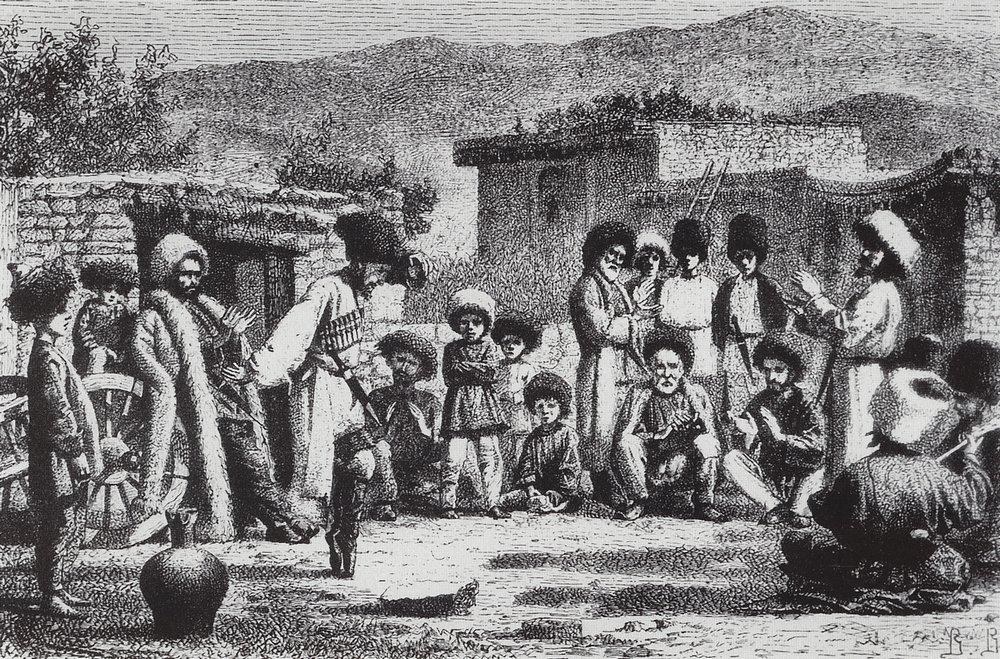
VereshchaginVasilyVasilyevich-Lezginka(1867)higher resolution
Vasily Vereshchagin
- Medium:
- Ink
- Era:
- Mid 1800s (Polka Era)
- Source:
- Wikimedia Commons
- Rights:
- Public domain — free to use, share and adapt.
- Recorded as:
- Public Domain
The Lezginka is a living tradition that has survived colonial suppression and Soviet assimilation policies; this image is a historical record of its 19th-century performance context and aesthetic. For scholars of imperial visual culture, the work exemplifies how dance was documented, exoticized, and circulated as part of European knowledge-making about colonized peoples. The image's specificity about costume and posture makes it valuable for reconstructing the dance's historical form.
What you are looking at
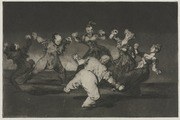
A group of Caucasian dancers, predominantly men and some women and children, perform in a mountainous village setting rendered in fine pen-and-ink cross-hatching. The figures wear traditional dress: the men sport long dark coats (cherkeskas) with characteristic cartridge holders across the chest, tall fur hats (papakhas), and some display curved daggers. The women wear long dresses and headdresses. The composition spreads across the picture plane in a loose semicircle, with the most active dancers toward the center and onlookers positioned around the edges. The setting is spare but convincing—mountainous terrain rises in the background, simple stone buildings with small windows anchor the scene, and a large pot sits in the foreground, suggesting a village gathering. The light is even throughout, typical of the engraving medium, with depth created entirely through overlapping figures and the density of the hatching.
The dancing
The central male dancers display a characteristic male Caucasian dance posture: upright, chest forward, arms held at varying heights with elbows bent, often held away from the body in positions suggesting controlled tension. One figure in particular shows the characteristic high-knee stepping action. The women's bodies are more demurely posed, their arms less dramatically extended. The figures nearest the viewer are rendered at life scale; those receding are smaller. Several onlookers—older men and children—stand or sit at a remove, establishing this as a social gathering where dance is central but observation is legitimate.
The dance depicted
This is the Lezginka (or Lezghinka), a male-dominated solo or duet dance from the Caucasus, particularly associated with the Lezghi people and other North Caucasian groups. The image captures its characteristic features: the upright carriage, the rapid footwork from the knee downward with minimal hip movement, the restrained arm gestures, and the competitive or display context. The presence of women and children watching, and the village setting with its mixture of performers and spectators, suggests this is a social occasion—wedding, celebration, or gathering—where men demonstrate skill and virility through the dance. The Lezginka was well known to European audiences of the 19th century through colonial encounter and Orientalist imagery.
How it was made
This is an ink engraving or pen drawing, likely a print. The technique relies entirely on line and cross-hatching to describe form, fabric texture, and atmospheric depth. The fineness and consistency of the line work suggests professional reproduction—either a wood engraving or a lithographic transfer—rather than a direct pen drawing. The medium allowed for wide circulation as a printed image, making it a vehicle for ethnographic knowledge and Orientalist fantasy among educated European audiences. The even rendering and lack of color locate this within the tradition of 19th-century documentary illustration, though with the romanticism characteristic of the period's treatment of non-European subjects.
About this work
Vereshchagin's *Lezginka* is a record of a Caucasian social dance captured during Russia's colonial presence in the region. The work documents the male-centered performance tradition of the Lezginka through the conventions of 19th-century ethnographic illustration: careful attention to costume, posture, and social context, combined with the Orientalist aesthetics that made such images legible and desirable to European viewers. As a printed work (likely an engraving), it served simultaneously as documentary evidence and as entertainment, shaping European understanding of Caucasian culture during a period of imperial expansion and conflict.
How to look at it
Attend to the posture of the central male dancers: the upright torso, the bent knees and rapid footwork visible in the line work, and the controlled arm positions that suggest strength held in reserve. Notice how the artist has positioned the dancers to display their full figures and costumes—this is portraiture of a people as much as documentation of a dance. The onlookers establish scale and social context; they frame the performance. The landscape background, though sketched lightly, anchors the scene in the Caucasus rather than a generic 'Orient,' suggesting Vereshchagin's commitment to specific place.
The artist
Vasily Vereshchagin (1842–1904) was a Russian realist painter and illustrator best known for his unflinching depictions of warfare and imperial conquest. He traveled extensively in Central Asia and the Caucasus, documenting landscapes, peoples, and conflicts through drawings and paintings. His work combined documentary precision with Orientalist aesthetics and often carried implicit or explicit critique of imperial violence. He was equally committed to printmaking and illustration, ensuring his images reached a wide audience. His Caucasian subjects reflect his time in the region and his interest in ethnographic detail.
The period
The 1860s were a moment of intense European fascination with the Caucasus, driven by Russia's ongoing military campaigns to consolidate control. Orientalist art and literature flourished in this decade, satisfying European curiosity about exotic peoples and regions while implicitly justifying colonial enterprise. Simultaneously, ethnographic illustration was developing as a pseudo-scientific discipline, with careful attention to dress, posture, and ritual. Dance imagery, in particular, was valued because it seemed to reveal something essential about a people's character and vitality. Vereshchagin's work sits at the intersection of artistic documentation, imperial record-keeping, and Orientalist spectacle.
Where it lives
The work is catalogued as an ink drawing on paper from 1864, held in an unrecorded collection. It is known through Wikimedia Commons, suggesting it is now in a public or institutional collection with open digital access.
Dance in this work
Questions about this work
What is the Lezginka?
The Lezginka is a traditional solo or duet dance of the Caucasus, particularly associated with the Lezghi people and other North Caucasian ethnic groups. It is characterized by rapid footwork, an upright carriage of the upper body, and restrained arm gestures—a style emphasizing control and virility. The dance remains central to Caucasian cultural identity and is performed at celebrations and social gatherings.
Why did Vereshchagin paint the Caucasus?
Vereshchagin traveled to the Caucasus during Russia's imperial consolidation of the region in the mid-19th century. He was drawn to subjects of war, conflict, and exotic peoples, which aligned with both his artistic interests and the appetite of European audiences for Orientalist imagery. His Caucasian works document the region's landscapes, peoples, and conflicts.
Is this a finished work or a study?
The high finish and detail suggest this is either a finished illustration or a preparatory drawing for a published print. The technique and scale indicate it was intended for reproduction and circulation, likely as part of an illustrated journal or album of Caucasian scenes.
How accurate is this depiction of the Lezginka?
The costumes and the posture of the male dancers are consistent with historical records and living memory of 19th-century Lezginka performance. The upright frame, the downward-driving footwork, and the restrained arm gestures are characteristic of the dance. However, as an Orientalist work, the image also emphasizes visual spectacle and exotic difference in ways that may not reflect all aspects of how the dance was performed or understood by its practitioners.
More dance artwork