49 works in this view — arrow keys or swipe to move between them.
Dance in Art · 1900
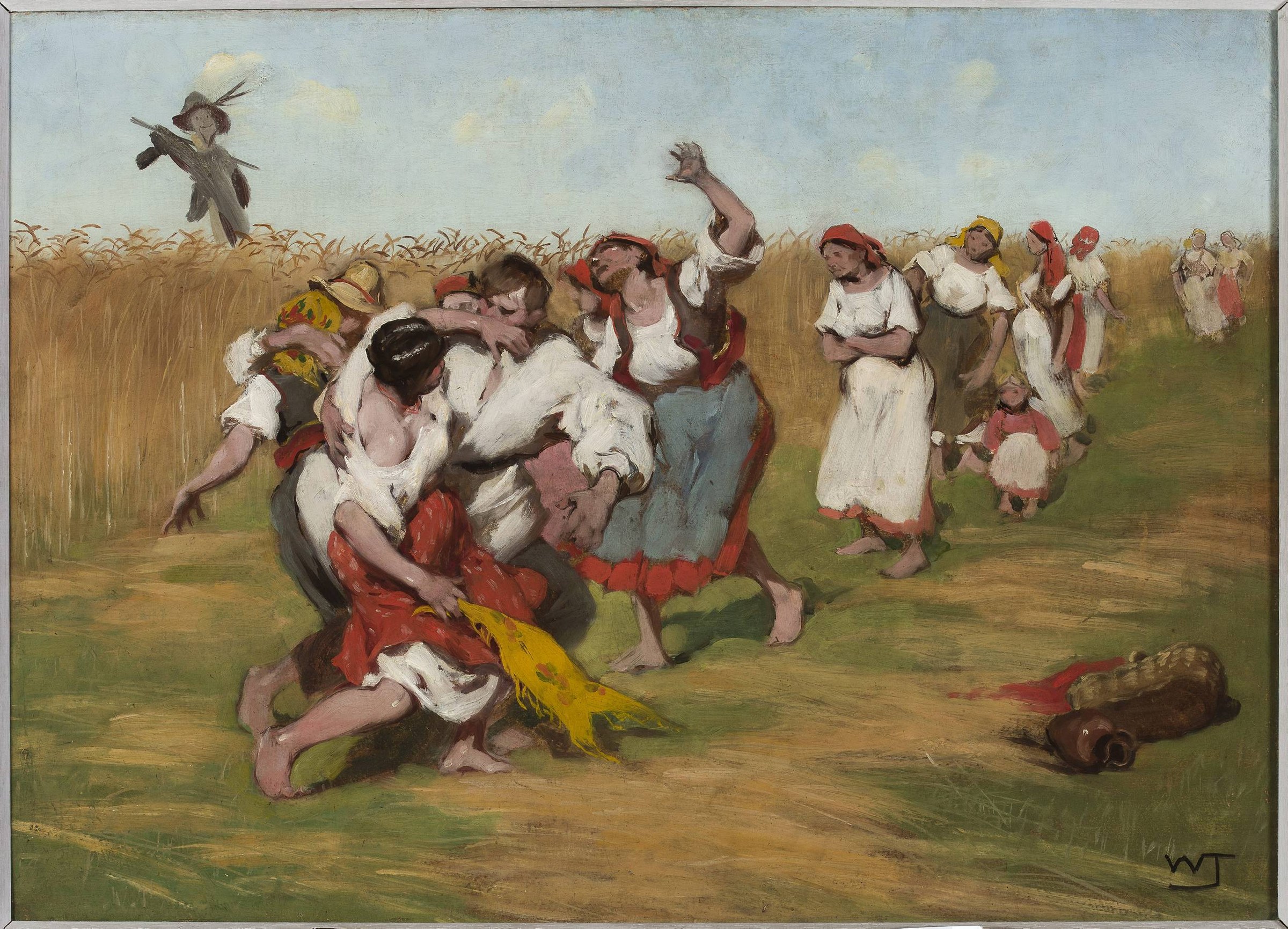
Włodzimierz Tetmajer - Harvest - MP 751 MNW - National Museum in Warsaw
Włodzimierz Tetmajer
- Medium:
- Oil Painting
- Era:
- 1900-1920 (Ragtime/Early Jazz)
- Source:
- Wikimedia Commons
- Rights:
- Public domain — free to use, share and adapt.
- Recorded as:
- Public Domain
This painting is primary visual evidence for early 20th century Polish or Eastern European harvest dance practice, showing the actual bodies, costumes, and social organization of a celebration form that was already becoming marginal as industrialization advanced. For historians of folk dance and for practitioners interested in reconstructing or understanding traditional forms, the specificity of detail—the barefoot weight distribution, the informal partnering, the mixed-age participation—is invaluable. The work also matters as an example of how avant-garde and salon painters of the period turned toward folk subjects, treating village celebration with the same formal seriousness as mythological or historical narrative.
What you are looking at
A harvest celebration unfolds in a grain field at the moment of peak festivity. The composition centers on a group of dancers in animated motion, their bodies twisted and leaping with exuberant energy. The women wear white linen shifts and red or burgundy skirts; the men are bare-chested or in white shirts with red accents. In the foreground, a woman in a yellow patterned garment (possibly a decorative headscarf or shawl) is lifted or held by a man, her body arched dynamically while a child reaches upward nearby. To the right, other dancers move in loose formation, some with arms raised. The background shows the golden grain field stretching toward the horizon, with a figure in a scarecrow-like pose visible at the left edge. The light is bright and naturalistic, suggesting midday, and the overall impression is of uninhibited, folk celebration—the kind of moment that marks the completion of harvest work.
The dancing
The dancers are barefoot or in soft shoes, moving with weight centered low and bodies frequently off-balance in ways that suggest vigorous, improvised movement rather than codified steps. The central couple shows a lift or near-lift, with the woman's torso extended and the man's arms supporting her—a gesture of exuberant partnering. Arms are raised, extended, or curved expressively rather than held in formal frame. The group clusters and disperses fluidly; there is no line, no mirror, no closed position. Weight transfers are visible in bent knees and tilted spines. The overall impression is of bodies in celebration rather than in learned sequence.
The dance depicted
This appears to depict a Polish or Eastern European folk harvest dance, most likely a *żniwiarka* (harvest dance) or similar regional celebration form. The painting captures a moment of social, participatory dance rather than theatrical performance—the kind danced by harvesters themselves at the culmination of work. The costumes, setting, and uninhibited physical expression are consistent with late 19th or early 20th century village celebration practices. The artist has chosen to emphasize the spontaneity and communal joy rather than technique, showing a moment when dance was still embedded in labor and seasonal ritual. Without inscription or documented context, the specific regional origin cannot be certain, but the visual language—costume, landscape, and movement quality—strongly suggests Central or Eastern European folk practice.
How it was made
This is an oil painting on canvas, a medium well suited to capturing the warmth of skin tones, the texture of linen and grain, and the effects of natural light on a landscape scene. The artist's handling is painterly and atmospheric—soft in the background (the grain field fades into pale sky), more defined in the foreground where the dancers' gestures and expressions matter most. The technique allows for the kind of narrative richness and psychological immediacy that makes the scene legible as a moment of lived experience rather than mere illustration. Oil on canvas was the medium of choice for European salon painting and serious documentary of folk life in this period, signaling that this was intended as a substantial art work for exhibition and collection, not a casual sketch.
About this work
This painting documents a harvest celebration, capturing the moment when work becomes festival and the community dances. The artist presents the scene not as picturesque costume drama but as genuine celebration: bodies move with the unselfconsciousness of people for whom dance is natural expression, not learned performance. The painting belongs in a dance archive because it shows us how harvest dances were actually done—the weight, the partnering, the absence of artifice—and because it insists that folk celebration is as worthy of serious artistic attention as court ballet or theatrical spectacle. The work is a record of a social practice and a moment in European art history when painters began to see village culture as subject matter worthy of the same formal attention once reserved for nobility.
How to look at it
Attend first to the moment frozen: this is the peak of exertion and joy, not a static pose or a single step. The artist has caught the dancers mid-leap, mid-turn, mid-lift—bodies off-balance and committed. Notice how the weight is carried low and the spines are flexible; notice that no two dancers are doing the same thing, and that there is no beginning or end to the action, only continuous celebration. The painting is organized not by symmetry or formal composition but by the natural clustering of bodies in motion. The color—the white linen, the red skirts, the golden grain, the bright sky—heightens the sense of festive abandon. This is not a painting about dance technique; it is a painting about what dance does to bodies and communities when it is still a natural form of expression.
The artist
Włodzimierz Tetmajer (1862–1923) was a Polish painter associated with the Young Poland movement and a keen observer of folk and peasant life. Working in the late 19th and early 20th centuries, he documented regional customs, celebrations, and daily practice with a combination of romantic sympathy and documentary precision. His work sits at the intersection of Romantic interest in folk authenticity and modernist interest in direct observation and formal innovation. Tetmajer exhibited internationally and was recognized as a serious painter of ethnographic and social subjects.
The period
The painting dates to 1900, a moment when European art was becoming increasingly interested in folk and village culture as a source of authenticity and national identity. This was the era of the Young Poland movement, the Secessionist interest in craft and peasant tradition, and the emergence of ethnographic painting as a respected genre. At the same time, rapid industrialization and rural migration were beginning to displace or transform traditional celebration forms. Painters like Tetmajer were documenting these practices partly as a record of something felt to be passing away. In dance history, this is the period just before the codification and revival of folk forms through nationalist movements and organized folk ensembles; this painting shows harvest dance in its communal, functional context before it became repertoire.
Where it lives
The painting is held in the National Museum in Warsaw (accession MP 751 MNW). It was encountered via Wikimedia Commons, indicating it is documented and accessible in the public record, though the nature of its acquisition and any exhibition history are not recorded here.
Dance in this work
Questions about this work
Is this a real dance or an invented scene?
The painting almost certainly documents a real harvest celebration practice, most likely Polish or Eastern European in origin. The specificity of costume, setting, and physical detail suggests direct observation or reliable report rather than fantasy. However, the artist has chosen and arranged the moment for artistic effect; this is not a documentary photograph but a composed work that selects and emphasizes what the artist found most compelling about the scene.
Can you identify the specific dance or region?
The costume, landscape, and style strongly suggest Polish or possibly broader Central European origin, and the context indicates a harvest celebration (żniwiarka or equivalent). The title alone does not specify. Without additional documentation from the artist or museum records, the precise regional origin and traditional name of the dance cannot be stated with certainty, though the visual evidence is consistent with well-documented Polish harvest practices.
What was the purpose of harvest dances?
Harvest dances marked the completion of heavy agricultural labor and served as communal celebration, thanksgiving, and social bonding. They often involved mixed participation (men, women, children) and served as occasions for courtship, socializing, and reinforcement of community identity. These dances were functional events embedded in the agricultural calendar, not performances for an outside audience—though by the time this painting was made, such practices were becoming rare enough that they were beginning to be observed and recorded by artists and ethnographers.
Why are the dancers barefoot?
Barefoot dancing was typical of folk celebration in rural communities, partly for practical reasons (shoes were precious and expensive; dancing in fields or on packed earth made bare feet practical) and partly because bare feet allowed freer, more grounded movement. The choice also signaled to contemporary viewers—and still signals to us—the rural and genuine nature of the scene, in contrast to the shod formality of ballroom or theatrical dance.
More dance artwork