49 works in this view — arrow keys or swipe to move between them.
Dance in Art · 1920
Adolf Münzer Dionysisches Ballett
Adolph Münzer
- Medium:
- Oil Painting
- Dance:
- Ballet
- Era:
- 1920-1950 (Swing Era)
- Source:
- Wikimedia Commons
- Rights:
- Public domain — free to use, share and adapt.
- Recorded as:
- Public Domain
This painting documents the modernist revaluation of dance as a vehicle for expressing ecstatic and primal states—a shift that fundamentally changed 20th-century performance. It shows how visual artists engaged with dance theory and practice in the early modernist period, translating concepts of liberation and authenticity into painted form. For dancers and historians, it reveals the ideological stakes: the rejection of classical refinement in favor of supposedly 'natural' or 'pagan' movement was not innocent, but deeply tied to primitivism, nationalism, and theories of gender and the body that were circulating at the time.
What you are looking at
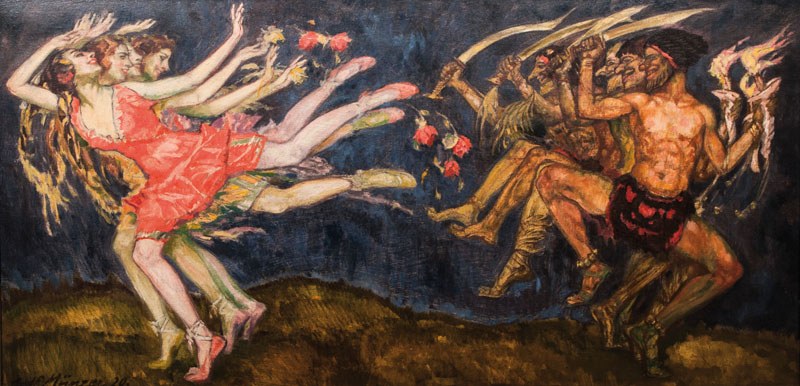
A mythological bacchanal unfolds across a dark ground beneath a stormy sky. On the left, three winged figures in classical drapery—two in pale flesh tones and one robed in crimson—leap and gesture with raised arms in ecstatic motion, their bodies caught mid-flight. On the right, a satyr and what appears to be a putto or young male figure, rendered in golden-brown tones, mirror the energy with raised scythes or curved implements held aloft. The composition divides the canvas into opposing forces: ethereal feminine grace on the left answered by earthy, masculine wildness on the right. The paint is worked with visible energy, the figures emerging from and dissolving back into the shadowed surface, creating an impression of movement and intoxicated abandon rather than formal stillness.
The dancing
The bodies are elongated and weightless, suspended rather than grounded. The three figures on the left show arms flung upward in abandon, legs extended in what appears to be leaping or aerial gesture, their torsos arched backward in surrender to ecstatic movement. The satyr on the right is more muscular and compact, braced low in a lunging or thrusting posture. No classical ballet line or frame is evident; instead, the bodies twist and spiral through space, lacking the vertical alignment or turned-out positions of formal ballet vocabulary. The movement reads as untrained, instinctual, Dionysian.
The dance depicted
This depicts the mythological dancing of a Dionysian revel or bacchanal—the frenzied, ecstatic dances associated with the god Dionysus and his followers (maenads, satyrs, and attendant spirits). It is not ballet in the technical or codified sense, despite the catalogue's label. The image shows the Romantic and modern European fascination with pagan ecstasy and altered states rendered through bodily movement. The title 'Dionysisches Ballett' ('Dionysian Ballet') likely reflects early 20th-century interest in dance as a vehicle for expressing primal emotion and mythic content—a context in which 'ballet' could mean 'dance spectacle' rather than classical technique. The painting belongs to the period's broader investment in expressionist and primitivist themes.
How it was made
Oil on canvas, as the record states. The paint is applied with visible gestural energy—broad strokes that allow the darker ground to show through, creating a sense of movement and uncertainty in the figures' outlines. The technique supports the subject: no smooth academic finish, but instead a rough, urgent surface that conveys ecstatic frenzy rather than controlled refinement. The scale (69.5 × 139.5 cm) suggests a substantial studio work intended for exhibition rather than private study, and the composition's horizontal span emphasizes the narrative sweep across the canvas.
About this work
This is a modernist painting of mythological dance made in 1920 by Adolf Münzer. It captures a Dionysian bacchanal—the frenzied, ecstatic dancing of satyrs, maenads, and attendant spirits in the mythology of Dionysus—in an expressionist idiom that values raw energy and emotional intensity over technical precision or classical restraint. The work sits at the intersection of Romantic primitivism, modernist expressionism, and the early 20th-century dance scene's fascination with releasing movement from formal constraints.
Münzer's painting represents a common artistic strategy of the 1910s–1920s: using classical myth and pagan imagery to legitimize the exploration of bodily abandon and altered consciousness. The work would have resonated in a period when avant-garde artists and dancers—Isadora Duncan, the Ballets Russes, German Expressionism—were actively rejecting academic ballet in favor of movement rooted in emotion, nature, and supposedly primal or instinctual sources. The title's invocation of 'ballet' signals this cultural moment, when the term was expanding beyond technique to encompass dance spectacle and artistic vision.
How to look at it
Attend first to the division of the canvas: the ethereal, aerial figures on the left in pale tones; the earthbound, muscular satyr and putto on the right in warm golden-brown. Notice how the bodies contradict each other—no unified movement, no ensemble coherence, but instead a clash of energies. Look at the edges of the figures, which blur and dissolve into shadow rather than holding a clean outline; this technique embodies the idea of ecstatic dissolution. The raised arms and extended limbs of the left-hand figures suggest weightlessness and abandon, while the satyr's low, braced posture suggests earthiness and force. The composition asks: what does uncontrolled movement look like? How do you paint ecstasy?
The artist
Adolf Münzer (German, active early 20th century) worked in an expressionist idiom during the period when modernist movements were fragmenting European art. His practice engaged with mythological and literary subjects, translating them into emotionally charged, gestural painting. The style—energetic brushwork, distorted figures, symbolic content—aligns with German Expressionism of the 1910s–1920s, the period when Munich and Berlin were centers of avant-garde activity. The painting's date (1920) places it in the immediate postwar years, when the interrogation of classical tradition was particularly intense.
The period
In 1920, European dance and visual art were in ferment. The Ballets Russes (founded 1909) had demonstrated that ballet could be a vehicle for modernist experimentation and mythological reimagining; Isadora Duncan had pioneered a return to supposedly 'natural' movement based on Greek antiquity; German Expressionism had established the body as a site of emotional and political expression. In visual art, the recovery of classical myth through a modernist lens was common—as was the strategic association of 'pagan' or 'primitive' movement with authenticity and liberation from bourgeois constraint. Münzer's painting participates in this moment: it uses Dionysian mythology to authorize the depiction of ecstatic, uncontrolled bodily movement, rejecting the verticality and restraint of academic ballet in favor of what the modernists imagined as primal expression.
Where it lives
The work is recorded as oil on canvas, signed and dated by the artist (l.u., 'lower left', according to the catalogue record). Its current holding collection is not recorded. The source is Wikimedia Commons, suggesting the work is in the public domain or freely documented, but no further provenance information is available.
Questions about this work
Is this really ballet?
Not in the technical sense. The title 'Dionysisches Ballett' uses 'ballet' to mean 'dance spectacle' rather than codified classical technique. The painting depicts mythological ecstatic dance, which the early 20th-century avant-garde valued as an alternative to academic ballet. The modernists often invoked 'pagan' or 'primitive' movement as a liberation from constraint, and the visual language here—weightless, contorted bodies in an expressionist idiom—reflects that ideology rather than classical training.
What is Münzer depicting?
A Dionysian bacchanal: the frenzied, ecstatic dancing associated with the god Dionysus and his retinue of maenads (female followers), satyrs (male hybrid creatures), and attendant spirits. In classical mythology, these figures danced in states of divine possession, often in mountainous or wild settings. Münzer's painting shows them in that ecstatic state, with raised arms, extended limbs, and unselfconscious abandon.
Why would an artist paint this in 1920?
In the early 20th century, modernist artists and dancers were deeply interested in pagan and 'primitive' sources as a way to critique academic training and bourgeois restraint. By depicting Dionysian dance, Münzer participates in a broader cultural project of using classical myth to authorize the exploration of emotion, the body, and states of ecstasy. It was a way of saying: authentic movement is wild, uncontrolled, and emotionally true—not refined or technically perfect.
What technique did Münzer use?
Oil on canvas with visible, gestural brushwork. The paint is applied energetically, with the darker ground showing through the figures, creating a sense of instability and movement. The rough surface and blurred edges support the subject—ecstatic frenzy—rather than a polished academic finish. This expressionist approach was itself a rejection of classical refinement.
More Ballet artwork