47 works in this view — arrow keys or swipe to move between them.
Dance in Art
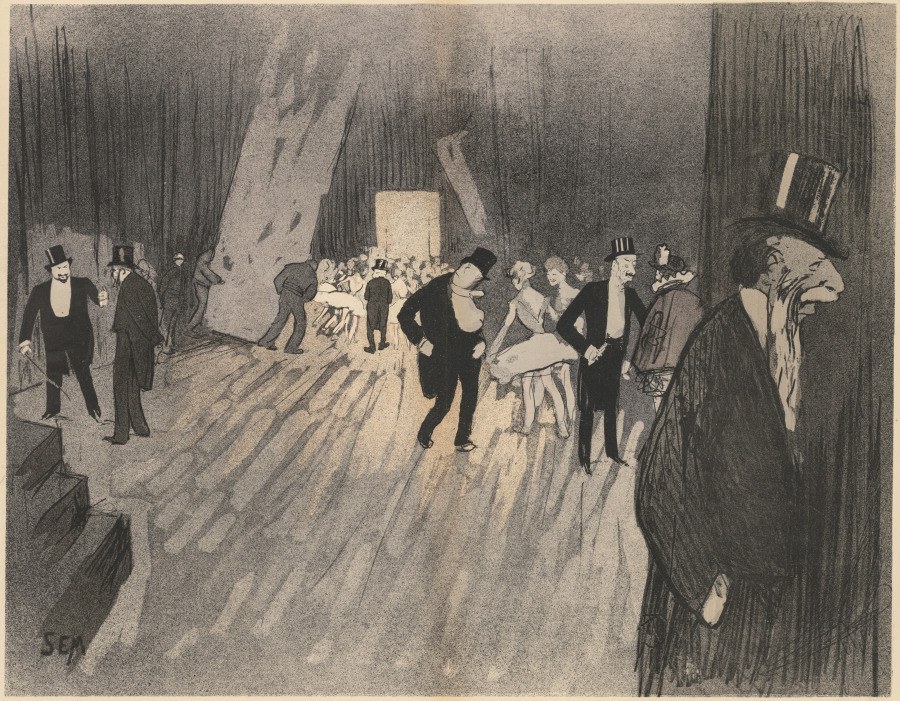
Backstage of the Ballet
Sem (Georges Gourçat) (French, 1863–1934)
- Dance:
- Ballet
- Source:
- Cleveland Museum of Art
- Rights:
- Public domain — free to use, share and adapt.
- Recorded as:
- CC0 (Public Domain)
The work is valuable as a historical document of ballet culture and the social world surrounding professional dance in its era. It reveals how ballet existed not only as technique and performance but as a social event, a gathering place for the fashionable and connected, and a theatrical spectacle in which the social scene was as significant as the dancing.
What you are looking at
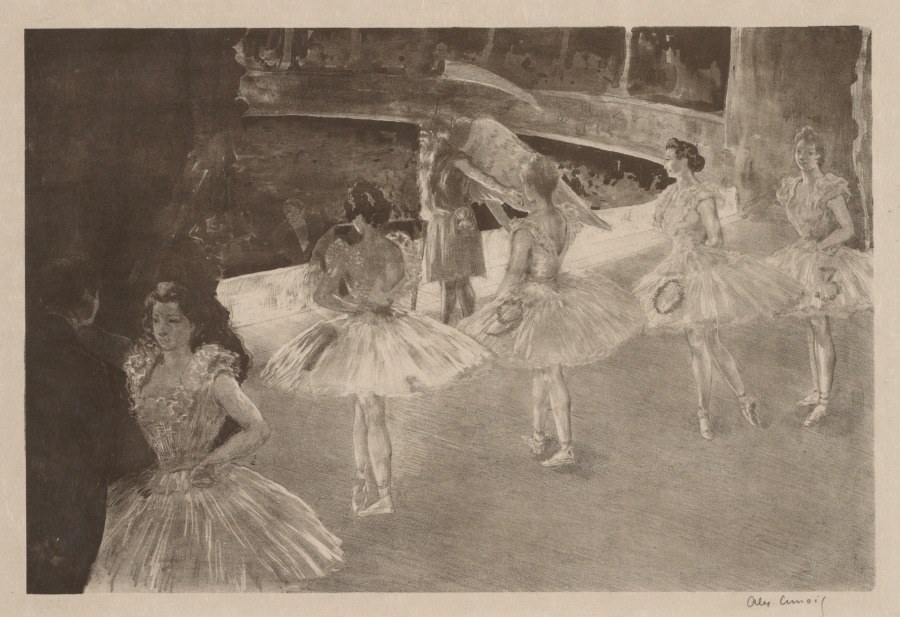
A theatrical backstage scene rendered in a stippled, grainy technique that suggests a nighttime or dimly lit setting. The perspective draws viewers deep into a narrow space bounded by heavy vertical curtains or drapes that frame both sides of the composition. A crowd of figures in formal evening dress—top hats, tailcoats, and gowns—stands in the middle distance, clustered around what appears to be a raised platform or stage element. The lighting is concentrated on this central gathering, leaving the foreground in relative shadow and the background obscured by the dark curtains. The scene captures a moment of social activity: some figures appear to be conversing or waiting, while others stand in formal postures. The overall tone is one of theatrical backstage intrigue—a moment glimpsed behind the scenes of a formal or operatic event.
The dancing
The figures are predominantly upright and stationary, dressed in formal evening wear that suggests late nineteenth or early twentieth-century conventions. Their poses are social rather than kinetic: they stand, gesture with arms, and cluster in informal groups. The nearest figures in the foreground show some movement or turning, but there is no sense of organized step-patterns or the sustained extension characteristic of trained dancers. The composition suggests witnesses, socializers, or participants in a theatrical backstage moment rather than performers executing choreography.
The dance depicted
The work is titled 'Backstage of the Ballet,' but the image does not depict active dance performance. Instead, it shows a social scene set in the theatrical world—possibly a backstage gathering, a green room moment, or a lobby during an intermission. The formal dress and the context suggest this is an audience, stagehands, or participants in ballet culture rather than dancers executing steps. The work documents the social apparatus around ballet rather than ballet technique itself.
How it was made
The work is executed in a stippled or dotted printing technique—most likely a photogravure or similar intaglio-derived process common for art reproduction in the late nineteenth and early twentieth centuries. The grainy, tonal effect creates atmosphere and depth while flattening the individual forms slightly, which is characteristic of reproductive print media of this period. This technique allowed for circulation as a gallery print or illustration, suggesting the work was intended for a broad audience interested in theatrical subjects.
About this work
This is a theatrical backstage scene from the ballet world, rendered in a monochromatic print technique that captures the social life surrounding performance rather than the performance itself. The work documents the formal social conventions and the human ecosystem of late-nineteenth or early-twentieth-century theatrical ballet—the patrons, participants, and atmosphere of high theatrical culture. It belongs in a dance art collection as a historical record of how ballet functioned as a social institution and cultural event, not as a depiction of dance technique or choreography.
How to look at it
Attend to the depth and perspective of the scene: the viewer is positioned as an observer looking into a theatrical space, much as one might peek behind the curtains of a stage. The layering of figures from foreground to background creates a sense of looking through a crowd into an intimate moment. Notice how the artist has used the heavy curtains as compositional elements that frame and contain the scene, suggesting both the theatrical setting and the social boundaries of this exclusive world. The formal dress and stationary poses of the figures emphasize that this is a moment of social rather than athletic or artistic display.
The period
This work was created in an era when ballet was a major attraction of high society and urban culture in Europe and North America. Ballet in this period was closely tied to formal social structures, aristocratic patronage, and the development of theatrical institutions. The formal evening dress visible in the scene reflects the conventions of late-nineteenth and early-twentieth-century high society, when attending the ballet was an occasion for formal presentation. The work itself—executed as a reproductive print—reflects the appetite for theatrical imagery and behind-the-scenes documentation that fascinated urban audiences of this period.
Where it lives
This work is held in the Cleveland Museum of Art's dance-related art collection. It is identified as a museum artwork without specific attribution, date, or medium recorded in the collection records, suggesting it entered the collection at an earlier period or through a donation where full documentation was not preserved.
Questions about this work
Is this actually a depiction of ballet dancing?
No. Although titled 'Backstage of the Ballet,' the work shows a social scene set in the theatrical world rather than dancers performing ballet. The figures are stationary, formally dressed, and engaged in social interaction—this is the world around ballet rather than the art form itself.
What era does this scene represent?
The formal evening wear, the style of theatrical presentation, and the printing technique all suggest this is a scene from the late nineteenth or early twentieth century, when ballet was a major attraction of high urban culture and formal social life.
What is the technique used to create this print?
The grainy, stippled appearance suggests a photogravure or related intaglio-derived printing process, common for art reproduction and theatrical imagery in this period. This technique allowed the work to be reproduced and circulated to a broad audience.
More Ballet artwork