44 works in this view — arrow keys or swipe to move between them.
Dance in Art
Le Ballet
Alexandre Lunois (French, 1863–1916)
- Dance:
- Ballet
- Source:
- Cleveland Museum of Art
- Rights:
- Public domain — free to use, share and adapt.
- Recorded as:
- CC0 (Public Domain)
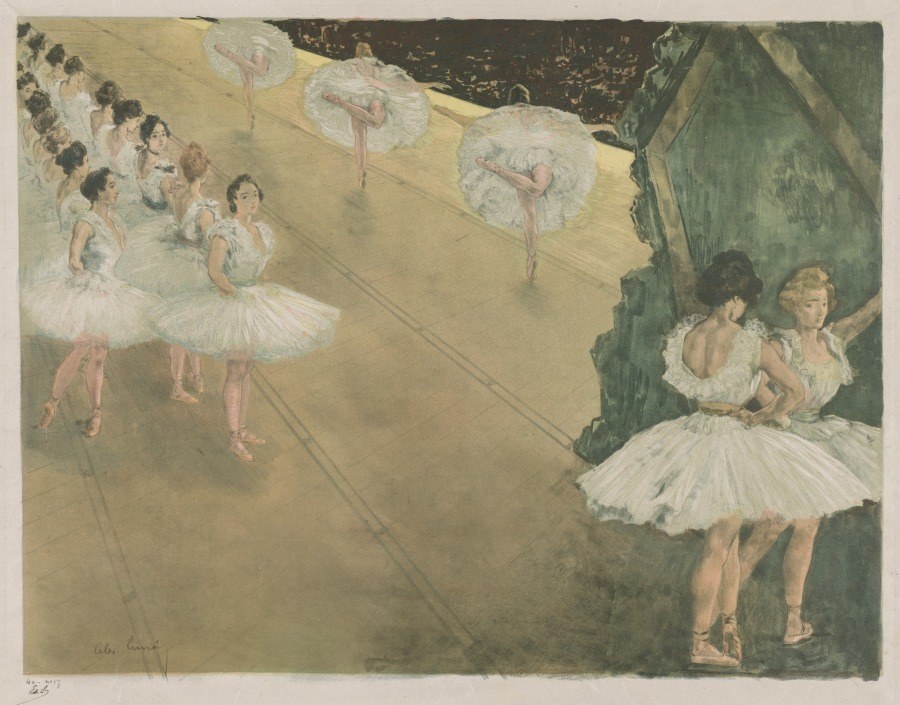
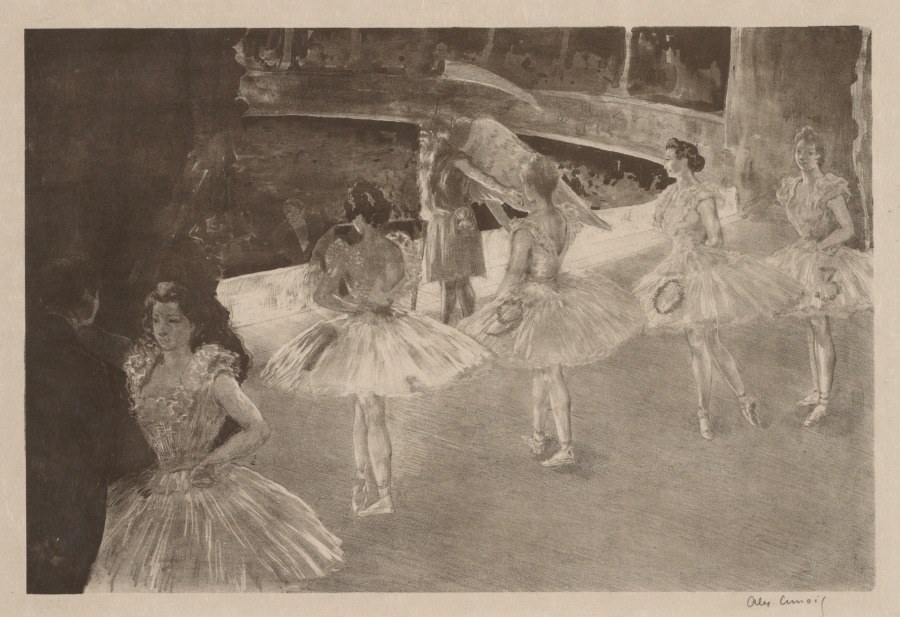
This print documents the visual language and narrative interest of classical ballet at a moment when ballet was being taken seriously as a subject for fine art. It shows us not a virtuosic peak moment but the quieter, more psychologically complex space of backstage and rehearsal—a shift in how artists were beginning to understand and represent dance.
What you are looking at
A rehearsal or performance scene in a ballet studio or theatre, viewed from a darkened wings or backstage area. In the foreground at left, a single dancer in an ornate, jewelled costume sits or reclines, watching the action. Across the stage floor, a line of dancers in classical tutus stretches into the middle distance, their bodies caught in various attitudes of movement or stillness. The lighting is uneven and atmospheric, with strong contrasts between lit and shadowed areas. The floor appears to be a stage floor, and the setting suggests the interior of a theatre or studio space with visible structural elements—perhaps scenery or rigging—visible at the top of the composition. The style and technique of the image—its soft tones, the quality of gradation, and the composition itself—suggest this is a printmaking work, possibly a lithograph or similar medium that reproduces tonal values.
The dancing
The dancers in the background are arranged in an open line across the stage, many appearing to be in a waiting or observational state rather than in active, coordinated movement. Several stand in relaxed classical posture; others seem to be adjusting their positions or looking toward the action. The foreground figure at left occupies a liminal space—neither fully in the theatrical action nor entirely outside it—and appears to be a principal dancer or observer of some narrative or rehearsal moment. The poses suggest a moment of transition or pause within a longer sequence rather than a climactic moment of unified action.
The dance depicted
This is almost certainly a scene from classical ballet, likely from the 19th century Romantic era. The tutus, the theatrical setting, and the composition—with its emphasis on a principal figure and a corps de ballet—all point to a work depicting a moment from a famous ballet or a generalised rehearsal scene. The image may depict a scene from *Swan Lake*, *The Sleeping Beauty*, *Giselle*, or a similar canonical work, or it may be a more general artistic meditation on ballet life and rehearsal. The composition suggests the artist was familiar with ballet's visual language and the hierarchical structure of classical ballet performance, with principal dancers distinguished from the ensemble.
How it was made
This is a print, likely a lithograph, executed in a tonal or crayon-lithographic technique that achieves soft gradations and atmospheric effects. The soft, somewhat hazy quality of the image and the way light is diffused across the scene suggest the printmaker worked with diluted or blended tones rather than firm linear marks. This technique allows for the subtle modeling of fabric and flesh and creates the sense of stage lighting and theatrical atmosphere. The print has circulated as a work of art for reproduction, and its refinement suggests it was intended for a cultured audience with access to fine printmaking.
About this work
This is a late 19th-century print depicting a scene from classical ballet, most likely a rehearsal or a moment from a well-known dramatic ballet. The composition frames ballet life from the perspective of the wings or backstage, emphasising the roles of principal dancer and corps de ballet and capturing a transitional moment rather than a scene of virtuosic performance. The printmaking technique allows the artist to render the atmospheric and tonal subtleties of the theatrical interior and the soft materiality of ballet costume. The work belongs to a significant tradition of artists depicting ballet as both an art form and a subject worthy of serious aesthetic attention—a tradition that includes Degas, Toulouse-Lautrec, and their contemporaries and successors. The image is valuable to dance historians both as a document of late 19th-century ballet aesthetics and as evidence of how ballet was understood and represented in the fine arts of the period.
How to look at it
Notice the artist's choice to depict a moment of waiting or transition rather than a moment of peak virtuosity. The principal figure at left creates a psychological focus; the corps de ballet in the middle distance serves both a spatial function (creating depth) and a narrative one (suggesting the hierarchies and collective structures of ballet). Attend to how the artist has used the stage setting and lighting to create atmosphere and to frame the bodies. The technique of the print itself—its soft, tonal quality—is designed to evoke the quality of stage light and the tactile softness of tulle and silk.
The period
This work dates almost certainly to the final decades of the 19th century, a period when ballet was experiencing a renaissance in Paris and Western Europe following the success of Russian Imperial Ballet tours and the revival of interest in classical forms. The 1880s and 1890s saw a flowering of artists interested in dance as a subject—notably Degas, who pioneered the representation of ballet rehearsal and backstage life. The printmaking tradition was experiencing a revival during this period, with artists using lithography and etching to reach cultured middle-class audiences. The composition and subject matter suggest the artist was working within or aware of the avant-garde artistic circles that took ballet seriously as a worthy subject for aesthetic representation.
Where it lives
The work is held in the Cleveland Museum of Art and is documented as part of their dance-related art collection. The source record indicates it came from a general collecting area (cma) with limited metadata. The print is a fine-art work intended for framed display or collection, rather than a commercial advertisement or popular illustration.
Dance in this work
Questions about this work
Is this a scene from a specific ballet, or a general image of ballet rehearsal?
We cannot identify a specific ballet from the image alone. The composition and setting suggest it could depict a famous 19th-century work, but it may equally be a more generalised artistic meditation on ballet life and the experience of rehearsal and performance.
Who made this print?
The artist is not recorded in the catalogue. The style and technique suggest a late 19th-century European artist working in the fine art tradition of printmaking, likely someone familiar with Parisian artistic circles and the tradition of depicting ballet established by artists like Degas.
What does the composition tell us about how ballet was understood at the time?
The choice to depict a quiet moment of waiting or transition rather than a peak moment of virtuosity shows that artists were interested in ballet as a complex human and theatrical experience, not merely as a display of technical skill. The emphasis on backstage life and the corps de ballet reflects emerging interest in the behind-the-scenes realities of theatre.
How can you tell this is a print rather than a drawing or painting?
The tonal qualities, the way light and shadow are achieved through parallel marks and blended crayon or lithographic stone, and the overall technical character all point to a printmaking technique, most likely lithography. The refinement of the work and its circulation history suggest it was intended as a fine art print for a cultured audience.
More Ballet artwork