41 works in this view — arrow keys or swipe to move between them.
Dance in Art
Ballet Dancers
Henri de Toulouse-Lautrec
- Dance:
- Ballet
- Source:
- Art Institute of Chicago
- Rights:
- Public domain — free to use, share and adapt.
- Recorded as:
- CC0 (Public Domain)
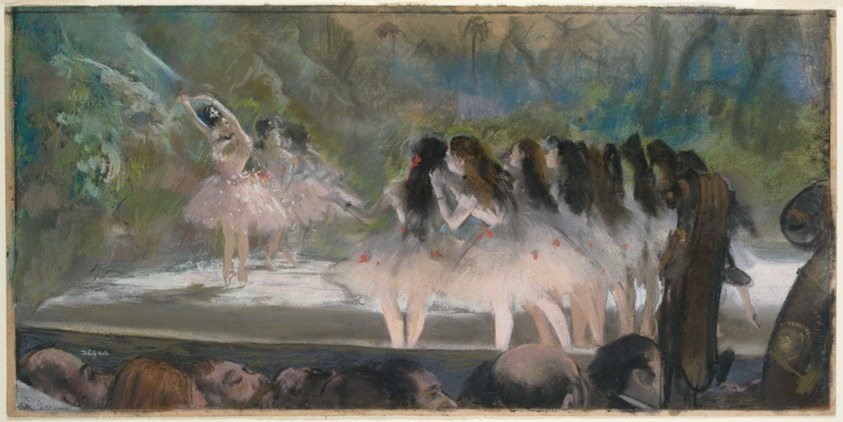
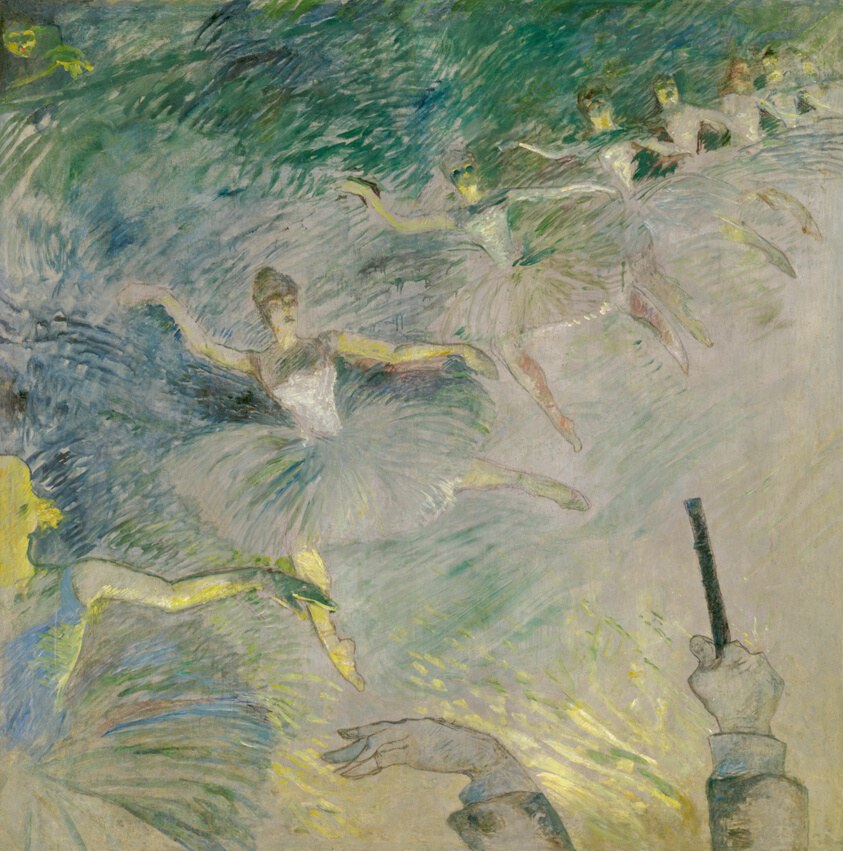
This painting documents the appearance and training of professional ballet dancers in the late 19th century, at a moment when ballet was central to cultural life in Paris. It demonstrates how artists of the Impressionist period valued dance as a subject worthy of serious aesthetic treatment, elevating what might be considered a momentary observation into a formal painting.
What you are looking at
A crowded scene of ballet dancers in white tutus and pointe shoes, arranged across the composition in overlapping groups that suggest depth and movement. The figures occupy most of the canvas, their pale costumes and flesh tones standing out against a background rendered in soft greens, blues, and muted earth tones. The brushwork is loose and impressionistic, with visible directional strokes that convey motion and atmospheric effect. Some dancers face forward; others are seen from the side or back, their bodies caught in various attitudes of preparation, turning, or stillness. A figure at the lower right holds what appears to be a conductor's baton or similar implement, gesturing toward the assembled dancers. The lighting is soft and diffuse, suggesting a rehearsal space or stage interior lit by natural or gas light. The overall effect is one of fluid movement and elegant repose captured in a moment of choreographic coordination.
The dancing
The dancers are distributed across the composition in a composition that suggests the looking down at a stage or rehearsal floor from above. Most wear classical ballet tutus and pointe shoes, depicted with particular attention to the vertical alignment of the torso and extended limbs typical of academic ballet training. Several figures show the characteristic turned-out legs and lifted carriage of trained dancers. The arms are variously raised, lowered, or extended in what appear to be balletic positions—some held aloft, others placed at the waist or sides. The poses suggest a range of movement from active turning and extension to moments of repose or waiting. One figure in the foreground gestures with raised arm; others are clustered in loose groups or individual poses. The overall effect is of dancers at different points in an exercise, phrase, or performance.
The dance depicted
This appears to be a scene of classical ballet, most likely a rehearsal or performance involving multiple dancers in the late 19th century, when such large ensemble scenes were common in full-length ballets. The white tutu costumes, pointe shoes, and academic positions are consistent with Romantic or Classical ballet of the era. The presence of what may be a rehearsal master or conductor at the lower right suggests this depicts a structured ballet class or a staged ensemble moment. Without additional documentation, it is not possible to identify a specific ballet, but the composition and costume are consistent with the corps de ballet scenes that were central to major theatrical productions of the period.
How it was made
This work is executed in oil paint with a loose, brushy Impressionist technique. The artist has used directional brushstrokes to suggest movement and atmosphere rather than rendering precise detail. The color palette emphasizes soft, cool tones—greens, blues, and grays—which recede behind the warmer flesh and white tones of the figures. The technique allows for atmospheric effects and suggests the fleeting quality of movement and light. This approach is characteristic of late 19th-century Impressionist painting, particularly that focused on modern subjects like theatre, dance, and leisure.
About this work
This is an Impressionist painting depicting a large ensemble of ballet dancers in classical costume, arranged in a composition that suggests viewing the stage from above or from the wings. The work captures a moment in a rehearsal or performance, showing dancers in various attitudes and stages of movement across a loosely defined interior space. The painting demonstrates a keen interest in the ephemeral effects of light on movement and fabric, rendered through vigorous brushwork and a restricted color palette.
The work exemplifies the Impressionist fascination with modern urban leisure and theatrical subjects. Like many artists of the period, the painter found in the ballet an ideal subject for exploring light, movement, and composition. The ensemble scene allows for a complex arrangement of figures at different scales and in different poses, creating a dynamic and rhythmic composition that mirrors the choreography being depicted.
How to look at it
Observe the variety of poses and positions across the canvas—some dancers are actively moving or turning, while others are waiting or standing. Notice how the artist has used overlapping figures to suggest depth and crowding, and how the white tutus create a visual rhythm across the composition. Look at the brushwork: it is deliberately loose and gestural, emphasizing the effect of light and motion over precise anatomical detail. The soft color palette and the way the figures emerge from the background create an atmospheric effect that suggests the dusty air and fleeting quality of a rehearsal or performance space.
The period
This work dates to the late 19th century, a period of intense artistic interest in the opera, ballet, and theatrical subjects. Ballet was a dominant form of entertainment in Paris and other major European cities, and the Opéra Garnier had recently opened (1875), making ballet more visible and accessible to artists. Impressionist and Post-Impressionist painters, including Edgar Degas, were particularly drawn to ballet as a subject because it allowed them to explore light, movement, composition, and the contrast between the artificiality of trained performance and the naturalism of the body in motion. The subject also represented modern leisure and urban culture, key concerns of Impressionism.
During this period, ballet was undergoing significant change. Romantic ballet had begun to give way to more classical forms influenced by Russian training and technique. The ensemble scenes visible in paintings like this one reflect the spectacle and choreographic complexity that characterized late 19th-century French ballet.
Where it lives
This work is held by the Art Institute of Chicago, one of the major American museums with significant holdings of Impressionist art. The attribution and dating remain uncertain, indicating that the painting may have entered the collection with incomplete documentation.
Dance in this work
Questions about this work
How do I know this is ballet and not another form of dance?
The white tutus, pointe shoes, and the turned-out legs and lifted carriage of the figures are all specific to classical ballet. These elements were highly codified and distinctive. The formal ensemble and the apparent rehearsal structure also indicate a professional ballet company.
Could this be from a specific famous ballet?
The large ensemble scene with tutus was common to many major ballets of the era, particularly full-length works like Swan Lake, The Sleeping Beauty, and others. Without additional documentation or markings on the work, it is not possible to identify a specific ballet.
Why is the brushwork so loose and impressionistic?
The loose brushwork is deliberate and reflects Impressionist painting technique, which emphasized the effect of light and momentary perception over precise detail. For a subject like ballet, with its emphasis on movement and ephemeral effects, this technique was particularly suited to capturing the fleeting quality of performance.
What does the figure with the baton at the lower right represent?
This is likely the ballet master or conductor, who would lead rehearsals and performances. The presence of this figure indicates that this is a rehearsal scene or a formalized performance moment, not an improvised gathering.
More Ballet artwork