48 works in this view — arrow keys or swipe to move between them.
Dance in Art
Avant Le Ballet
Charles Paul Renouard (French, 1845–1924)
- Dance:
- Ballet
- Source:
- Cleveland Museum of Art
- Rights:
- Public domain — free to use, share and adapt.
- Recorded as:
- CC0 (Public Domain)
This image documents the privatization and feminization of ballet training among the bourgeoisie in the late nineteenth century—a crucial but understudied aspect of ballet's social history. Renouard's work as a society illustrator gives us direct visual evidence of how ballet was consumed and performed in non-theatrical contexts, which shaped the art form's aesthetics and accessibility during this period.
What you are looking at
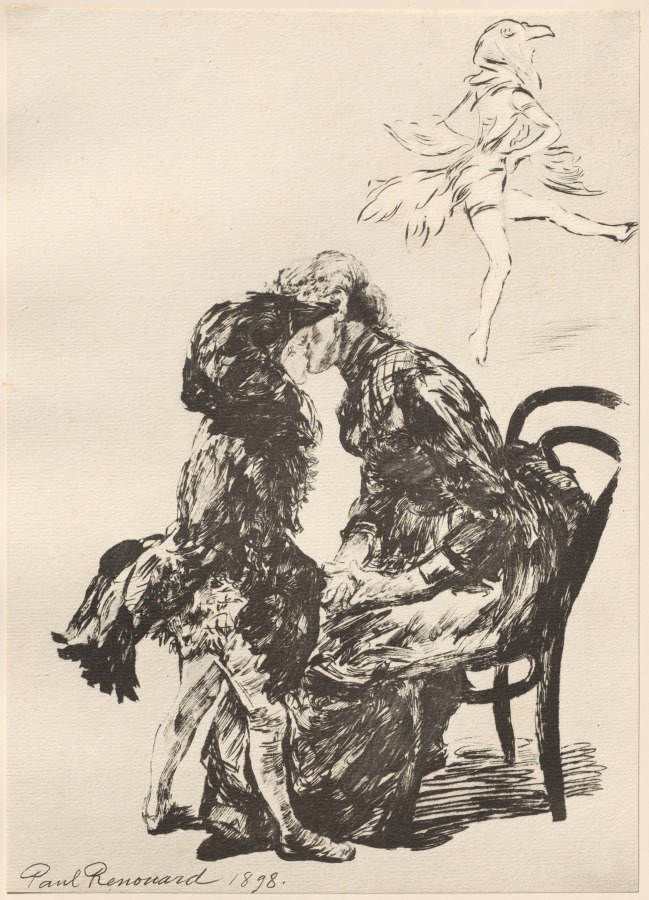
A figure in elaborate dark clothing sits on a chair, viewed from behind, holding two small dogs or similar animals aloft in a playful gesture. The seated figure wears richly textured garments with visible brushwork suggesting movement and volume. Above and to the right, a lightly sketched figure in a tutu or ballet skirt is shown in a dynamic pose, one leg extended upward, arms raised. The composition is sparse and unfinished in places, with the upper figure rendered in quick pen lines while the seated figure receives more detailed attention. The interaction between the two figures—one earthbound and substantial, one ethereal and elevated—suggests a narrative of instruction, admiration, or theatrical performance. The drawing is signed "Paul Renouard 1878" in the lower left.
The dancing
The seated figure leans forward with arms extended upward in an animated gesture, the weight settled into the chair. The standing or posed figure above shows classical ballet alignment: torso upright, one leg lifted high in extension, arms in a graceful frame suggesting the épaulement characteristic of ballet training. The contrast in rendering—the lower figure heavily worked and three-dimensional, the upper figure sketched lightly and almost ethereal—suggests a hierarchy of substance and aspiration. The dogs serve as a playful intermediary element, their small forms linking the two figures across the composition.
The dance depicted
This appears to document a moment from late nineteenth-century ballet pedagogy or rehearsal. The lightly sketched figure performing the extension is almost certainly a ballet student or dancer, shown executing a développé or similar vocabulary of classical technique. The seated figure, given the date (1878) and Renouard's practice as a society illustrator, may represent an instructor, ballet master, or patron—possibly a woman of wealth watching or participating in a teaching moment. The inclusion of the dogs suggests this occurs in a private or domestic setting rather than a theatrical stage, consistent with the phenomenon of wealthy amateurs training in ballet during the Gilded Age.
How it was made
This is a pen and ink drawing, likely etched or engraved, with varying densities of line work. The signature and date are rendered in the same medium. Renouard's technique shows economy of line in the upper figure—the dancer is defined by essential strokes suggesting form and movement—while the lower figure receives more ornamental attention to texture and fabric. This differential finish is typical of nineteenth-century society illustration and suggests the work was either a study for a larger composition or a finished sketch intended for reproduction in a periodical. The medium's suitability for rapid notation made it ideal for capturing a fleeting social moment.
About this work
This 1878 drawing by Paul Renouard captures a private ballet lesson or rehearsal moment, showing a student or dancer in classical pose beneath a seated patron or instructor. Renouard was a prolific illustrator of Parisian society, and this work belongs to his substantial output documenting the lives and leisure pursuits of the wealthy during the Third Republic. The drawing preserves evidence of how ballet training occurred in domestic and semi-private spaces in late nineteenth-century France, not confined to the official institutions of the Opéra. The dated signature and skillful rendering suggest this was made from life or memory as a finished work, not merely a preparatory study.
The title "Avant Le Ballet" (Before the Ballet) suggests the moment before a performance or formal session—a threshold moment. The playful presence of the dogs and the domestic interior setting distinguish this from theatrical or institutional representations of dance and locate ballet training within the social and erotic economy of the gilded salon.
How to look at it
Attend to the unfinished quality of the upper figure—the dancer—versus the substantial rendering of the seated figure. This compositional choice inverts the usual hierarchy: the body performing classical ballet technique is rendered almost as a dream or aspiration, while the patron or instructor who watches (or demonstrates?) is solidly present. The uplifted dogs create a visual echo of the dancer's extended leg, a witty formal parallel that suggests the amateur status or playfulness of the moment. Notice how the pen work itself performs the difference between weightlessness (the dancer) and material presence (the seated figure and her clothing).
The artist
Paul Renouard (1845–1924) was a French painter, printmaker, and illustrator celebrated for his society scenes and theatrical subjects. He contributed regularly to periodicals including Le Figaro Illustré and L'Illustration, developing a distinctive style of pen drawing suited to rapid reproduction. His subjects were drawn from Parisian elite life—salons, rehearsals, behind-the-scenes theatrical moments, and sporting events. Renouard's eye for social narrative and his technical mastery of the pen made him an invaluable documenter of cultural life under the Third Republic.
The period
In the 1870s, ballet in France occupied an uncertain position. The official ballet of the Opéra was in artistic decline, yet interest in dancing among the wealthy bourgeoisie was growing. Private lessons from retired dancers or ballet masters became fashionable accessories to a woman's education. Simultaneously, the rise of mass-circulation illustrated periodicals created new demand for social illustration—a form Renouard perfected. His treatment of ballet mirrors broader cultural shifts: the shift from theatrical spectacle to intimate social performance, and the codification of ballet vocabulary as a marker of cultivation and leisure.
Where it lives
The work is held by the Cleveland Museum of Art and is identified as part of the museum's dance-related art collection. The signature and date are integral to the image.
Dance in this work
Questions about this work
Who is the seated figure holding the dogs?
The catalogue record does not identify her. Given Renouard's practice of illustrating Parisian society and the title 'Avant Le Ballet,' she may be a patron, an instructor, or an amateur dancer. The elegant dress and the domestic setting suggest wealth and leisure. Without additional documentation, her identity remains open to interpretation.
Is this a finished work or a study?
The signature and date suggest it was considered a finished drawing by Renouard. The variation in finish—detailed lower figure, sketched upper figure—reflects his illustrative style rather than incompleteness. Such drawings were reproduced in periodicals and appreciated as independent works.
What is the title 'Avant Le Ballet' telling us?
'Before the Ballet' likely indicates a private rehearsal or lesson rather than a public performance. It positions the viewer as an intimate observer of preparation, instruction, or amateurish performance in a domestic space—a world the periodicals Renouard worked for were intensely interested in documenting.
Why are the two figures rendered so differently?
The heavier rendering of the seated figure gives her weight, authority, and presence, while the lighter sketching of the dancer creates an effect of elevation and idealization. This formal contrast may reflect the artist's interest in the relationship between the watcher and the watched, or between material reality and aspiration.
More Ballet artwork