42 works in this view — arrow keys or swipe to move between them.
Dance in Art
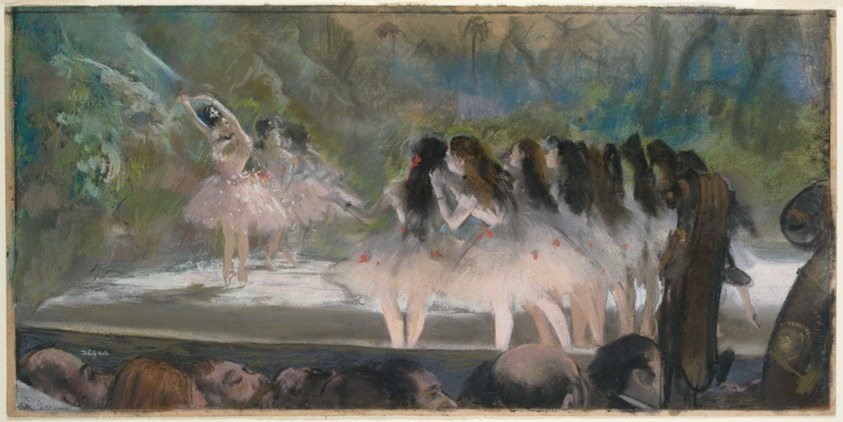
Ballet at the Paris Opéra
Hilaire Germain Edgar Degas
- Dance:
- Ballet
- Source:
- Art Institute of Chicago
- Rights:
- Public domain — free to use, share and adapt.
- Recorded as:
- CC0 (Public Domain)
This work provides visual evidence of how Romantic ballet was staged, lit, costumed, and experienced as a collective theatrical phenomenon. It documents the aesthetic and technical ideals of the corps de ballet—precision, uniformity, subordination to ensemble effect—which remain central to classical ballet training. For historians and dancers, it offers both a snapshot of period practice and a window into the artistic values that shaped the ballet canon we inherit.
What you are looking at
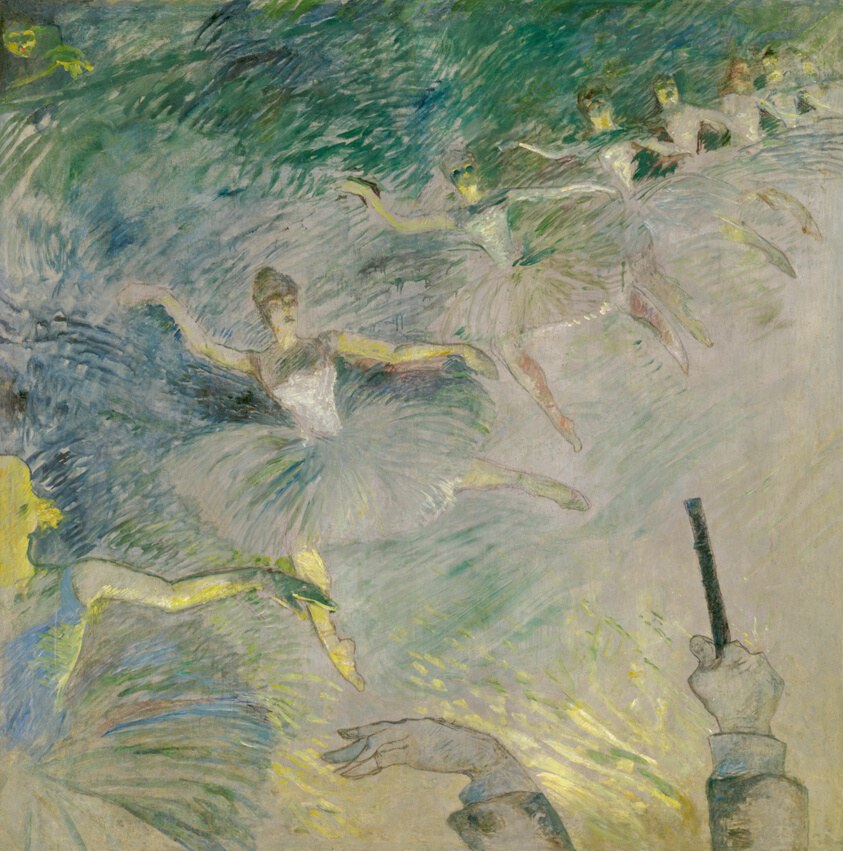
A theatrical ballet scene set in a moonlit forest or grotto. In the foreground, a single ballerina in a pale, translucent tutu stands on the stage floor, her posture upright and composed. Behind her stretches a line of corps de ballet dancers, also in tutus, receding into shadow. The setting is rendered in soft greens, blues, and greys, with tall trees or rock formations rising in the background. The lighting is theatrical and atmospheric—a bright, cool illumination falls on the stage floor where the dancers perform, while the surrounding landscape fades into dusky mystery. Spectators are visible in the foreground in silhouette, their heads and shoulders dark against the stage light, watching from what appears to be the orchestra pit or front rows. The composition captures a moment of stillness or preparation—the dancers are neither in violent motion nor at rest, but suspended in a formal arrangement typical of classical ballet corps work.
The dancing
The principal dancer stands in an upright, composed frame with arms positioned formally—likely a position of repose or the preparation for movement. Her weight is evenly distributed, suggesting a moment of classical stability. The corps dancers behind her form a uniform, rectangular formation, their bodies aligned and their postures mirrored, indicating synchronized, disciplined movement. No violent or dramatic gestures are evident; instead, the dancers embody the formal, geometric precision that defines classical ballet technique. The extreme recession of the corps into shadow emphasizes the principal dancer's isolation and importance while reinforcing the ordered, linear aesthetic of ensemble work.
The dance depicted
This is a classical ballet scene, almost certainly from the Romantic era of the mid-19th century. The presence of a single principal dancer framed by a corps de ballet in formation, combined with the ethereal tutu and the supernatural, woodland setting, places this firmly within the Romantic ballet tradition. The theatrical emphasis on moonlight, mystery, and the solitary female dancer—likely a sylph, naiad, or spirit—is characteristic of ballets such as *La Sylphide* (1832) or *Giselle* (1841). The orderly, symmetrical formation of the corps, their pale costumes, and their role as an ensemble backing the principal dancer all support identification as Romantic ballet, a style in which such scenes of supernatural encounters or magical forests were commonplace. The specific narrative moment cannot be determined from the image alone, but the visual language is unmistakably that of mid-19th-century French or Danish classical ballet.
How it was made
The work is executed in what appears to be watercolor, gouache, or possibly a mixed medium combining wash and opaque pigment. The technique allows for luminous, atmospheric effects—the soft glow of the stage light and the ethereal quality of the dancers' costumes are rendered through delicate layering and blending of pale tones. The translucency of the background and the precision of the foreground suggest a hand skilled in both intimate detail and broad compositional effect. The medium and style indicate this was likely a preparatory study, a theatrical design, or an illustration intended for a collector of ballet imagery—not a large-scale oil painting, but a more intimate work meant to circulate in print or as part of a folio. The technical mastery of light and atmosphere suggests this was created by someone with direct knowledge of theatrical practice and ballet aesthetics.
About this work
This is a Romantic-era ballet scene depicting a principal dancer and corps de ballet in a supernatural or woodland setting, painted or drawn with atmospheric sensitivity to theatrical lighting and the formal conventions of classical ballet. The work belongs to a substantial tradition of ballet imagery produced from the 1830s onward, when Romantic ballet became not only a popular spectacle but also a subject of serious artistic attention. The image captures the aesthetic ideals of the period—ethereality, mystery, perfect formal order, and the apotheosis of the female dancer—and presents them as theatrical spectacle witnessed from the audience's perspective. It is a rare direct view into how ballet audiences of the era experienced and valued the art form, and into how visual artists attempted to translate the fleeting, ephemeral art of dance into a permanent medium.
How to look at it
Attend first to the lighting and its theatrical artificiality—notice how the bright, cool stage light isolates the dancers from the shadowy, atmospheric landscape. This lighting technique was itself an innovation of the Romantic era and fundamentally shaped how dancers moved and how audiences perceived the dance. Observe the absolute stillness and formality of the corps formation; there is no individual expression or variation, only perfect alignment. This geometric precision was not accidental but a fundamental value of the period—the corps dancer's body was understood as part of a larger visual design. Finally, consider the position of the viewer: the work shows ballet as it was meant to be seen, from the audience's vantage point, with the performers framed as an illusory world separated from reality by the stage's edge and by light itself.
The period
The mid-to-late 19th century saw ballet establish itself as a dominant form of theatrical entertainment, particularly in Paris, Milan, and Copenhagen. Following the success of *La Sylphide* (1832) and *Giselle* (1841), the Romantic aesthetic—characterized by supernatural themes, female dominance, ethereal costuming, and a visual emphasis on mystery and otherworldliness—became the dominant style. The corps de ballet, once a functional ensemble, became an essential aesthetic element: a unified body of dancers creating visual patterns, symmetry, and atmosphere around the principal dancer. This period also saw a flourishing of ballet imagery intended for educated collectors—lithographs, watercolors, and theatrical designs that circulated through Paris and Europe, making ballet visible to a wider public than could attend performances. The work of artists capturing ballet in visual media became an important complement to dance criticism and helped establish ballet as a subject worthy of serious artistic attention.
Where it lives
The work is held in the Art Institute of Chicago and is catalogued as part of their collection of theatrical and dance imagery. Its original medium, precise date, and artist remain unrecorded in the catalogue, suggesting it may have been acquired as part of a larger collection of 19th-century dance-related prints, designs, or watercolors without full individual documentation.
Dance in this work
Questions about this work
Is this from a specific ballet?
The catalogue record does not identify a particular ballet, and while the style and setting are consistent with *La Sylphide*, *Giselle*, or similar Romantic works, the image alone cannot confirm which ballet is depicted. The style and aesthetic are unmistakably Romantic ballet, but the specific narrative moment and title remain uncertain.
What are the pale dresses the dancers are wearing?
These are Romantic-era ballet tutus, typically made of multiple layers of translucent tulle or gauze. The pale, ethereal quality was essential to the aesthetic of Romantic ballet, which prized otherworldliness and an illusion of weightlessness. The costume was also practical—the layered skirt allowed for visibility of the dancer's legs and footwork while creating a fluid, cloud-like silhouette.
Why are there so many dancers in the background?
These are corps de ballet dancers, whose role was to create unified visual patterns and atmosphere around the principal dancer. In Romantic ballet, the corps often represented supernatural beings—sylphs, spirits, or otherworldly creatures—and their synchronized movement and formation emphasized the magical or otherworldly nature of the scene.
What is the technique used to create this image?
While the medium is not recorded in the catalogue, the work appears to be executed in watercolor, gouache, or a combination of wash and opaque pigment. This technique allowed the artist to achieve luminous atmospheric effects and suggest theatrical lighting in a way that would have been difficult with other media. Such works were often preparatory designs or illustrations for collectors rather than large-scale paintings.
More Ballet artwork