46 works in this view — arrow keys or swipe to move between them.
Dance in Art
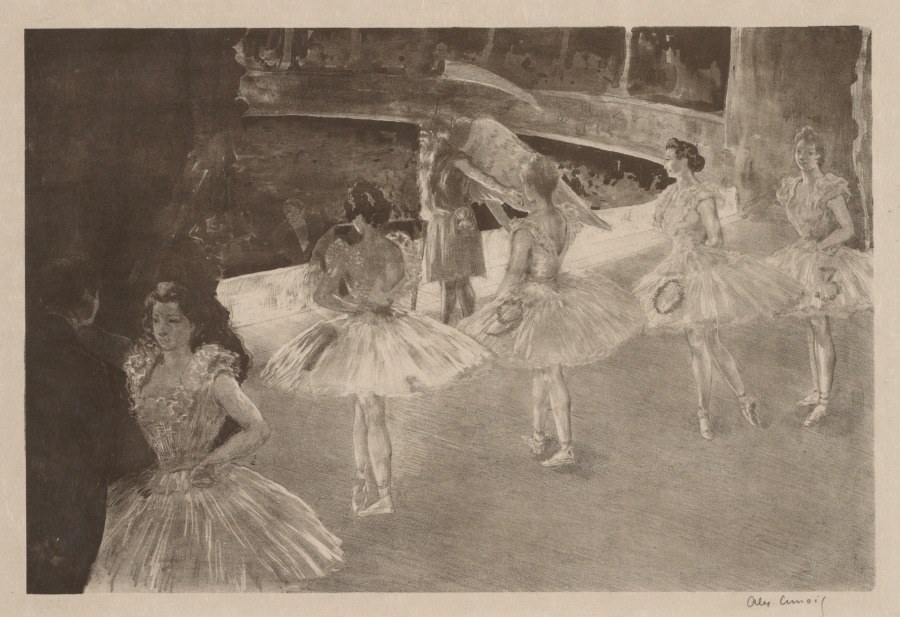
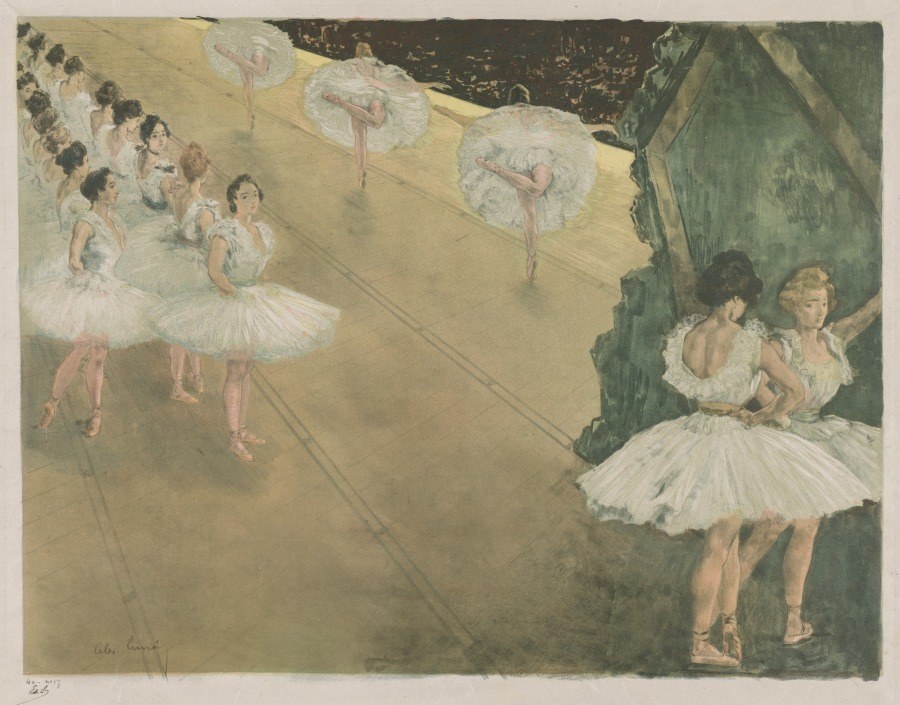
Ballet Dancers
Alexandre Lunois (French, 1863–1916)
- Dance:
- Ballet
- Source:
- Cleveland Museum of Art
- Rights:
- Public domain — free to use, share and adapt.
- Recorded as:
- CC0 (Public Domain)
This is visual evidence of how Romantic ballet looked in performance and how it was marketed and circulated to the public. The print shows the evolution of female dance technique and aesthetics between the Classical and modern periods, and captures the moment when ballet became defined by the ethereal, supernatural, and emotional rather than purely technical display. For historians, it provides concrete documentation of costume, pointe work, and the corps de ballet aesthetic that shaped dance for a century.
What you are looking at
A studio or stage interior divided between two distinct moments of the same rehearsal or performance. On the left, a corps of dancers in white tutus and pink tights stands in formation, some suspended mid-leap with arms raised in classical port de bras, while others are caught in various attitudes of preparation or rest. The space is flooded with pale golden light from above. On the right, two dancers in the foreground—one in a white tutu with bare shoulders, the other in similar dress—are turned away from the main group, their bodies angled as if consulting or stepping aside. A dark green curtain or wall rises behind them. The composition creates a temporal puzzle: these appear to be the same dancers at different moments, or a before-and-after study of the same passage. The palette is soft: cream, pale pink, white, with touches of warm gold and deep forest green.
The dancing
All the dancers wear the classical romantic tutu—short, bell-shaped skirt—with pink tights and pointe shoes. Arms are lifted in soft, rounded positions typical of early-nineteenth-century classical technique. The raised dancers show light weight and extension, with the balletic line emphasizing verticality and elongation. The two figures on the right stand in a more closed, intimate grouping, their bodies slightly forward and toward each other, suggesting either instruction or a moment of private emotional exchange. The postures show understanding of the turnout and lift essential to classical ballet.
The dance depicted
This depicts Romantic ballet, most likely a scene of corps work or ensemble rehearsal. The white tutus, pointe shoes, and ethereal quality of movement identify this as ballet from the 1830s–1860s era. The repeated figures and the light, weightless attitude of the leaping dancers suggest a scene from the Romantic repertoire, possibly depicting a famous ballet such as *La Sylphide*, *Giselle*, or *Les Sylphides*—works in which young female dancers appeared in synchronized groups in sylph-like or ghostly form. The composition itself mirrors the narrative structure of romantic ballet: the ensemble as a vision or corps de ballet, and the soloist stepping forward from the group.
How it was made
This is a color lithograph or chromolithograph, evident from the soft, layered application of color, the way hues blend and overlap without harsh edges, and the characteristic grain of the stone visible in background washes. The medium allowed the artist to achieve the luminous, atmospheric effect essential to depicting romantic ballet—the glow behind the dancers, the delicate modeling of form through color rather than line. Lithography was the dominant medium for theatrical imagery in the nineteenth century and allowed broad circulation of dance imagery to a middle-class audience.
About this work
This color print captures the essence of Romantic ballet at its height: weightless, ethereal female dancers in the tutu and pointe work that defined the style, set in a studio flooded with otherworldly light. The composition—with its doubled perspective and almost hallucinatory repetition of figures—suggests not a single moment but the dream-like quality central to romantic ballet narrative. The work documents both the visual spectacle and the technical achievement of dancers performing work that demanded extraordinary control of the body in the appearance of effortlessness.
How to look at it
Look at how the artist uses light and repetition. The glowing background and the way the dancers seem to float above the stage floor were hallmarks of romantic aesthetics. Notice the peculiar composition: why are there two groups? This may represent the fleeting, dreamlike quality of the ballet itself—a moment of vision that cannot be pinned down to a single viewpoint. Observe the precision of the pointe shoes and the carefully articulated arms: the artist understood ballet technique and used it to convey both the physical mastery and the apparent effortlessness that defined the form.
The period
This work dates to the Romantic era in ballet, approximately 1830–1870. This was the period of *La Sylphide* (1832), *Giselle* (1841), and the rise of female dancers as the central focus of ballet. The ethereal tutu replaced the longer skirt, and pointe work became essential to the vocabulary. Lithographic prints of famous ballerinas and scenes from popular ballets were a major form of theatrical promotion and fan merchandise, circulating images of dancers to audiences across Europe and America who might never see a live performance. The soft, romantic aesthetic visible here—the pale colors, the dreamy lighting, the emphasis on weightlessness—was central to how the period understood and celebrated female beauty and artistry.
Where it lives
The work is held in the Cleveland Museum of Art's collection of dance-related art. It is catalogued as a historical artwork related to theatrical performance, part of a broader effort by museums to document the visual culture of dance.
Dance in this work
Questions about this work
Why are there two groups of dancers in one image?
The composition may depict the same moment from two viewpoints, show rehearsal and performance simultaneously, or express the dreamlike, non-linear quality central to Romantic ballet narrative. Romantic-era prints often used doubled or overlapping compositions to suggest vision, memory, or the supernatural—key themes in ballets like *Giselle* and *La Sylphide*.
How do I know this is Romantic ballet and not Classical?
The tutus are shorter and fuller than in Classical ballet (which used longer skirts); the pointe shoes are clearly visible; and the overall aesthetic—the ethereal quality, the emphasis on weightlessness, the emotional rather than purely technical display—are all hallmarks of Romantic dance (1830s–1860s). Classical ballet (late 1700s–early 1800s) had more geometric, grounded movement.
Was this a common way to promote ballets?
Yes. Lithographic prints of famous dancers and ballet scenes were mass-produced and sold as merchandise, much like celebrity publicity today. They were affordable, widely circulated, and shaped how the public understood and remembered performances they might never have seen.
More Ballet artwork