49 works in this view — arrow keys or swipe to move between them.
Dance in Art · 1918
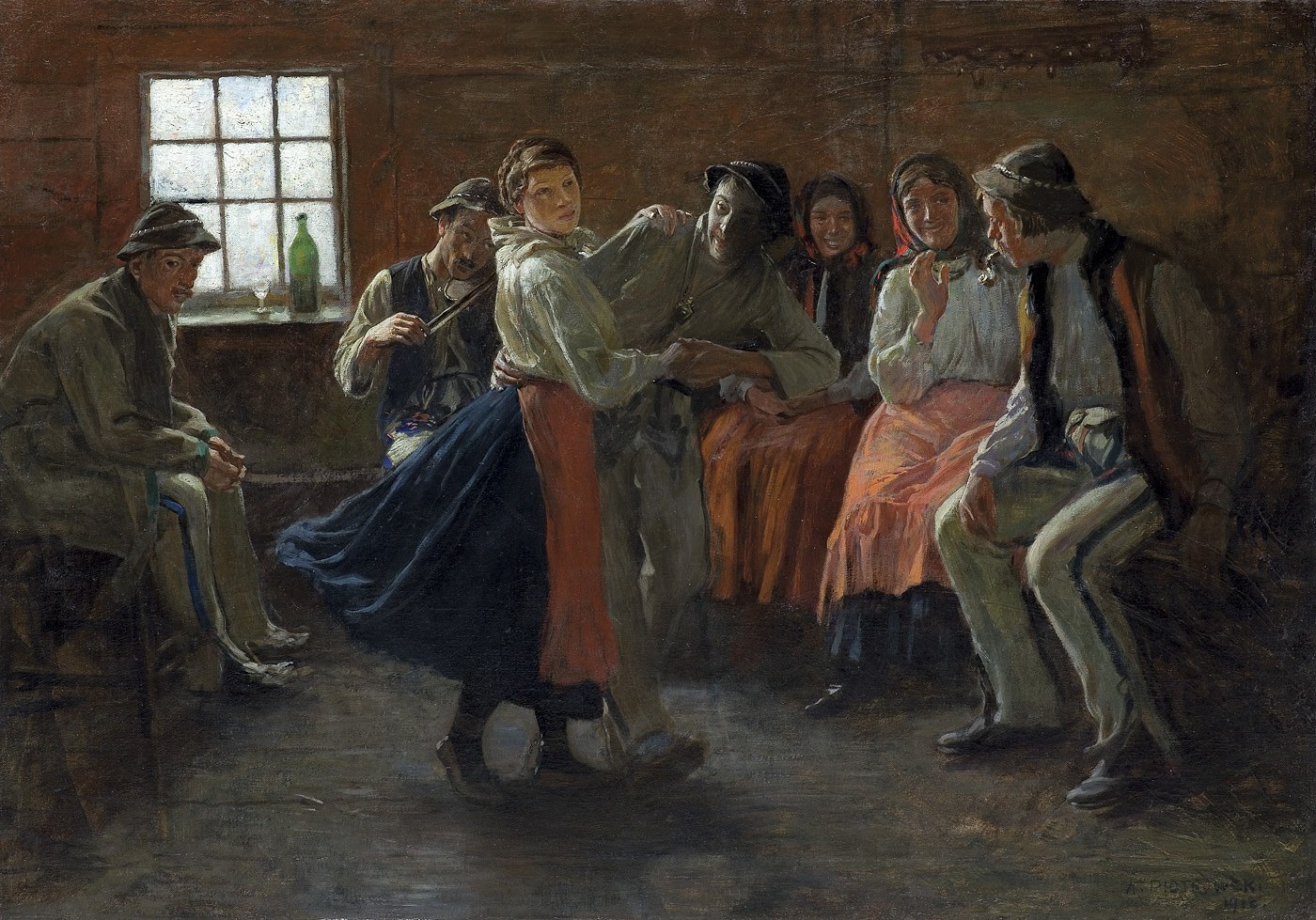
Antoni Piotrowski. Taniec góralski
Antoni Piotrowski
- Medium:
- Oil Painting
- Era:
- 1900-1920 (Ragtime/Early Jazz)
- Source:
- Wikimedia Commons
- Rights:
- Public domain — free to use, share and adapt.
- Recorded as:
- Public Domain
This painting is one of few visual documents of Góral dance from the early 20th century, preserving not just the steps but the context and atmosphere in which they were danced—the role of community gathering, the presence of live music, and the integration of dance into village life. For historians of folk dance and for the Góral people themselves, it offers evidence of how the tradition was practiced and valued at a moment of national transformation in Central Europe.
What you are looking at
A group of eight figures in a dimly lit interior space, gathered in a loose circle around a central pair of dancers. The setting appears to be a simple wooden room, warmed by earthy browns and deep shadows, with a small window admitting pale light in the upper left. The figures wear folk costume: the women in full skirts of rust, orange, and deep blue, with white blouses and headscarves; the men in vests, caps, and traditional Alpine or mountain dress. The central pair are actively dancing—a woman in a cream-colored blouse and rust skirt with arms raised, a man in green reaching toward her—while the surrounding figures watch and participate as musicians or engaged onlookers. One figure on the left holds what appears to be a musical instrument. The mood is one of intimate celebration: the light falls warmly on the faces and costumes, the bodies lean inward, and there is a palpable sense of community ritual rather than performance.
The dancing
The two central dancers occupy contrasting positions: the woman stands with weight on both feet, arms raised and extended in an open, joyful frame; the man leans toward her with arms reaching, suggesting a moment of approach or invitation within the dance. The surrounding figures are not passive observers—several stand in postures suggesting they will join or are about to join, with bodies angled toward the center. The gathered circle itself is a key formal element, typical of participatory folk dancing where spectators form an active social boundary rather than sitting at remove. Arm positions are relatively simple and vertical, without the closed holds or complex frames of ballroom dance.
The dance depicted
This is almost certainly Taniec góralski, the traditional highland dance of the Góral people of the Tatra Mountains in southern Poland and northern Slovakia. The costume, setting, and dance composition all align: the women's full skirts, headscarves, and embroidered details are characteristic of Góral dress; the simple wooden interior suggests a village hall or cottage; and the circular grouping with central dancers is the standard formation for this communal dance. The raised-arm, open-frame position of the woman and the approaching stance of the man are typical of Góral dance movement, which emphasizes vertical carriage and relatively restrained upper-body work. The inclusion of a musician and the gathered community indicate this is not a staged performance but a record of lived practice.
How it was made
Oil painting on canvas. The artist has used a warm, muted palette dominated by browns, ochres, and deep greens, with strategic placement of white and bright skirt colors to draw the eye. The loose, painterly handling and soft focus—particularly in the background figures—create atmospheric depth and suggest the candlelit or lamplight conditions of an indoor gathering. This technique, popular in early 20th-century European art, allows the artist to convey both documentary specificity (recognizable costume and gesture) and emotional immediacy (the warmth and participation of the moment). The painting circulates as documentary ethnographic art rather than as salon or commercial entertainment.
About this work
This painting documents a moment of Góral folk dance in its social context—a living tradition of the Tatra Mountain region rather than a performance for external viewers. The artist captures not only the dance itself but the community structure around it: the musicians, the watching and waiting figures who form the circle's boundary, the intergenerational or neighborly gathering that sustains the practice. In 1918, as Poland was newly independent and Eastern European national identity was being reimagined, such paintings served a dual purpose—both as ethnographic record and as assertion of cultural continuity. The work belongs in a dance archive not only because it depicts movement but because it shows how dance functions as social and cultural practice embedded in costume, music, space, and collective participation.
How to look at it
Attend first to the central pair and the moment they occupy: not a climactic leap or dramatic turn, but a moment of social encounter within the dance—the woman's openness and the man's approach. Notice how the circle of onlookers is not incidental decoration but integral to the composition: their postures and placement reinforce the idea that this dance is a communal act, not a display. The artist has chosen a moment of relative quiet and engagement rather than maximum exertion, allowing the viewer to see both the bodies and the relationships between them. The warm, soft light and the crowded interior space emphasize intimacy and participation over spectacle.
The artist
Antoni Piotrowski (1853–1924) was a Polish painter associated with Kraków and the broader European Romantic and realist traditions. He is known for scenes of Polish and regional folk life, painted with ethnographic interest but also with an eye toward the emotional and social dimensions of rural communities. His work reflects the broader 19th- and early 20th-century European interest in national folk traditions as sources of cultural authenticity and identity, particularly acute in Central and Eastern Europe during the period of partitions and the emergence of independent nation-states.
The period
In 1918, Poland had just regained independence after 123 years of partition. Across Central Europe, folk traditions were being collected, preserved, and celebrated as expressions of national character and continuity. Piotrowski's work sits within this context of cultural nationalism—the idea that folk dance, costume, and music embodied the true spirit of a people and deserved documentation and preservation. Simultaneously, modernist movements were beginning to critique or reimagine folk traditions; yet documentary and ethnographic art remained a respected mode of engaging with regional cultures. The Góral highlands, with their distinct language, costume, and music, were of particular interest to Polish cultural nationalists and artists seeking to define Polish identity after independence.
Where it lives
The work is documented through Wikimedia Commons, a digital repository of out-of-copyright and public-domain artworks. Its current holding institution is not recorded in the catalogue entry, but the digital availability suggests it is held in a public or institutional collection, likely in Poland.
Dance in this work
Questions about this work
What is Taniec góralski?
Taniec góralski is the traditional folk dance of the Góral people, who inhabit the Tatra Mountains of southern Poland and northern Slovakia. It is characterized by circular or line formations, relatively restrained upper-body movement, and rhythmic footwork often accompanied by live fiddle or bagpipe music. The dance is deeply tied to Góral identity and has been performed continuously in village celebrations, weddings, and community gatherings for centuries.
Why do the figures in the painting wear headscarves?
Headscarves and head coverings were standard elements of Góral women's dress, worn as everyday and festive costume. They signified social status, marital status, and regional identity. In Góral culture, a woman's headscarf was as important as her embroidered skirt or vest as a marker of cultural belonging and personal identity.
Is this a performance or a social dance?
The painting depicts a social dance—a communal gathering in what appears to be a private or village space, not a staged theatrical performance. The presence of musicians, the informal circle of onlookers, and the intimate scale of the scene all suggest a living social practice rather than entertainment produced for an external audience.
What is the significance of the year 1918?
1918 marks Poland's independence after 123 years of partition. In this context, paintings documenting Polish and regional folk traditions took on added cultural and political meaning as assertions of national identity and continuity. Piotrowski's work can be read as part of a broader cultural project of preservation and celebration of folk traditions in the newly independent state.
More dance artwork