49 works in this view — arrow keys or swipe to move between them.
Dance in Art · 1850
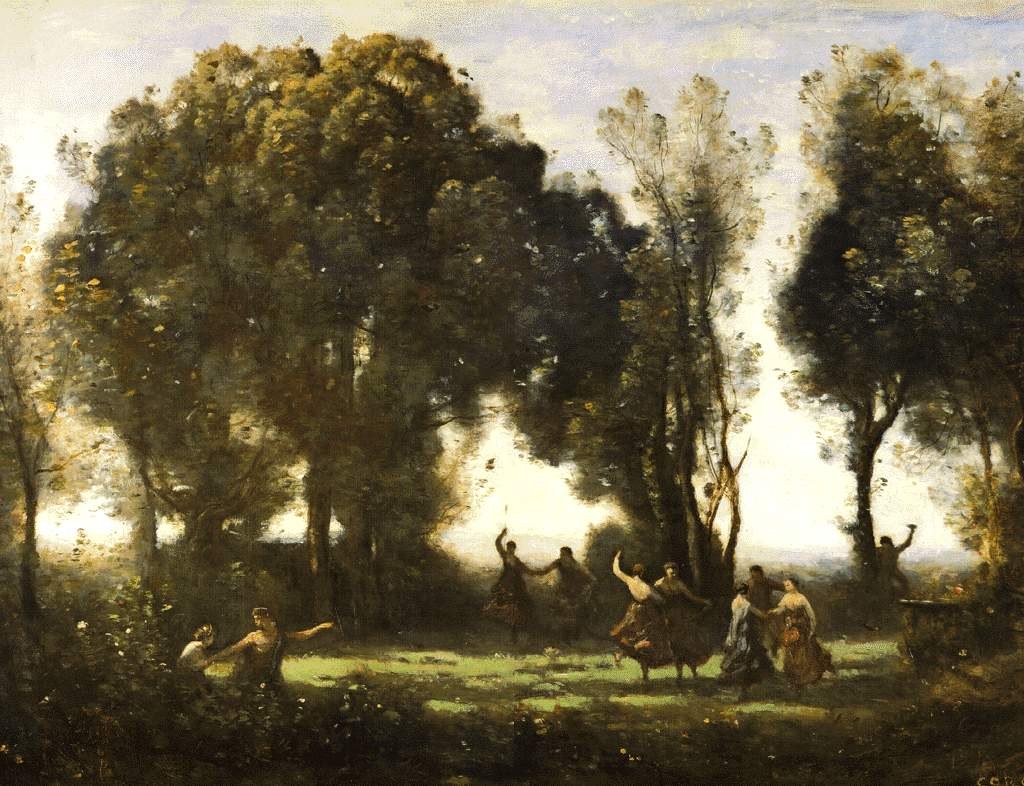
Camille Corot Dança das Ninfas
Jean-Baptiste Camille Corot
- Medium:
- Oil Painting
- Era:
- Mid 1800s (Polka Era)
- Source:
- Wikimedia Commons
- Rights:
- Public domain — free to use, share and adapt.
- Recorded as:
- Public Domain
This painting demonstrates how 19th-century artists drew on dance and the moving body to express Romantic ideals of nature, freedom, and classical antiquity—themes that shaped how dance was understood and represented in visual culture. It shows that 'dance imagery' includes not only representations of actual social or theatrical forms, but also imagined, mythological, and allegorical uses of the moving figure.
What you are looking at
A wooded glade opens in the middle distance, flooded with golden light that breaks through the dense canopy of tall trees framing both sides of the composition. The trees—rendered in dark olive and ochre tones with luminous highlights suggesting sunlit foliage—create a cathedral-like space. Within this clearing, a group of figures in classical drapery engages in rhythmic movement. The figures are scattered across the grassy ground in attitudes of dance: some with arms raised, others in profile with bodies in motion. The palette is warm and atmospheric, dominated by greens, browns, and cream, with the light creating a hazy, dreamlike quality typical of Corot's Romantic landscape style. The scene has the quality of a vision or reverie rather than a document—figures emerge from shadow and merge back into it.
The dancing
The dancers wear classical or neo-classical drapery—loose robes and tunics—rather than contemporary dress. Bodies are depicted in varied attitudes: some figures have arms lifted or extended in arcs suggesting flowing movement, others stand in contrapposto or seem caught mid-stride. The group lacks the formal geometric arrangement of a quadrille or ballroom formation; instead, bodies are distributed informally across the space, creating a sense of spontaneous, lyrical motion. The scale of individual figures is small relative to the landscape, emphasizing atmosphere over anatomical precision. Limbs are suggested rather than defined, consistent with Corot's technique of building form through light and shadow rather than line.
The dance depicted
This represents a Romantic-era interpretation of a classical or mythological dance scene—'Dança das Ninfas' (Dance of the Nymphs) in the title confirms this. The work depicts not any codified social or theatrical dance of the 1850s, but an imagined ancient or mythological festivity. The loose, flowing drapery and the informal grouping suggest a free, uninhibited movement rather than the structured forms of 19th-century ballroom or ballet. Corot's interpretation places emphasis on the mood and setting—the communion between dancing figures and nature—rather than on the technical execution or style of the dance itself. This is dance as poetry and atmosphere, a Romantic vision of antiquity.
How it was made
Oil on canvas, rendered in Corot's characteristic technique: a luminous, atmospheric style built through layers of translucent color and careful modulation of light. The painting demonstrates his mastery of creating atmospheric perspective and a sense of depth through the interplay of warm and cool tones. The figures are not sharply delineated but emerge from the overall tonal structure of the composition, which privileges the effect of light filtering through foliage over narrative clarity. This technique—painting light as much as form—was central to Corot's influence on later Impressionism and his appeal to 19th-century collectors seeking Romantic landscape mood.
About this work
Jean-Baptiste Camille Corot's 'Dança das Ninfas' (c. 1850) is a Romantic landscape that frames dancing figures within a luminous, wooded setting. The painting exemplifies the 19th-century Romantic fascination with classical mythology and the idealization of nature as a space for graceful, uninhibited movement. Rather than depicting a specific historical dance form or a scene of contemporary social dancing, Corot creates an imagined, timeless vision—a reverie on the theme of nymphs dancing in a sacred grove.
The work sits at the intersection of history painting (with its classical subject matter) and landscape painting (where the forest itself is as much the subject as the figures). For dance history, it represents how 19th-century visual culture used the figure of the dancing nymph or classical maiden as an emblem of natural grace, freedom from social constraint, and the Romantic ideal of beauty unmediated by civilization. It is not a document of dance technique or practice, but rather a reflection of how dance was imagined and valued in Romantic aesthetics.
How to look at it
Attend first to the architecture of light: the way the brightest area of the canvas is the clearing in the middle distance, drawing the eye inward and creating a sense of discovery. The dancers are revealed gradually as your eye adjusts to the luminosity and shadow—they are not the obvious focal point but emerge from careful study. Notice how the artist has avoided sharp outlines and instead suggested the movement of bodies through posture and the flow of drapery. The composition is deliberately informal and asymmetrical, creating the impression of a spontaneous scene rather than a staged spectacle. Look at how the forest itself participates in the dance—the vertical rhythm of the trees echoes and frames the upright or reaching postures of the figures.
The artist
Jean-Baptiste Camille Corot (1796–1875) was a dominant figure in 19th-century French landscape painting. He trained in the classical tradition, traveled to Italy, and developed a distinctive style that combined classical composition with direct observation of light and atmosphere. His work bridged Neoclassicism and Romanticism, and later influenced the Impressionists. Corot was celebrated during his lifetime for his ability to capture the poetic mood of landscape, often by introducing mythological or classical figures into natural settings. His forests and glades populated by nymphs, bacchantes, and classical maidens became iconic images of the period, reproduced widely and deeply influential on how European culture imagined the classical past.
The period
In the mid-19th century, European art and culture were suffused with classical mythology and a Romantic longing for an idealized, pre-industrial past. Dance in this period was divided between the rigid forms of academic ballet (which was becoming increasingly technical and removed from nature) and the imagined freedom of classical and oriental movement. The 1850s saw the height of Romantic ballet's interest in the figure of the sylph or nymph—ethereal, weightless, moving in harmony with nature rather than against it. Corot's painting participates in this visual fantasy: it offers the classical body as an alternative to the constraints of contemporary social dancing. At the same time, landscape painting was becoming the dominant genre in European art, and the inclusion of figures within landscape—especially figures engaged in graceful or leisurely activity—was a means of expressing harmony between human life and nature.
Where it lives
The work is catalogued as an oil painting by Corot dated 1850, sourced from Wikimedia Commons. No holding institution is recorded in the catalogue. Corot produced many versions and variations of the nymph-in-the-forest theme, and such works were highly sought by collectors and frequently copied or engraved.
Questions about this work
Is this a ballet scene?
No. Although the painting was titled to invoke classical dance ('Dança das Ninfas'), it does not depict ballet or any codified dance form. The figures wear loose classical drapery and move informally across a landscape, not on a stage. This is an imagined or allegorical dance—a Romantic vision of how ancient nymphs or maidens might move in nature—rather than a representation of a choreographed work or a recognizable social or theatrical dance of the period.
Why are the figures so small and hard to see?
Corot deliberately subordinated the human figures to the landscape and especially to the effect of light. The obscurity and small scale create a dreamlike, atmospheric quality that was central to Romantic aesthetics. The painting asks you to feel the mood of the scene—the sense of a sacred or enchanted grove—rather than to study the dancers' technique or expressions. This technique was revolutionary for its time and deeply influential.
What is the historical context for paintings of dancing nymphs?
The theme of nymphs dancing in forests was a classical subject revived throughout European art. In the 19th century, it became a vehicle for expressing Romantic ideals: the freedom of nature, the beauty of the human body in motion, and a longing for an idealized classical past. These paintings often implicitly contrasted the constraint and artificiality of contemporary social life (and contemporary ballet) with an imagined natural grace.
More dance artwork