49 works in this view — arrow keys or swipe to move between them.
Dance in Art · 1852
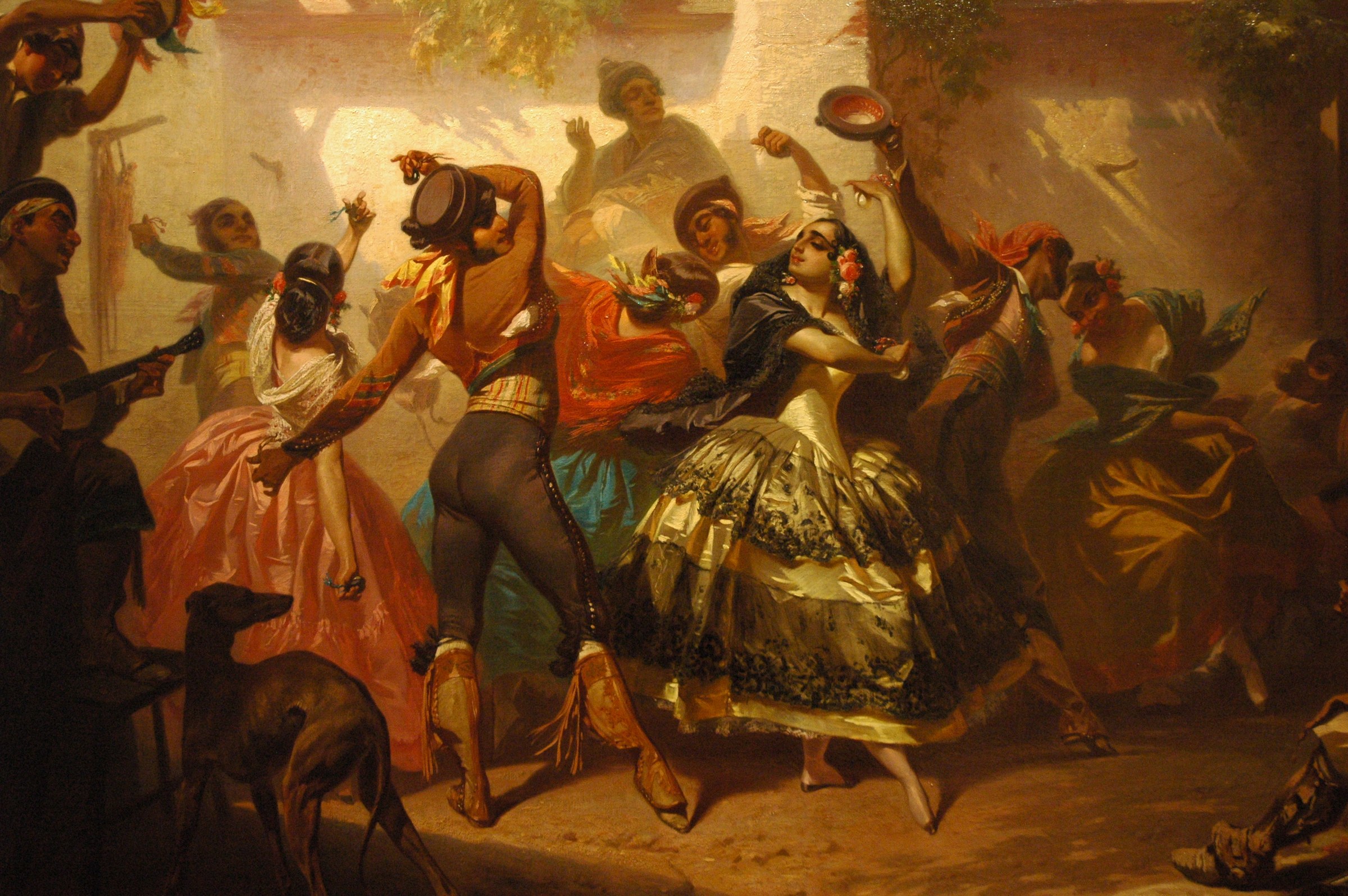
Danse dans une posada d'Eugène Giraud
Eugène Giraud
- Medium:
- Oil Painting
- Era:
- Mid 1800s (Polka Era)
- Source:
- Wikimedia Commons
- Rights:
- Public domain — free to use, share and adapt.
- Recorded as:
- Public Domain
This painting is one of the few detailed visual records of Spanish folk dancing in the 1850s, showing how dancing was actually performed in non-elite settings—without mirrors, without strict technique, in the presence of participation rather than passive spectatorship. For dancers and historians, it documents the physical vocabulary and social structure of a regional tradition that shaped later developments in flamenco, Spanish dance, and Latin American forms.
What you are looking at
A convivial indoor dance scene set in what appears to be a Spanish inn or tavern, lit by warm golden light that floods the composition and casts deep shadows. In the foreground, a woman in a vibrant orange-red dress with white undergarments dances with animated energy, her body twisted in an expressive pose, hat held aloft. Beside her, a second woman in a gold brocaded skirt with dark bodice gestures equally vibrantly. Male figures in period dress—some in orange jackets, others in darker coats—surround them, clapping, watching, and participating in the revelry. The setting is rustic: whitewashed walls, hanging vegetation, and what may be a barrel or vessel visible at right. The composition is crowded and dynamic, with figures overlapping and turning in multiple directions, creating a sense of spontaneous, unscripted celebration rather than formal choreography.
The dancing
The dancers display an informal, improvisational quality with bodies in asymmetrical positions—twisted torsos, raised arms, one figure with arm extended overhead. The woman in orange is captured mid-gesture, her weight shifted, suggesting rapid weight changes and traveling movement. There is no closed ballroom hold or rigid frame; instead, the figures occupy separate spatial areas, sometimes facing each other, sometimes turned away, in what looks like call-and-response or circular group dancing. The onlookers' clapping hands and animated postures suggest audience participation or collective rhythm-making rather than partner dancing.
The dance depicted
This appears to be a Spanish folk or social dance, most likely a fandango, jota, or regional Spanish dance tradition of the sort performed in rural inns and outdoor celebrations. The setting, dress, and body language point toward 19th-century vernacular Spanish dance rather than formal ballroom technique. The presence of multiple participants, the informal grouping, and the expressive arm and torso work are consistent with Spanish regional dances that valued spontaneity and individual flair within a communal framework. The orange dress and dark-jacketed male figures match historical costumes of Spanish regional celebrations.
How it was made
Oil painting with warm, golden tonality created through layered glazes and careful modeling of light and shadow. The technique allows Giraud to capture the ephemeral quality of social dancing—the steam or dust visible in the light, the dynamic overlap of bodies, the momentary gestures. The warm palette and theatrical lighting suggest the work was intended for a public audience familiar with Orientalist and Romantic genre painting, circulated through exhibition or reproduction rather than as a private commission.
About this work
Eugène Giraud's *Danse dans une posada* (Dance in an Inn) documents a moment of Spanish social dancing in what appears to be the 1850s, capturing the informality and collective pleasure of inn-based celebration. The painting belongs to the 19th-century tradition of Romantic genre painting that took an interest in folk life and regional custom, treating dance not as formal technique to be perfected but as an expression of communal joy and cultural identity. The work sits at the intersection of Orientalism and social realism, recording a specific place and moment while elevating vernacular dance to the dignity of academic painting.
How to look at it
Attend to the asymmetry of the poses: notice how the woman in orange is captured mid-pivot, her weight on one foot, her torso twisted, her gesture incomplete—this is the artist choosing a moment of dynamic instability rather than a classical line. Look at the hands of the onlookers: they are clapping, indicating participation in rhythm-making. Observe how the light isolates certain figures while plunging others into shadow, a technique that heightens the sense of movement and spontaneity. The composition is deliberately crowded and off-center, avoiding the formal balance of academic history painting.
The artist
Eugène Giraud (1806–1881) was a French painter known for Orientalist scenes, historical compositions, and genre paintings of exotic or foreign settings. He exhibited at the Paris Salon and was part of the mid-19th-century movement that brought non-European and regional European subjects into academic art. His work combined careful observation of costume and setting with Romantic idealization of folk life.
The period
The 1850s saw a surge of European interest in regional and folk culture, driven by Romantic nationalism and the growth of ethnographic curiosity. In Spain, regional dance traditions were undergoing transformation as industrialization and urbanization changed rural life; artists like Giraud documented these traditions at a moment when they were becoming subjects of artistic and intellectual attention. The painting coincides with the period when Spanish dance was beginning to be codified and commercialized, yet still largely rooted in local practice.
Where it lives
The work is recorded in the catalogue as an oil painting dated 1852, titled *Danse dans une posada d'Eugène Giraud*. The source is Wikimedia Commons; the holding collection is not recorded.
Dance in this work
Questions about this work
Is this flamenco?
Not exactly, though flamenco shares roots with the regional Spanish traditions depicted here. This painting documents a more informal, communal dance tradition performed in rural inns, without the specialized technique and formalized music that characterize flamenco. However, the setting and energy offer a window onto the folk culture from which flamenco evolved.
Why are there so many people dancing at once?
This reflects the social nature of 19th-century inn dancing in Spain. Dance was a collective activity, not a performance for an external audience. Multiple participants, clapping, and communal rhythm-making were normal; the dancer did not need professional accompaniment or a formal stage.
What is a posada?
A posada is a Spanish inn or small hotel, often a gathering place for local people. Dancing in a posada was informal, spontaneous entertainment that might occur on any evening, unlike the courtly or theatrical contexts where other European dances took place.
More dance artwork