49 works in this view — arrow keys or swipe to move between them.
Dance in Art · 1899
Duk-duk dance
Joachim von Pfeil
- Medium:
- Oil Painting
- Era:
- Late 1800s (Victorian Ballroom)
- Source:
- Wikimedia Commons
- Rights:
- Public domain — free to use, share and adapt.
- Recorded as:
- Public Domain
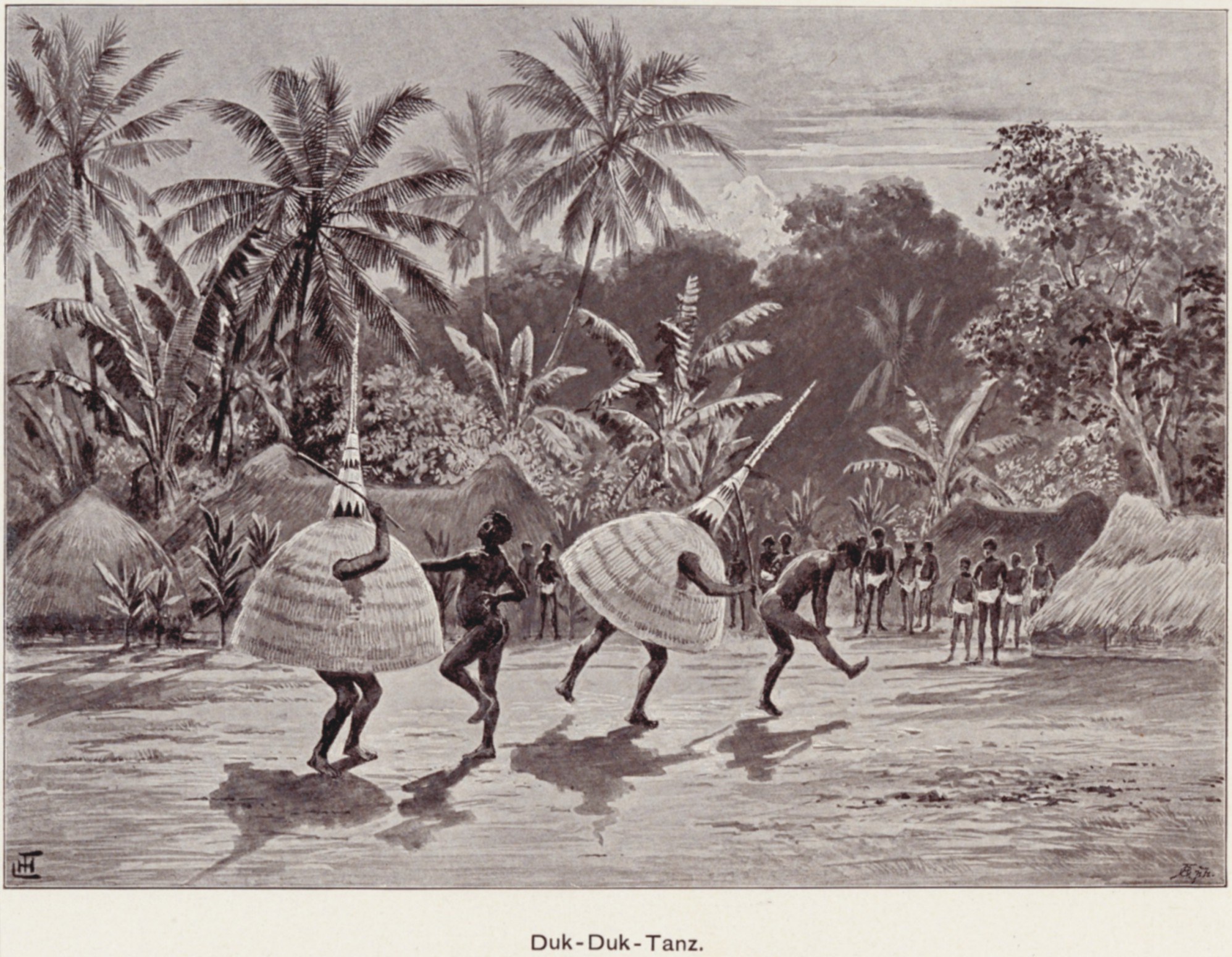
This is one of the few documented visual records of Duk-Duk performance from the period before extensive colonial disruption of Tolai society. It provides evidence of the costume construction, group formation, and bodily vocabulary of a major Pacific secret society and its ritual dances. For historians of Pacific dance, non-Western performance traditions, and the circulation of ethnographic imagery, this work is a primary source—one of the few images that allows us to see how these ceremonies actually looked to an outside observer.
What you are looking at
Three male dancers wearing large, distinctive shield-like costumes dominate the center of this engraved or lithographed composition. These costumes—woven conical structures that cover the torso and upper body, tapering toward the top—are characteristic of the Duk-Duk society performers of the Tolai people. The dancers are captured mid-performance in an open village clearing, their postures dynamic and bent-kneed, suggesting vigorous movement. The setting is a tropical landscape: coconut palms and banana plants frame the scene on both sides, their fronds rendered with fine linear detail. A water feature (likely a lagoon or river) occupies the left foreground, depicted in horizontal lines. In the background, a crowd of onlookers—rendered as smaller figures—watches from the right side of the composition, establishing this as a public ceremonial event. The sky is soft and atmospheric, and the entire scene is rendered in grayscale tones typical of 19th-century engraving or wood-cut printing.
The dancing
The three primary dancers are positioned in a loose line, each bent at the knees in a semi-squat, weight forward in the legs. Their bodies lean slightly forward from the hips, and their arms are raised and extended in various positions—some bent at the elbows, suggesting dynamic arm gestures integral to the performance. The shield-like costumes conceal the upper body entirely, making the movement primarily visible in the legs, torso angle, and arm positions. The poses suggest synchronized or coordinated movement rather than individual virtuosity; all three bodies echo a similar physical vocabulary. The supporting cast (spectators or other society members) stand more upright in the background, clearly demarcating performers from witnesses.
The dance depicted
This is a depiction of Duk-Duk dance as performed by the Tolai people of the Gazelle Peninsula, New Britain, Papua New Guinea. The Duk-Duk is a men's secret society, and the masked dancers wearing the distinctive cone or shield-shaped costumes are initiates or authorized performers. The dance shown here appears to be a public presentation or ceremonial gathering where the society demonstrates its power and ritual authority. The bent-knee posture and low center of gravity, combined with the forward-leaning torso, suggest vigorous, grounded movement quite distinct from European ballroom or theatrical traditions. The presence of multiple dancers moving in visual coordination indicates that this is a group performance rather than solo or partnered work in the Western sense.
How it was made
The image is rendered in black and white using fine linear hatching and cross-hatching characteristic of 19th-century wood engraving or lithography. The technique allows for precise detail in the costume geometry and the tropical foliage while maintaining atmospheric depth through tonal variation. The fine lines and the overall compositional control suggest professional engraving work intended for reproduction and wide circulation, likely as an illustration in a published account or ethnographic work. The date of 1899 and the artist attribution to Joachim von Pfeil (also recorded as Joachim Graf Pfeil) indicate this was produced as documentary or ethnographic imagery rather than fine art for exhibition.
About this work
This is a documentary engraving of a Duk-Duk society dance ceremony from Papua New Guinea, produced by Joachim von Pfeil in 1899. The work records a specific ritual performance of the Tolai people, capturing both the distinctive shield-like costumes that conceal and transform the male performers and the dynamic, low-centered movement vocabulary that characterizes the dance. As an illustrated ethnographic record from the colonial period, it is a valuable visual document of indigenous Pacific performance practice—though, like all such colonial-era imagery, it must be read with awareness of the artist's perspective and the context of its production and circulation. The work belongs in a dance history collection as evidence of how non-Western performance traditions were observed, recorded, and circulated through European print culture in the late 19th century.
How to look at it
Attend first to the three central figures and their body positions: the bent knees, forward-leaning torso, and raised arms establish the essential movement vocabulary of the dance. Notice how the artist has rendered the massive shield-like costumes in precise geometric detail—these are not merely decorative but integral to the performance, transforming the human body into something monumental and abstract. The tropical setting (palms, water, foliage) frames the action and emphasizes geographical and cultural difference for a European viewer. The crowd of onlookers in the background, though small, is essential: this is a public ceremony, witnessed and authorized by the community. Finally, consider what is hidden: the faces and upper bodies of the dancers are completely concealed by the costume, making the dance a transformation of identity rather than a display of individual virtuosity.
The artist
Joachim von Pfeil (also known as Joachim Graf Pfeil) was a German explorer, naval officer, and artist who traveled extensively in the Pacific in the late 19th century. His works documenting Pacific peoples and practices were produced during the height of European colonial expansion and ethnographic interest in non-Western cultures. His illustrations were published and circulated in German and European journals and books, contributing to European knowledge (and often stereotyped understanding) of Pacific societies. He worked primarily in drawing and engraving, and his practice was documentary rather than fine art in intent.
The period
In 1899, European colonial powers were actively documenting and collecting imagery of non-Western cultures as part of both imperial administration and the emerging discipline of ethnography. Pacific societies were of particular interest, and illustrated accounts by explorers and travelers were popular in Europe. The same period saw the development of anthropology as an academic field, and visual documentation was seen as scientifically valuable. However, such images were produced from a fundamentally colonial perspective: the artist and audience were European, and the "subjects" were viewed as exotic, premodern, or primitive. Dance was of particular ethnographic interest as supposedly revealing something essential about cultural character. The technical sophistication of the engraving—its precision and detail—suggests it was intended for educated European audiences, likely in a published travel narrative or ethnographic journal.
Where it lives
This work is recorded in the catalogue as sourced from Wikimedia Commons. The original holding collection is not recorded. It is listed as an oil painting in the catalogue record, though the visual evidence suggests it is more likely an engraving or lithograph intended for reproduction and publication.
Dance in this work
Questions about this work
What is the Duk-Duk society and why does it matter?
The Duk-Duk is a men's secret society among the Tolai people of Papua New Guinea. It functions as a form of social control, authority, and ritual power, with masked dancers performing ceremonies that assert the society's dominance and sacred knowledge. The organization and the ceremonies persist in various forms today, making historical documentation important for understanding both precolonial and contemporary Tolai culture.
Why are the dancers completely covered by these costumes?
The costumes conceal the individual identity of the dancer, transforming him into a representative of the society and its power rather than a display of personal skill. The massive, abstract form of the costume makes the Duk-Duk appear almost supernatural or otherworldly—part of its social function is to inspire awe and enforce authority. The concealment is central to the ritual meaning.
Is this a reliable record of what the dance actually looked like?
This is a document of how a German artist observed and recorded the performance in the 1890s. It is valuable evidence, but not neutral: the artist's training, perspective, and choice of moment all shaped what was depicted. The image should be read as a late-19th-century European interpretation of Tolai performance, not as a transparent window into the dance itself.
Is this the only record of Duk-Duk dance from this period?
It is among the few documented visual records from before extensive colonial disruption. Other written accounts exist, and Duk-Duk ceremonies continue to be performed today, though often in changed forms. This image is valuable precisely because it is rare—one of very few contemporary visual documents of the tradition.
More dance artwork