49 works in this view — arrow keys or swipe to move between them.
Dance in Art · 1930
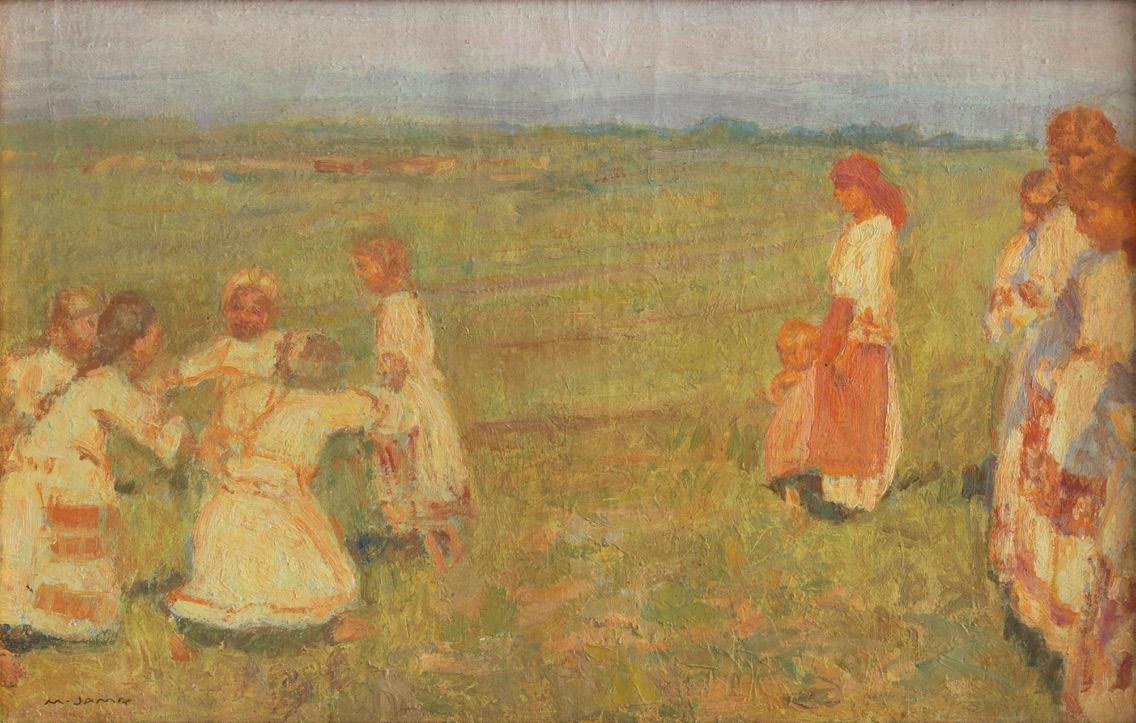
Matija Jama - Plesalke
Matija Jama
- Medium:
- Oil Painting
- Era:
- 1920-1950 (Swing Era)
- Source:
- Wikimedia Commons
- Rights:
- Public domain — free to use, share and adapt.
- Recorded as:
- Public Domain
The painting captures dance as social ritual and communal practice—a perspective often absent from performance-focused art history. For dancers and historians interested in folk dance, the work documents how the subject was visualized and valued in the early 20th century, at a moment when European artists were increasingly looking to folk cultures as sources of authentic expression and connection to place.
What you are looking at
A group of figures in traditional Eastern European dress gathers in an open landscape beneath a hazy sky. The composition shows at least a dozen people scattered across a sunlit meadow, some clustered in conversation on the left, others standing or moving across the right side of the canvas. The figures wear white embroidered blouses and colorful skirts or trousers in reds and oranges—the women distinguished by their reddish-blonde hair and fuller skirts, the men by darker clothing and caps. The setting is rural and expansive, with fields stretching into a soft, indistinct horizon. The light is warm and diffuse, casting the scene in golden tones that suggest late afternoon or a hazy day. The overall mood is one of leisure and social gathering rather than formal performance.
The dancing
The figures are distributed casually across the landscape rather than arranged in deliberate formation. Some stand in conversation; others appear to be in motion or at rest. The postures are upright and relaxed—no extreme extensions, lifts, or acrobatic frames. Arm positions are natural and gestural rather than balletic. The clothing—particularly the full skirts on the women—suggests clothing that moves with the body but does not require the specific training evident in ballet or formal dance technique. The spacing and informality suggest social rather than staged movement.
The dance depicted
The work is titled *Plesalke* (Dancers), a Slavic-language term, and depicts what appears to be social folk gathering rather than a formal dance performance. The dress, landscape, and composition suggest Central or Eastern European folk tradition—possibly Serbian, Croatian, or another Balkan region. The informal arrangement and outdoor meadow setting are characteristic of rural social dancing rather than staged theatrical dance. No specific folk dance style is clearly identifiable from the bodies or arrangement, but the context points to communal social dancing of the kind that would accompany gatherings, celebrations, or courtship. The work captures the social and convivial aspect of dance rather than technical detail.
How it was made
Oil painting on canvas, executed in a loose, impressionistic style with soft brushwork and muted color harmonies. The artist has prioritized atmospheric effect—the haze, the golden light, the soft transitions between figures and landscape—over precise anatomical detail or sharp definition. The technique allows figures to emerge from and dissolve into the landscape, creating a sense of mood and occasion rather than documentary precision. This approach was common in early 20th-century European art, particularly in work interested in folk life and rural subjects as subjects of aesthetic feeling rather than ethnographic record.
About this work
This oil painting depicts a social gathering of figures in traditional Eastern European folk dress scattered across an open landscape. The work is titled *Plesalke* (Dancers), but it captures the social and convivial context of folk dance rather than formal choreography or technique. The loose, impressionistic technique and warm, diffuse light prioritize the mood and occasion over documentary clarity, suggesting the artist's interest in folk life as a subject of aesthetic and cultural value.
The work belongs in a gallery of dance in art as a document of how early 20th-century artists understood folk dance: not as a discipline to be analyzed or elevated, but as a lived social practice embedded in landscape, community, and celebration. It sits alongside other works that treat dance as cultural belonging rather than technical achievement.
How to look at it
Attend first to the distribution and posture of the figures: they are relaxed, conversational, and embedded in landscape rather than staged or formally arranged. Note the clothing and its relationship to movement—full skirts and embroidered blouses that suggest a tradition of dress for social gathering. Observe how the artist uses light and atmosphere to unify the scene rather than sharp definition: this softness creates a sense of a moment observed from a distance, preserving the privacy and authenticity of the gathering. The composition asks you to read the work as a mood and a moment rather than as a record of steps or choreography.
The artist
Matija Jama was a Croatian painter working in the early 20th century. His practice engaged with folk subjects and rural life, reflecting a broader European interest in vernacular culture and national identity. The soft, impressionistic style evident here places him within early modernist painting, though his subject matter remained grounded in observed social life rather than abstraction or formal experiment.
The period
This work dates to 1930, a moment when folk dance and folk culture held significant cultural and political meaning across Europe. The interwar period saw intense interest in folk traditions as expressions of national identity and authentic cultural heritage—a movement that had both progressive and nationalist dimensions. In visual art, this interest manifested in paintings, sculptures, and ethnographic documentation of rural life. The style and subject align with this cultural moment, when folk culture was understood as worthy of serious artistic attention and preservation.
Where it lives
The work is documented as an oil painting by Matija Jama dated 1930, sourced from Wikimedia Commons. No holding collection is recorded in the available catalogue data.
Dance in this work
Questions about this work
Is this a depiction of a specific folk dance?
The work is titled *Plesalke* (Dancers) and depicts figures in traditional Eastern European dress in a social gathering, but no specific folk dance style is clearly identifiable from the composition or body positions. The artist has chosen to capture the social and convivial context of folk dancing rather than to document specific steps or choreography. The emphasis is on occasion and community rather than technical content.
Why is this painted in such a soft, impressionistic style?
The loose brushwork and diffuse light create an atmosphere of observation and intimacy—as if the viewer is witnessing a private social moment. This technique was characteristic of early 20th-century European art and allowed the artist to prioritize mood and cultural meaning over precise documentary detail. The softness also suggests reverence for folk culture as a subject worthy of aesthetic attention.
What does the dress tell us about the dance tradition?
The embroidered blouses and full skirts are typical of Central and Eastern European folk costume, particularly from the Balkans. These garments move with the body and allow for the kinds of social dancing that characterized rural celebrations and gatherings. The richness and specificity of the embroidery suggest a tradition with deep cultural roots and pride in craft.
More dance artwork