49 works in this view — arrow keys or swipe to move between them.
Dance in Art · 1893
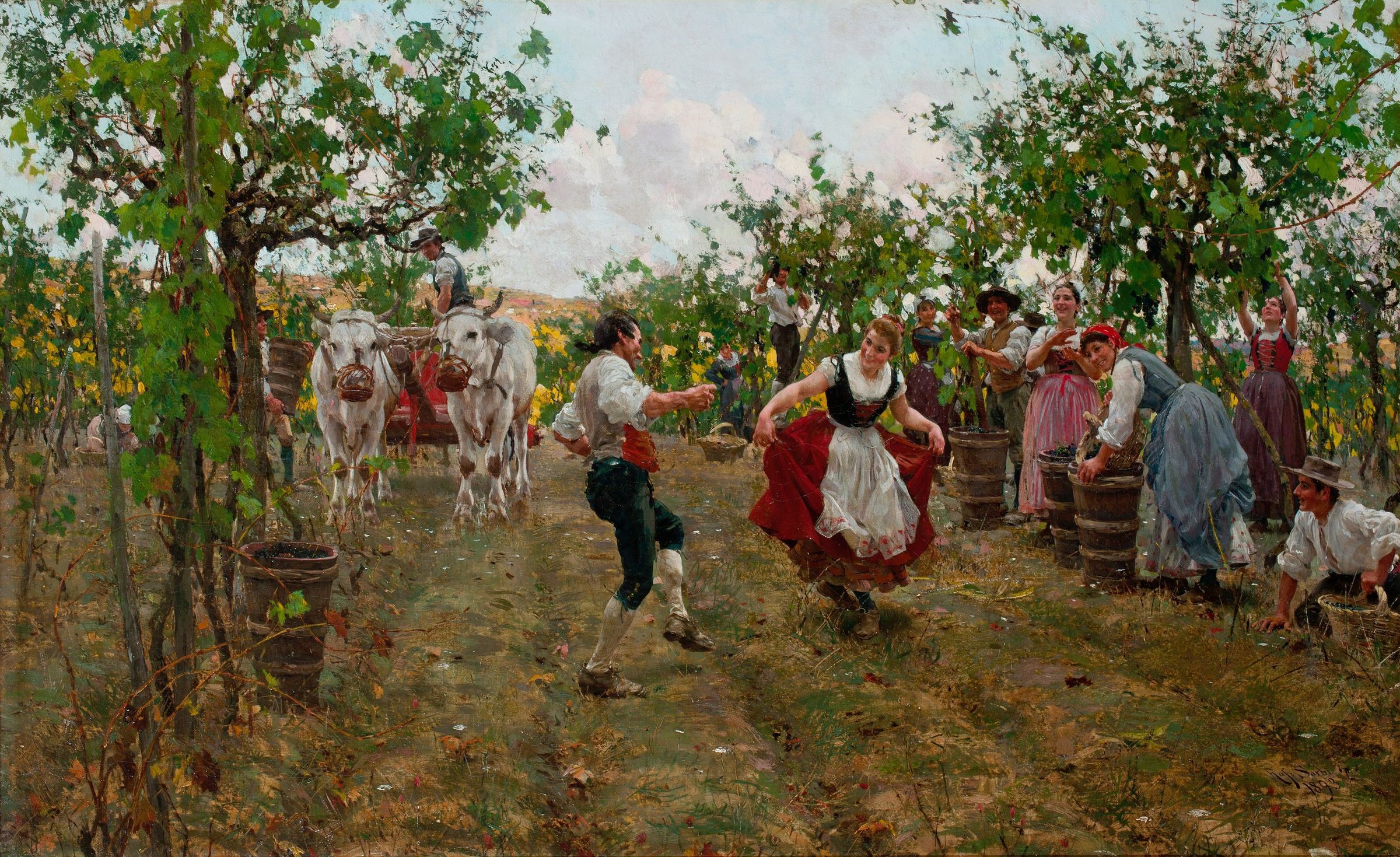
Raffaello Sorbi - La festa della vendemmia
Raffaello Sorbi
- Medium:
- Oil Painting
- Era:
- Late 1800s (Victorian Ballroom)
- Source:
- Wikimedia Commons
- Rights:
- Public domain — free to use, share and adapt.
- Recorded as:
- Public Domain
The painting documents the social and material context of peasant and regional dance as lived practice rather than as a staged or codified form. It shows us the dress, the setting, the multigenerational gathering, and the kinds of movement—neither structured choreography nor idle gesture—that existed in the world before those movements were collected, named, and preserved by folklorists. For anyone studying the roots of European folk and regional dance, this is evidence of the occasion and culture that produced it.
What you are looking at
A harvest festival unfolds in a sunlit vineyard in late afternoon. Rows of grapevines laden with foliage create a natural pergola overhead, their green leaves diffused by golden light. In the middle distance, a pair of white oxen draws a cart; across the canvas, figures in regional dress—women in white aprons and colored skirts (deep red, dusty blue, grey), men in vests and caps—move through the sandy vineyard paths among clay harvest baskets. The composition is anchored by a woman in a red skirt and white apron center-frame, her posture animated mid-movement. A broad landscape with golden fields opens behind the vineyard. The season appears early autumn; the light and foliage suggest late afternoon warmth.
The dancing
The figures move in small groups and singly rather than in couples or lines. The woman in red at center has her body turned and her arms away from her sides—the frame and carriage suggest movement through space rather than a formal dance position. Around her, other figures stand, gesture, and walk; some reach toward the vines or baskets. The bodies are upright and active, the gestures those of labor interrupted by celebration, not trained dancers in a closed frame. Children run among the adults. The overall impression is of vernacular, participatory motion arising from the occasion rather than choreographed steps.
The dance depicted
This is a harvest celebration (vendemmia) of the kind documented across wine-growing regions of southern Europe in the 19th century. The figure in the red skirt appears to be engaged in a moment of social dancing or exuberant movement, but the work does not depict a specific, named dance style. Rather, it shows improvised, communal celebration—the kind of informal social movement and courtship display that accompanied harvest festivals. The setting and dress suggest Italian or Iberian tradition, where such festivals combined labor, music, food, and social bonding. No instruments are visible; no clear formation or technique can be read.
How it was made
Oil on canvas, as stated in the record. The technique is academic realism with strong attention to light and color. The artist has used warm ochres and greens for the vineyard setting, contrasting crisp white garments and the oxen against earth tones. The brushwork is deliberate and representational—individual figures are rendered with attention to their particular dress and gesture, while the leafy canopy is suggested through looser, impressionistic handling. This scale and finish suggests exhibition painting rather than a sketch, implying an educated audience familiar with Italian regional scenes and peasant life as a subject.
About this work
Raffaello Sorbi's 1893 harvest festival depicts a moment of social celebration and informal dancing within the labor of the vintage. The painting captures a specific cultural practice—the mingling of work, music, and courtship at harvest time—in which spontaneous movement and festivity were expected parts of the seasonal cycle. Rather than illustrating a defined dance form, it records the lived context from which regional folk dances emerged: the gathering, the costume, the bodily exuberance of a community at festival. The work belongs in a dance history not because it shows technique, but because it shows the social occasion and bodily expression from which dance traditions arose.
How to look at it
Attend to the woman in red: her weight is shifted, her posture open, her gaze directed outward rather than downward or inward. She is not dancing alone, but she is the focal point of a moment of movement and joy. Notice too the children, the baskets, the oxen, and the ordinary tools of harvest that fill the canvas alongside the figures. This is not a ballroom or a concert stage; the dance is continuous with the labor and the landscape. The artist's choice to paint this moment—not the work's climax, not the feast afterward, but the transition point where labor becomes celebration—tells us something about how harvest dance was experienced: as something that arose from and remained part of the day's work.
The artist
Raffaello Sorbi (1844–1931) was an Italian academic painter known for historical scenes and representations of Italian regional and peasant life. He worked in the late 19th-century tradition of salon realism, combining technical precision with romantic interest in labor, tradition, and local custom. His works were exhibited widely and often acquired by public collections, reflecting the period's appetite for picturesque scenes of rural life rendered in academic style. Sorbi's paintings of Italian life were both documentary in intention and idealized in execution—accurate in costume and setting but composed for aesthetic and narrative effect.
The period
In the 1890s, European academic painters were increasingly drawn to peasant and regional subject matter, partly from ethnographic interest and partly from nostalgia for rural life as industrial society advanced. In the same decades, folklorists across Europe were actively collecting folk songs, dances, and customs—often from the same communities and occasions Sorbi painted. The harvest festival was a recognized subject in European art; it carried associations with fertility, community, and the dignity of labor. The specific moment Sorbi chose—not the work itself but the celebration within it—reflects how dance and movement were understood as inseparable from occasion, costume, season, and social life rather than as abstract technique.
Where it lives
The work is recorded as an oil painting from 1893 by Raffaello Sorbi, currently held in an unspecified public or private collection. It was sourced for this catalogue from Wikimedia Commons.
Dance in this work
Questions about this work
Is this a real harvest ritual or did Sorbi invent it?
Harvest festivals with music, dance, and communal celebration were genuine practices across wine-growing regions of Italy and southern Europe. What Sorbi has painted is a recognizable kind of occasion. However, this is an academic painting composed for exhibition, not a documentary photograph; the arrangement, light, and emphasis have been shaped for aesthetic effect. It shows us the real elements—costume, setting, gesture—of harvest celebration, but presented as a finished artistic work, not as anthropological record.
What dance is being performed?
No specific, named dance style can be identified. What is shown is informal, social movement—the kind of spontaneous dancing, courtship display, and exuberant motion that occurred at harvest festivals. This is the context from which regional folk dances emerged, but the painting does not depict a codified dance tradition. The movement appears to be improvised and participatory rather than formally choreographed.
Why is a painting of a harvest scene in a dance gallery?
Dance is not confined to stages or formal technique. This painting documents the social occasion, costume, and lived experience of movement and celebration in which dance traditions were rooted. For historians and dancers, it is evidence of how and when people moved, what they wore, and what kinds of gathering produced the dance forms we now study as folklore. It shows us the context before the dance was codified.
Who is the woman in red?
She is not identified. She stands as a representative figure—one woman among the community at festival—chosen by the artist to embody the moment of exuberance and movement at the harvest's peak. Her particularity as an individual is subordinate to her role as part of the festive scene.
More dance artwork