49 works in this view — arrow keys or swipe to move between them.
Dance in Art · 1750
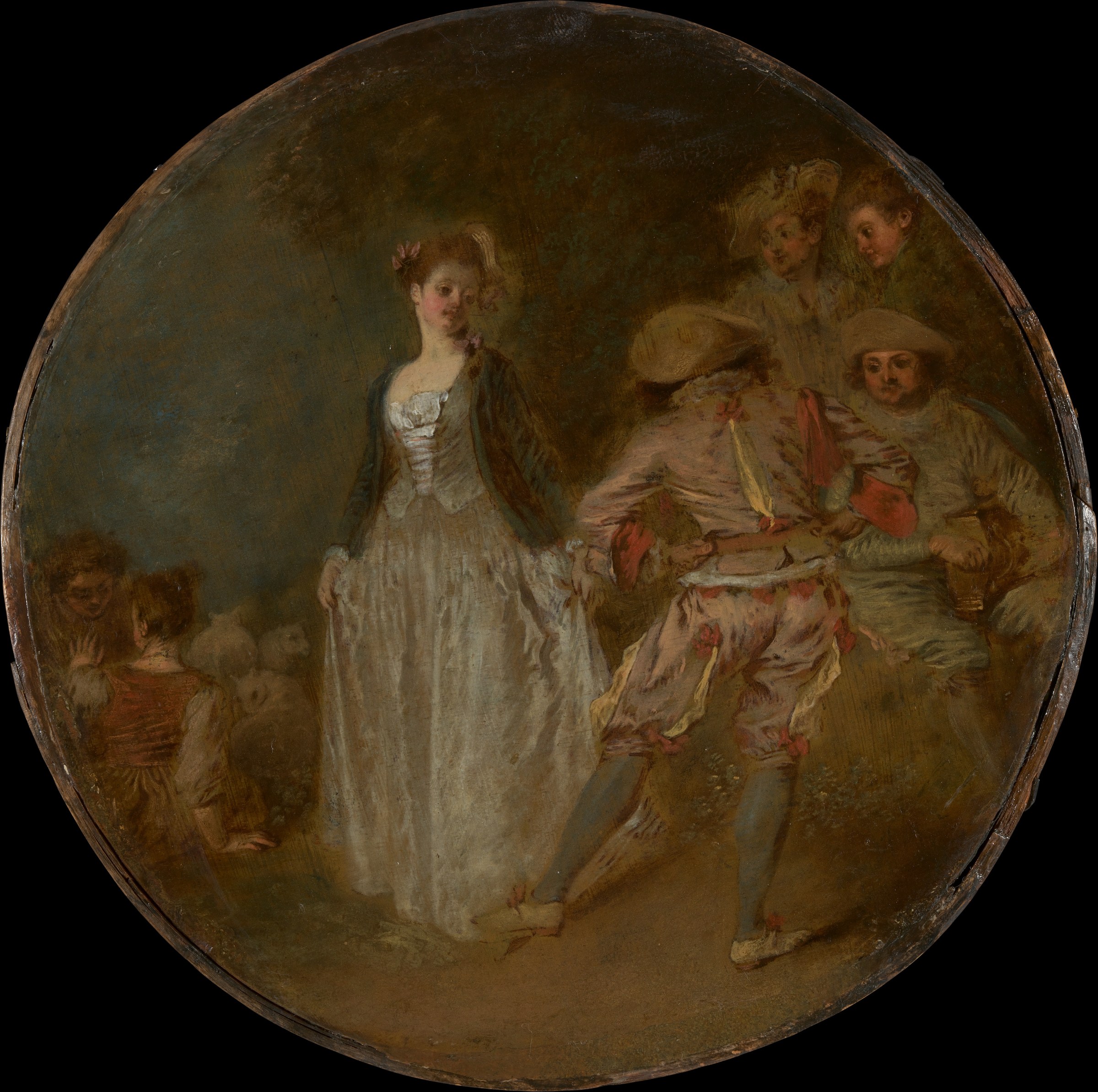
The Country Dance MET DP-1417-001
Jean-Antoine Watteau
- Medium:
- Oil Painting
- Era:
- 1700s (Enlightenment/Minuet Era)
- Source:
- Wikimedia Commons
- Rights:
- Public domain — free to use, share and adapt.
- Recorded as:
- CC0
Historians of dance need to understand the social and theatrical contexts in which dance took place, and Rococo conversation pieces are primary documents for that context. Watteau's work shows that 'country dances' were not primarily about technique but about flirtation, display, and the blurring of everyday courtship with theatrical performance. The painting also reveals the role of exoticism and costume in the pleasures of the period.
What you are looking at
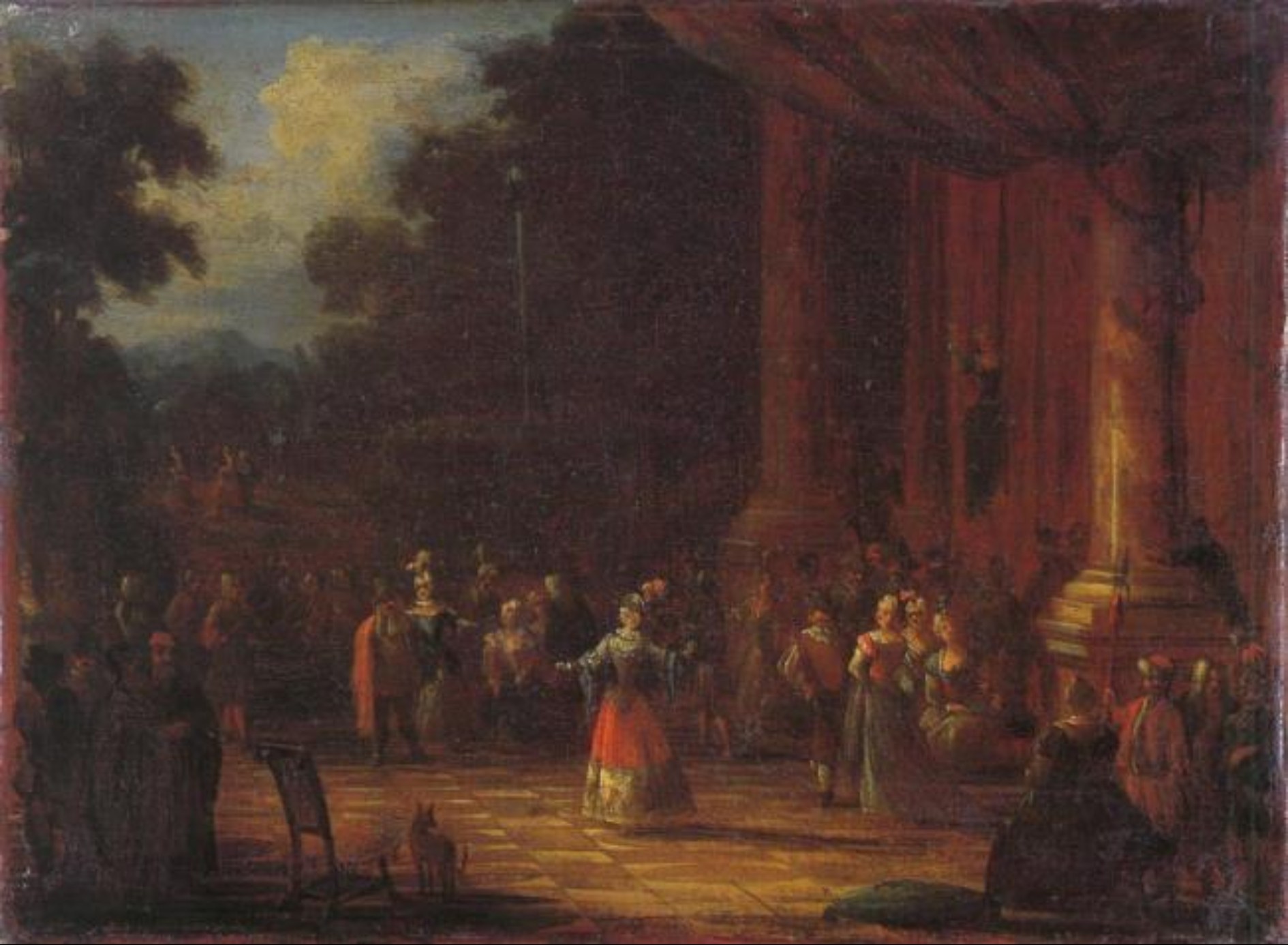
A woman in an elegant white gown stands alone on the left, observing a group of figures in the middle distance. Three men in exotic costume—plumed hats, richly patterned coats in ochre and red, and pale breeches—attend to her. The setting is rendered in warm earth tones, with a dark background that suggests an interior space or theatrical setting. A cherub or putti appears at the far left, barely visible in shadow. The composition is circular, with the figures arranged in a moment of social interaction rather than active dance: the woman's posture is poised and formal, while the men gesture toward her with a mixture of deference and entertainment. The painting has the soft, luminous quality of Rococo work, with loose brushwork that captures fabrics and the play of candlelight.
The dancing
The central female figure stands in a relaxed contrapposto, her weight on one leg, her body angled away slightly from the group—a pose of social observation rather than participation. The three male figures are mobile and attentive, with animated gestures suggesting conversation or performance. Their arms are raised and extended in welcoming or presentational movements. None of the figures is in a dance hold or formation. The woman's dress, while elegant, is not arranged for active movement; her posture suggests she is being entertained rather than dancing.
The dance depicted
This appears to be a fête galante or scene of aristocratic courtship and entertainment rather than a depiction of actual dancing. The title 'The Country Dance' is misleading: no one is dancing. Instead, the work captures a moment of social flirtation and performance, possibly representing the 'country dance' (contredanse) as a social event—a gathering or promenade rather than the figures in the act of dancing. The exotic costumes of the men (suggesting shepherds, soldiers, or theatrical commedia characters) and the woman's elegant simplicity suggest a theatrical or masquerade context. The painting documents the culture of dance and courtship in 18th-century Rococo society rather than technique.
How it was made
Oil on what appears to be a circular support (tondo format). The catalogue dates this to 1750, late in Watteau's career or possibly after his death (he died in 1721—a significant discrepancy worth flagging). The technique is characteristic of Rococo painting: transparent glazes, soft handling of fabric, muted palette with warm highlights, and atmospheric perspective that dissolves the background. The circular format and intimate scale suggest this was made for a collector's cabinet or as a decorative panel, a format common for Rococo conversation pieces.
About this work
This is a scene of aristocratic leisure and courtship in the manner of the fête galante, a genre Watteau pioneered. The painting depicts not a dance in progress but the social context in which dance occurred—a moment of flirtation and entertainment in which music, costume, and spectacle were deployed for pleasure. The 'country dance' of the title refers to the social event and the courtship ritual it enabled, not to the technical choreography. It belongs in a dance gallery because it documents the performative culture of 18th-century courtship and the role of exotic dress and theatrical gesture in aristocratic entertainment. The work shows how dance was woven into the fabric of social life rather than isolated as a technical art.
How to look at it
Attend first to the woman's stillness and detachment: she is the still center of the composition, and the men orbit around her. Notice how her posture—relaxed, observant, slightly withdrawn—differs from the animated gestures of the men. The exotic costumes invite you to read this as a theatrical moment, a masquerade or entertainment staged for seduction. The circular format creates an intimate, enclosed world; you are invited into a private moment of aristocratic play. Look at the brushwork: Watteau captures the weight and fall of silk and linen with extraordinary delicacy, suggesting movement and light without depicting action.
The artist
Jean-Antoine Watteau (1684–1721) was the defining painter of the Rococo and inventor of the fête galante, a genre depicting aristocratic leisure, music-making, and courtship in parkland or theatrical settings. He was fascinated by costume, commedia dell'arte, and the intersection of everyday life with theatrical performance. His small-scale paintings, often on wood or canvas, were highly sought by collectors. Though he died in 1721, his work was widely copied and reinterpreted by later artists, and this painting's date may need verification.
The period
In early 18th-century France, the minuet was the dominant courtly dance, but the contredanse (country dance) and other social dances were becoming fashionable in aristocratic circles. Dance was inseparable from music, costume, and courtship ritual. The Rococo period celebrated leisure, pleasure, and the theatricalization of everyday social life. Exotic costumes—often representing shepherds, soldiers, or characters from commedia dell'arte—were worn at masquerades and fêtes. Watteau's paintings document this culture of performance and pleasure with unprecedented intimacy and psychological nuance.
Where it lives
The painting is catalogued at the Metropolitan Museum of Art as DP-1417-001. The source cited here is Wikimedia Commons. The date 1750 is problematic given Watteau's death in 1721 and should be verified.
Dance in this work
Questions about this work
Is anyone actually dancing in this painting?
No. The title is misleading. The painting depicts a social moment of courtship and entertainment, not a dance in progress. The 'country dance' refers to the social event and ritual, not to figures actively dancing. This is typical of the fête galante genre: Watteau was interested in the social and theatrical contexts of dance rather than in depicting technique.
What are those exotic costumes?
The men wear costumes suggesting shepherds, soldiers, or characters from commedia dell'arte—stock figures of Rococo entertainment. Such costumes were worn at masquerades and theatrical fêtes, blurring the line between everyday aristocratic life and performance. They signal that this is a staged moment of seduction and pleasure.
Why is the woman separate from the men?
Her separation and stillness are deliberate. She is the object of the men's attention and entertainment, positioned as an observer or spectator even as she is being wooed. Her formal, elegant dress contrasts with the theatrical exoticism of the men's costumes, suggesting different social roles.
How does this relate to dance history?
Rococo conversation pieces like this document the social rituals in which dance occurred. They show that courtly dances like the minuet and contredanse were not isolated technical performances but part of a larger theatrical and erotic performance of courtship. Understanding the context of dress, music, and courtship is essential to understanding how these dances functioned.
More dance artwork