25 works in this view — arrow keys or swipe to move between them.
Dance in Art · 1907
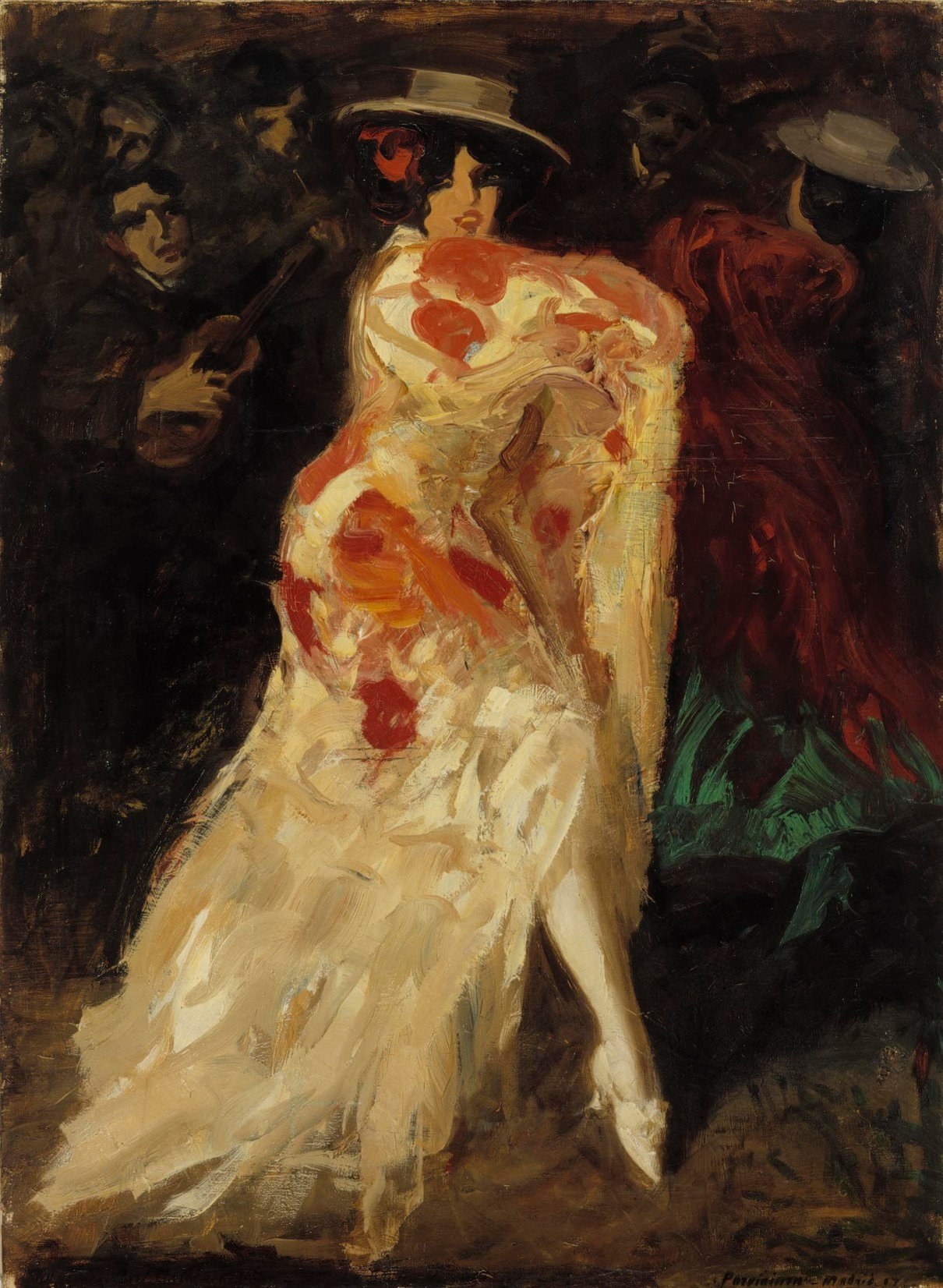
Oscar Parviainen - Espanjalainen tanssijatar (Tango) - A III 1792 - Finnish National Gallery
Oscar Parviainen
- Medium:
- Oil Painting
- Dance:
- Tango
- Era:
- 1900-1920 (Ragtime/Early Jazz)
- Source:
- Wikimedia Commons
- Rights:
- Public domain — free to use, share and adapt.
- Recorded as:
- Public Domain
The painting is significant not as a technical representation of tango but as evidence of how the dance functioned in early-20th-century European imagination: as spectacle, as an object of male gaze, and as a marker of urban modernity and erotic transgression. For historians of both dance and visual culture, it demonstrates how artists engaged with tango as a cultural phenomenon rather than a technique, and how the dance became a vehicle for exploring contemporary anxieties and desires around gender, sexuality, and social change.
What you are looking at
A woman in an elegant white gown with red patterning stands at the center of a crowded, dimly lit interior—likely a cabaret or social venue. She wears a wide-brimmed white hat and dark glasses, her posture upright and assured. The garment is a loose, flowing wrap or shawl draped over her body, decorated with bold red geometric or floral motifs. Around her, shadowy male figures in dark suits and hats lean in, their faces rendered impressionistically, some gazing toward her intently. The composition is tightly cropped, with the figures surrounding her creating a sense of intimate scrutiny or admiration. The lighting is warm and golden on the woman's dress, contrasting sharply with the dark, almost menacing treatment of the onlookers. The painting captures a moment of performance or display, with the woman as the focal point of collective attention.
The dancing
The central figure stands with weight evenly distributed, her body tilted slightly, the white garment flowing loosely from her shoulders. Her arms are not prominently featured, and the drape of fabric suggests a stationary or slowly moving stance rather than dynamic motion. The surrounding male figures are rendered in loose, gestural brushwork, their heads and shoulders cropping the frame; none are in an embrace with the woman or in a partnered hold. The composition suggests observation rather than interaction—the woman is being watched rather than dancing with any of the figures present.
The dance depicted
The catalogue identifies this as tango, and the setting—an intimate social venue with formally dressed spectators—is consistent with early-20th-century cabaret culture where tango was performed and displayed. However, the image does not clearly depict the characteristic partnered frame, close embrace, or footwork of tango. Instead, it appears to show a solitary performer or model being observed, which may represent a performance context, a moment of display, or a stylized interpretation of the dance rather than its enactment. The work seems more interested in the social and erotic dimensions of the tango scene—the gaze, the attention, the spectacle—than in dance technique itself.
How it was made
Oil painting on canvas, executed with loose, expressive brushwork and muted palette dominated by dark browns, blacks, and ochres, with bright accents of white and red. The impressionistic rendering of the background figures creates atmospheric depth and psychological tension, while the woman's figure is more carefully delineated. The technique suggests this is a studio work, likely intended for exhibition, characteristic of early-20th-century European modernism's engagement with social subjects and nightlife. The fluidity of the paint application and the dramatic tonal contrasts evoke the visual language of contemporary theater set design and avant-garde painting.
About this work
This is an oil painting by Finnish artist Oscar Parviainen from 1907, catalogued as depicting Spanish tango, though the scene is more accurately a cabaret or ballroom interior where tango was performed and consumed as spectacle. The woman in the center—her face and body isolated by dramatic lighting and the pressing attention of anonymous male observers—embodies the tango's status as a dance of display and desire in the urban nightlife of the early 20th century. Rather than showing the dance itself, Parviainen captures the social and erotic theater surrounding it. The work belongs to a larger documentary impulse in European modernism to represent modern leisure, sexuality, and entertainment culture as it emerged in metropolitan spaces.
How to look at it
Focus on what the artist chose *not* to show: there is no closed embrace, no visible footwork, no partnered movement. Instead, look at how the woman is positioned as an object of attention, and how the surrounding figures are rendered as a collective gaze. The dramatic lighting—warm light on her dress, shadowy darkness around her—is not incidental to the dance; it is the point. The painting captures tango not as a technical practice but as a social drama of display and desire. Note also how the woman's face is somewhat obscured by the hat and glasses, rendering her simultaneously present and remote, available to view but not to know.
The artist
Oscar Parviainen (1878–1925) was a Finnish painter known for his work in portraiture and contemporary social scenes. Active during the early 20th century, he was engaged with the modernist developments of his time, particularly the expressive use of color and loose brushwork influenced by Fauvism and Expressionism. His interest in cabaret and entertainment scenes places him within a broader European context of artists documenting urban nightlife and modern leisure. The work reflects the cosmopolitan interests of Finnish culture during this period.
The period
Tango emerged in Buenos Aires in the 1880s and by the early 1900s had become a sensation in European capitals, particularly Paris. By 1907, when this painting was made, tango was at the height of its fashionability and moral controversy in Europe—condemned by clergy and conservatives, celebrated by bohemians and modernists as a symbol of modernity, sensuality, and social transgression. Simultaneously, European painting was undergoing a radical shift toward expressionism and modernism, with artists increasingly interested in depicting contemporary life, especially the spaces of modern urban leisure—cabarets, music halls, ballrooms. Parviainen's work sits at the intersection of these currents: tango as a newly arrived, thrilling, and morally charged dance form, and modernist painting's fascination with nightlife and the figure of the female performer.
Where it lives
The work is held in the Finnish National Gallery (catalogued as A III 1792) and is documented via Wikimedia Commons. It is part of the national collection of Finnish modernist painting.
Dance in this work
Questions about this work
Is this actually a tango, or is it misidentified?
The catalogue identifies it as tango, and the setting—a cabaret or ballroom with formally dressed onlookers—is consistent with where tango was performed in 1907 Europe. However, the painting does not depict the partnered embrace and footwork characteristic of the dance. Instead, it shows a solo figure being observed, which may represent a tango performance or a stylized interpretation of the dance as spectacle rather than technique. The work is more interested in the social theater surrounding tango than in the dance itself.
Was tango actually danced this way in 1907?
No. Tango requires two dancers in a close embrace, but this painting shows a solitary woman surrounded by observers. The work is a modernist interpretation of the tango scene—the nightlife context, the gaze, the erotic charge—rather than a documentary of how the dance was actually performed. It reflects how tango was understood in European culture as spectacle and transgression.
Who was Oscar Parviainen?
A Finnish painter (1878–1925) active in the early 20th-century modernist movement. He was known for portraiture and contemporary social scenes, particularly the spaces of urban nightlife. This work is part of his broader interest in modern leisure, performance, and the figure of the female entertainer.
Why would a Finnish artist paint a Spanish tango scene?
Tango was a pan-European phenomenon by 1907—not exclusively Spanish, and performed and consumed in major cities across Europe, including Scandinavia. European modernist artists were documenting contemporary urban life, and nightlife scenes with tango were part of the appeal. The exoticism and transgression of tango made it a compelling subject for painters interested in modernity.
More Tango artwork
![[Les noces de trottoir, par les compagnies Tango Sumo et Vendaval. Chalon dans la rue. 2007 / photographies de Joël Verhoustraeten] by Verhoustraeten, Joël (1954-2019). Photographe](https://gallica.bnf.fr/iiif/ark:/12148/bc6p058zgkc/f1/full/800,/0/native.jpg)