25 works in this view — arrow keys or swipe to move between them.
Dance in Art · 1930
Xavier Sager Le Tango 4
Xavier Sager
- Medium:
- Oil Painting
- Dance:
- Tango
- Era:
- 1920-1950 (Swing Era)
- Source:
- Wikimedia Commons
- Rights:
- Public domain — free to use, share and adapt.
- Recorded as:
- Public Domain
This image is a primary source for understanding how tango was marketed, taught, and imagined in 1920s–1930s Europe. It shows the closed embrace and partner frame that defined the ballroom tango of this era—a crucial moment in the dance's history, when it was transformed from a street dance into a fashionable social form. For a historian of dance, dress, or graphic design, the work is evidence of how images of dance were made and distributed; for a dancer, it is a vivid record of posture, frame, and the relationship between partners that governed this period.
What you are looking at
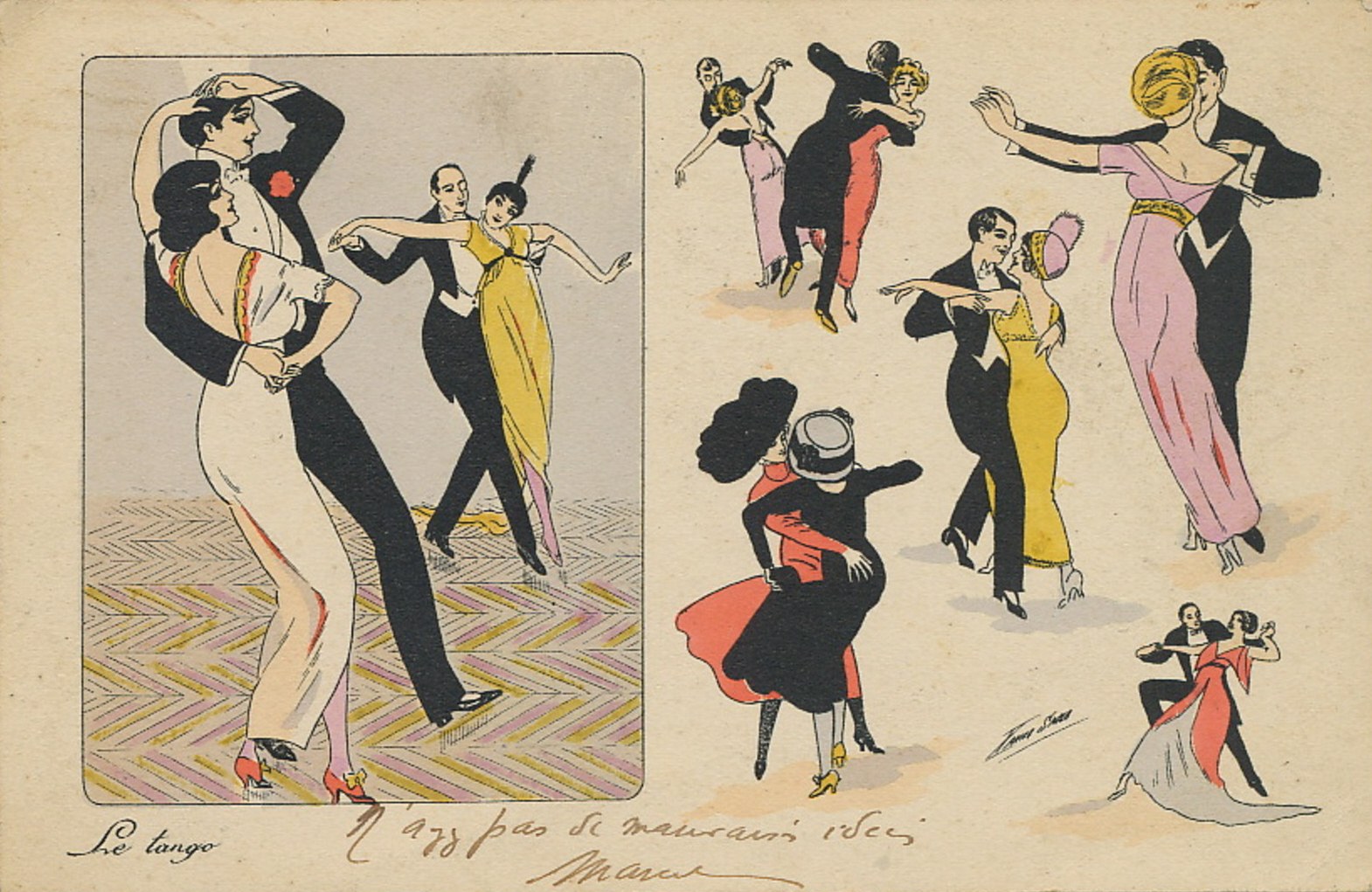
This is a composite illustration showing multiple couples dancing tango in the early 20th century. The left panel, framed in a border, depicts two figures in a tight closed embrace: a woman in a white dress with coral-red trim, her hair up and one arm raised to her partner's shoulder, the other at her side; a man in black tails leaning back deeply, his frame creating acute angles characteristic of the Argentine tango of this era. A second couple in the background mirrors this intensity. The right panel unfolds a frieze of smaller vignettes showing tango in motion: couples at various stages of the dance, some in dramatic leans and pivots, others in close holds, the women in contrasting dress—yellow, pink, coral—against the men's black. The setting is indistinct but suggests an interior space; the parquet floor with its geometric pattern grounds the action. The style is that of a hand-colored postcard or illustration, with bold black outlines, flat planes of color, and a clarity of line suited to mass reproduction.
The dancing
The primary couple on the left demonstrates the characteristic Argentine tango frame: a closed hold with the man's right arm around the woman's back, his left arm extended to receive her right hand, both bodies in a pronounced contra-body position suggesting a deep lean or backward pivot. The woman's posture is upright but yielding, her weight forward into the man. The secondary figures in the frieze show variation in the embrace—some upright, some in dramatic leans—and all feature the woman as the follower responding to the man's lead. The proportions and weight distribution suggest bodies trained in the dance, not amateurs.
The dance depicted
This is Argentine tango as danced and understood in the early 1920s–1930s. The image captures the dance at a moment of high popularity in Europe, particularly in Paris, where tango had become fashionable among the middle and upper classes. The closed embrace, the man's backward lean, and the woman's responsive follow are hallmarks of the ballroom or salon tango of this period, distinct from the street tango (tango orillero) of Buenos Aires. The multiple vignettes suggest the variety of positions within a single dance—the tango was not static but a conversation of weight and direction. The artist's treatment suggests this is exhibition or social dancing, performed with style and for an audience.
How it was made
The work is rendered in what appears to be color lithography or hand-colored lithographic print, a medium ideal for postcards and commercial illustrations. The technique allows for bold, simplified forms with strong outlines and flat color fields, which gives the work its graphic impact and clarity. The border around the left panel and the frieze composition of the right suggest a design for a postcard (the catalogue notes 'carte postale'), a format that made dance imagery widely accessible in the early 20th century. The limited palette—black, white, coral-red, yellow, pink, and flesh tones—and the precise registration typical of lithography indicate a work designed for reproduction and circulation among a broad audience.
About this work
Xavier Sager's *Le Tango* is a French commercial illustration documenting the tango craze of the interwar period. Created as a postcard, it captures the dance at the moment of its European fashion, showing both the formal closed embrace and the dynamic partnering that made tango distinct from the ballroom dances of earlier generations. The work is simultaneously a fashion plate, a dance instruction (in visual form), and a record of how the middle-class couple understood their bodies in motion together. Sager's graphic clarity and his choice of multiple vignettes reflect the postcard's role as a tool of mass communication and cultural dissemination.
The image belongs in a dance history because it records not only the steps and hold of a specific dance, but the social context in which it was performed. The woman's fashionable dress, the man's formal wear, the interior setting, and the repeated emphasis on the couple as the unit of the dance all speak to tango's adoption into European ballroom culture, where it competed with waltz, foxtrot, and other social dances. This is tango as a European phenomenon, understood through the lens of Parisian taste and commercial illustration.
How to look at it
The left panel presents the tango in its essence: two figures locked in an embrace, the man's deep backward lean suggesting the moment of maximum extension in a pivot or lunge. This is not the beginning of the dance but a moment of commitment and connection. The right panel shows the dance unfolding: by presenting multiple couples at different points in the movement, the artist conveys the tango's dynamic quality, its constant shift of weight and direction. Notice the women's posture across all figures—they are responsive rather than active, their bodies yielding to the man's lead. This was the convention of the era. The composition as a whole—a single dramatic image on the left, a busy frieze of motion on the right—contrasts the tango's intensity with its variety.
The artist
Xavier Sager was a French commercial illustrator and designer active in the early 20th century, known for fashion plates, advertisements, and postcard designs. His work typically featured elegant figures in stylish dress, rendered in the flat, graphic style suited to lithographic reproduction. Sager was part of the broader culture of fashion and lifestyle illustration that flourished in Paris during the 1920s and 1930s, when postcard imagery played a major role in shaping taste and disseminating popular culture. His illustrations were not fine art but commercial design—their value lay in their clarity, appeal, and reproducibility.
The period
In the 1920s, tango was at the height of its fashion in Europe and North America. The dance had arrived from Buenos Aires in the early 1910s and scandalized conservative society, but by the 1920s it had been absorbed into ballroom dancing and social fashion. In the same period, the postcard had become the dominant medium for the circulation of images of modern life—cheaper and more ephemeral than fine prints or paintings, but far more widely seen. The graphic clarity and commercial appeal of Sager's work are typical of the period's visual culture. The tango itself was undergoing codification: the frame, the hold, and the basic figures were being standardized and taught in ballrooms across Europe, a process that would eventually lead to the International Standard Tango of competitive ballroom dancing.
Where it lives
The work is held by Wikimedia Commons and is recorded as a postcard (carte postale). It dates to the early 1930s, based on style and fashion. No institutional holding or accession information is recorded.
Dance in this work
Questions about this work
Was tango danced this way in Argentina?
Not exactly. This is European ballroom tango, refined and formalized for middle- and upper-class social dancing in Paris and other European cities. Argentine street tango (tango orillero) was more improvisational, less formally framed, and evolved differently. This image documents tango as it was fashionable in Europe, not as it was originally danced in Buenos Aires.
What is a carte postale and why do they matter?
A carte postale (postcard) was a cheap, mass-produced image that could be mailed without an envelope. They were hugely popular in the early 20th century and served as the primary medium for fashion, entertainment, and lifestyle imagery. Dance historians value them because they show how ordinary people saw dance, what was fashionable, and what bodies were supposed to look like.
Why are the women's dresses different colors?
The variety of dress colors in the right panel demonstrates the range of fashionable choices available to women in the 1920s. It also helps the viewer distinguish between the multiple couples and adds visual interest. The colors—coral, yellow, pink—were all fashionable in this period and appear frequently in contemporary fashion plates.
What does the man's backward lean tell us?
The backward lean is characteristic of the Argentine tango frame and distinguishes it from other ballroom dances of the era (foxtrot, waltz). It suggests a high level of connection and communication between partners: the man is controlling the direction and momentum, while the woman maintains her frame and balance while responding to his weight.
More Tango artwork
![[Les noces de trottoir, par les compagnies Tango Sumo et Vendaval. Chalon dans la rue. 2007 / photographies de Joël Verhoustraeten] by Verhoustraeten, Joël (1954-2019). Photographe](https://gallica.bnf.fr/iiif/ark:/12148/bc6p058zgkc/f1/full/800,/0/native.jpg)