33 works in this view — arrow keys or swipe to move between them.
Dance in Art · 1872
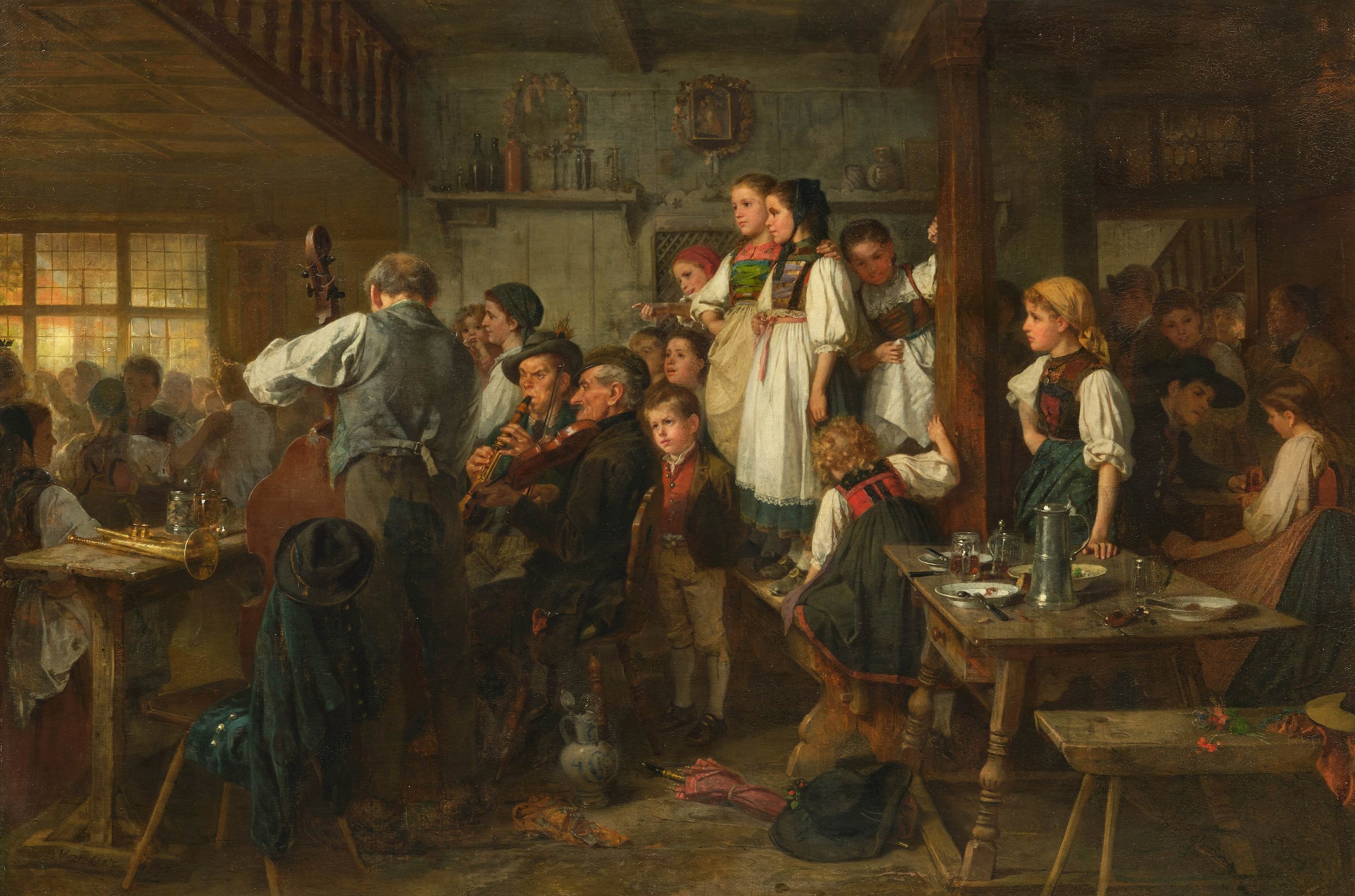
Benjamin Vautier Festgesellschaft beim Tanz
Benjamin Vautier
- Medium:
- Ink
- Dance:
- Folk/Country
- Era:
- Late 1800s (Victorian Ballroom)
- Source:
- Wikimedia Commons
- Rights:
- Public domain — free to use, share and adapt.
- Recorded as:
- Public Domain
This image shows how dance was embedded in village life and community ritual in 19th-century Alpine culture, and what mattered to urban artists about documenting it: not the steps themselves, but the crowd, the musicians, the warmth, and the togetherness. For historians of folk dance, it is evidence of the instruments, dress, and social context in which such dances occurred, even if the choreography is not visible.
What you are looking at
A crowded cottage interior erupts in festive celebration. Musicians occupy the center-left: a man plays bagpipes while another holds what appears to be a wind instrument, and a third figure plays a stringed instrument. Around them, figures in folk dress—women in white linen shifts with colored vests and aprons, men in dark jackets—cluster in animated groups. Some stand on tables and benches to watch; others lean in close. The lighting is warm and amber, concentrated around the musicians and the crowd, with the shadowed interior receding toward shelves of household goods and religious images on the whitewashed walls. The composition is dense and overlapping, capturing a moment of collective joy rather than ordered choreography.
The dancing
The bodies are angled inward toward the musicians rather than arranged in dance formation. Most figures stand or lean, watching intently; no one is in a clear dance hold or frame. Some appear to be clapping or gesturing with hands raised. The overall posture is convivial and celebratory rather than executed—weight distributed in standing positions of attention and engagement rather than the suspension or extension of trained movement. The scene suggests participation in festivity but not a display of technical dance.
The dance depicted
This is a genre scene of Alpine or Central European folk celebration, almost certainly German or Swiss given Vautier's practice. The presence of bagpipes and the cottage setting indicate mountain village culture. Whether dancing is actively occurring is ambiguous from the image: the gathering is clearly musical and festive, but no figures are positioned in recognizable dance steps or holds. The crowd may be actively dancing (folk dances like the Ländler were performed at such gatherings), or they may be assembled to hear music, clap, and celebrate. The work documents the social event rather than isolating the dance itself.
How it was made
The catalogue records this as ink, but the visual evidence—the rich modeling of light, the warm atmospheric quality, the layered application of color, the careful rendering of fabric and shadow—suggests oil on canvas or possibly a large gouache. Ink alone cannot produce these effects. The work is executed with the detail and finish of exhibition-scale academic painting, suggesting it was made for display and a literate urban audience familiar with ethnographic subject matter rather than for reproduction. The technique allows the artist to capture the complexity of crowd psychology and the subtle play of firelight on gathered people.
About this work
Benjamin Vautier was a prolific German-Swiss painter of village life and peasant subjects active in the mid-19th century. This work depicts a folk music gathering in a mountain cottage, crowded with figures in traditional dress clustered around musicians. The painting captures a moment of communal festivity—what the title calls a 'Festgesellschaft' (festive gathering) at a dance or music event. As a scene of dance and music-making in rural culture, it belongs to a tradition of 19th-century Orientalist and ethnographic art that used peasant subjects to explore authenticity, community, and the picturesque non-urban world. The work documents not the refined execution of dance but its social embeddedness—music and movement as expressions of collective identity.
How to look at it
Look first at the dense, overlapping composition: no figure is isolated or posed artificially. The artist has chosen a moment of collective attention rather than a moment of individual skill. Notice the instruments—bagpipes dominate—and the dress: the women's white linen and colored vests, the men's dark jackets. The light is the key to meaning: it pools around the musicians and the nearest watchers, creating intimacy and warmth, while the edges of the room fade into shadow. This is not a dance show but a communal event, and the painting honors that distinction.
The artist
Benjamin Vautier (1829–1898) was a German painter born in Mulhouse (Alsace) who spent much of his career in the mountain regions of Switzerland and Germany. He specialized in detailed genre scenes of peasant and village life—celebrations, markets, domestic interiors, and communal events. His work was commercially successful and widely reproduced; he painted the same subjects repeatedly for a middle-class market hungry for images of picturesque rural authenticity. His style combined careful realism with warm, anecdotal sentiment.
The period
The 1870s were the height of European fascination with peasant culture as a source of authentic national identity and pre-industrial virtue. Painters like Vautier capitalized on this market by documenting village life with ethnographic precision but romantic framing. At the same time, folk dance itself was being collected and codified by nationalist movements across Europe—the Ländler, polka, and other regional forms were being elevated from local practice to symbols of national character. Vautier's painting sits at the intersection: a record of actual practice transformed into art-world commodity.
Where it lives
The work is dated 1872 (signed lower left). The catalogue record notes oil on canvas and dimensions (77.5 × 115.5 cm) but provides no holding institution; the source is listed as Wikimedia Commons, suggesting the image is widely circulated but the physical work's current location is not recorded here.
Dance in this work
Questions about this work
Is anyone actually dancing in this painting?
The image shows a festive musical gathering in a cottage, but no figures are clearly positioned in dance steps or holds. The crowd is animated, engaged, clapping, and celebrating around musicians, but whether active dancing is occurring or whether people are assembled to listen and participate socially is ambiguous from the painting alone. The title and setting suggest a dance event, but Vautier has chosen to depict the gathering rather than the choreography.
What instruments are being played?
A bagpiper dominates the left side of the composition. At least one other musician holds what appears to be a wind instrument (possibly an Alpine horn or similar), and a third plays a stringed instrument, possibly a hurdy-gurdy or fiddle. These are the instruments of Alpine folk music, characteristic of the mountain villages that were Vautier's frequent subject.
What region does this depict?
The costume, instruments, architecture, and Vautier's own practice point to the Alpine regions of Switzerland or southern Germany. The white linen shifts, colored vests, and aprons are consistent with 19th-century mountain village dress. Vautier worked extensively in these regions and painted such scenes repeatedly.
Why would a 19th-century urban audience care about this subject?
In the 1870s, middle-class European collectors and museums were fascinated by peasant life as a source of authenticity, national character, and pre-industrial virtue. Vautier's paintings offered urban viewers a window into village culture that seemed more honest and emotionally direct than urban society. The scenes also served nationalist agendas—documenting folk traditions as evidence of national identity.
More Folk/Country artwork