34 works in this view — arrow keys or swipe to move between them.
Dance in Art · 1910
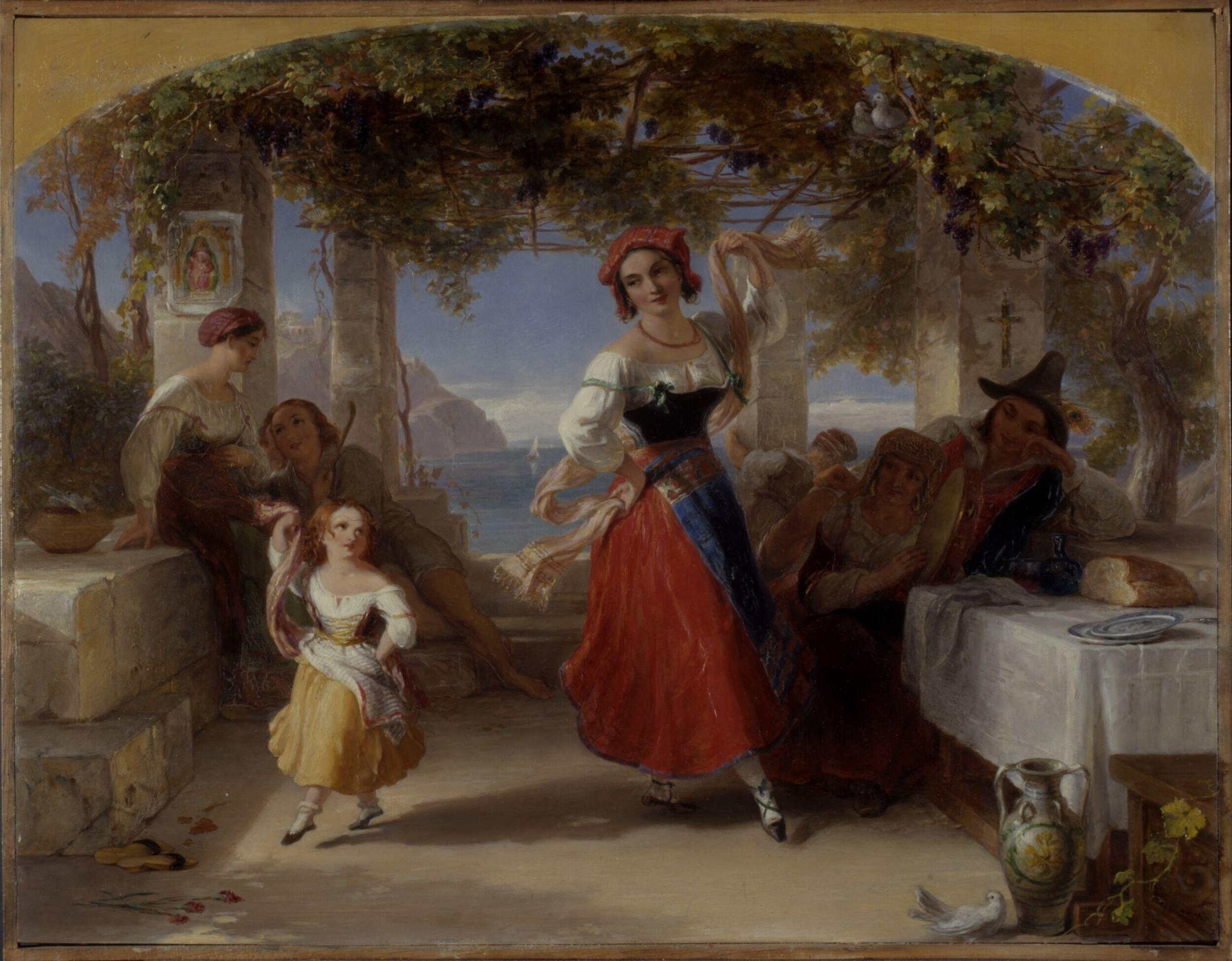
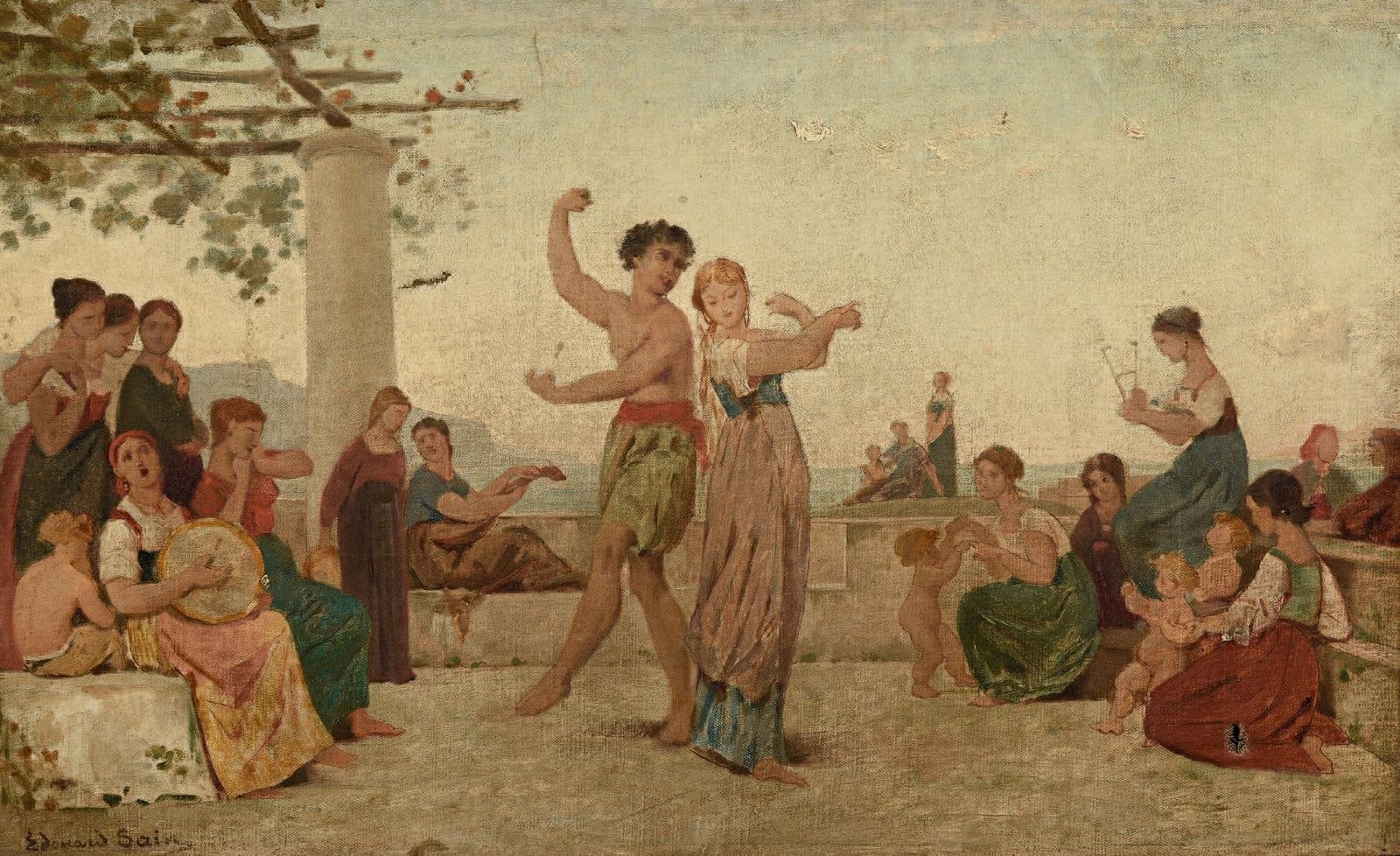
Dance in Italy (unknown date), by Édouard Alexandre Sain
Édouard Sain
- Medium:
- Oil Painting
- Dance:
- Folk/Country
- Era:
- 1900-1920 (Ragtime/Early Jazz)
- Source:
- Wikimedia Commons
- Rights:
- Public domain — free to use, share and adapt.
- Recorded as:
- Public Domain
The work demonstrates how European academic painters used classical antiquity as a screen for exploring contemporary anxieties about body, gender, and social order. The female dancer's composed, almost passive stance and the male dancer's expansive, physically dominant gesture reflect late 19th-century gender conventions, even as they claim to represent timeless classical values. For dance historians, this is a crucial reminder that historical images of dance are never merely descriptive; they are always interpretive, shaped by the artist's own moment and assumptions.
What you are looking at
A sunlit Mediterranean courtyard or terrace, painted in warm ochres and pale blues, hosts an informal gathering of figures around a central pair of dancers. The two dancers occupy the composition's heart: a bare-chested man with dark curly hair, wearing red drapery at the waist, raises one arm in an expansive gesture while the other swings freely; beside him stands a young woman in a cream-and-green draped dress, her posture open and receptive. They are surrounded by seated and standing onlookers—women and children in period dress, some holding tambourines or lyres, others simply watching. The setting suggests antiquity: classical columns frame the scene, and ivy drapes from above. The paint is applied loosely, with much of the canvas showing through, creating an effect of immediacy and sketch-like informality that was characteristic of late 19th-century academic painting. The light is even and diffuse, casting minimal shadows, which flattens the figures slightly and emphasizes the frieze-like arrangement of the group.
The dancing
The male dancer's upper body is animated: his shoulders are loose, one arm raised to shoulder height with the palm open, the other extended downward in a flowing counterbalance. His weight appears to rest on a single leg, suggesting mid-stride or mid-turn. The female dancer's pose is more contained; she stands nearly upright, her arms at mid-height with elbows slightly bent, creating a composed, receptive frame. The surrounding figures—predominantly women and children—are arranged in informal groups on the ground or on stone ledges, creating a gallery of witnesses. Their attention is directed toward the dancers, establishing the social and ceremonial nature of the event. No closed holds or partner frame are evident; the dancers occupy shared space but do not touch.
The dance depicted
This appears to depict an imagined scene of ancient Greek or Roman social dancing, likely informed by classical sources and 19th-century Romanticism rather than ethnographic accuracy. The context—a leisured outdoor gathering with musicians and witnesses—suggests a celebration or religious festival, traditions associated with Greek and Roman symposia or sacred processions. The male dancer's free, open movement and the female dancer's receptive posture are consistent with ancient literary descriptions of social dancing where men and women danced separately or in less codified proximity than later European ballroom forms. The presence of tambourines and lyres reinforces the Hellenic or Roman setting. This is not a folk or regional tradition as the catalogue record suggests, but rather a painter's interpretation of classical antiquity through the lens of 19th-century academic art and historical imagination.
How it was made
Oil on canvas, applied with visible brushwork and tonal economy. The artist has used a limited palette dominated by warm earth tones—ochre, sienna, pale cream—with touches of deeper greens and reds. Much of the canvas is left semi-exposed, with thin glazes allowing the ground to show through, a technique common in late 19th-century academic practice. This approach creates an effect of immediacy and sketch-like spontaneity while maintaining the compositional control expected of salon painting. The technique would have been suited to reproduction, suggesting this work was intended for broader circulation through engraving or photographic reproduction in art periodicals or monographs.
About this work
This is an imaginative reconstruction of an ancient Mediterranean dance scene, painted in the academic tradition of the late 19th century. Édouard Sain, a French academic painter known for historical and orientalist subjects, has composed a frieze-like arrangement of classical figures around two central dancers to convey a moment of social or ceremonial performance. The work belongs to a long tradition of European painters invoking antiquity to explore themes of leisure, beauty, and the civilized society—a tradition that was deeply invested in distinguishing European high culture from contemporary non-European peoples. For a dance historian, the painting is valuable not as documentary evidence of how ancient peoples actually danced, but as a window into how late 19th-century European artists imagined dance, movement, and social life. It shows an informed appreciation for the compositional principles of Greek vase-painting and fresco traditions, translated into the academic oil medium.
How to look at it
Attend to the asymmetry between the two dancers: the man's energy is kinetic and expansive, his body caught mid-gesture; the woman's is static and composed. Notice how the surrounding figures are arranged—not as equal participants but as an audience, with their bodies angled toward the dancers and their attention clearly directed. The painting freezes a moment of performance, not of partnership. Look also at the handling of drapery: the man's fabric swings freely with his movement, while the woman's falls in orderly folds, reinforcing the gendered contrast. The classical setting—the column, the ivy, the warm stone—frames this as a timeless moment, even though its sensibility is thoroughly modern and European.
The artist
Édouard Alexandre Sain (1830–1910) was a French academic painter specializing in historical, orientalist, and mythological subjects. He exhibited regularly at the Paris Salon and was associated with the academic tradition that dominated French official art in the mid-to-late 19th century. His work is characterized by careful composition, attention to historical costume and setting, and a romantic sensibility toward both the distant past and contemporary non-European cultures. Sain's interest in 'Italy'—whether as classical antiquity or contemporary peasant culture—was shared by many European artists of his generation, reflecting both genuine scholarly interest and the commodification of Mediterranean exoticism for the northern European market.
The period
This painting was made during a period when European academic art was investing heavily in historical reconstruction and orientalism. The late 19th century saw intensifying scholarly interest in ancient Greek and Roman life, fueled by archaeological discoveries and new philological methods. At the same time, European artists and writers were increasingly staging antiquity as a contrast to industrial modernity, recovering it as a source of aesthetic and social values. In dance specifically, this was the era of the classical ballet tradition—Petipa's St. Petersburg ballets were at their height—and also of the emerging Greek-inspired 'natural' dance reform movements that would culminate in Isadora Duncan. Sain's painting sits at the intersection of these currents: it invokes classical authority while also suggesting a more 'natural,' uncodified movement aesthetic than the rigid ballet of the academic stage.
Where it lives
The work is recorded as oil on canvas with a date of 1910, though the catalogue notes that the date may be uncertain. It is held in an unspecified collection and appears to have entered the public record through Wikimedia Commons.
Questions about this work
Is this meant to be historically accurate?
No. This is an imagined reconstruction, created by a 19th-century European painter working from classical literary sources, vase paintings, and historical knowledge of his time. It tells us more about how late 19th-century academics thought about antiquity than about how ancient peoples actually danced. However, it is informed by real scholarship and visual sources, so it is not pure fantasy; it represents a credible (if heavily interpreted) vision of classical dancing.
What dance is being performed?
It is impossible to identify a specific named dance. The setting and costumes suggest ancient Greek or Roman social dancing, possibly part of a religious festival or celebration. The open, gestural quality of the male dancer's movement and the presence of musicians (lyre and tambourine players visible in the group) suggest improvisational social dancing rather than a formal choreographed form.
Why does the male dancer move so differently from the female dancer?
This reflects both classical sources (ancient texts describe men and women dancing separately or in less formal proximity) and 19th-century gender conventions. The painter has emphasized the man's physical agency and the woman's composure, unconsciously projecting modern gender assumptions onto the classical past. This asymmetry tells us as much about the Victorian era as it does about antiquity.
Who was Édouard Sain?
Sain (1830–1910) was a successful French academic painter known for historical and orientalist subjects. He was part of the established Salon tradition and had a steady market among European collectors for works that combined scholarly historical interest with romantic aesthetics. His work was widely reproduced and circulated through art journals and monographs.
More Folk/Country artwork