35 works in this view — arrow keys or swipe to move between them.
Dance in Art · 1910
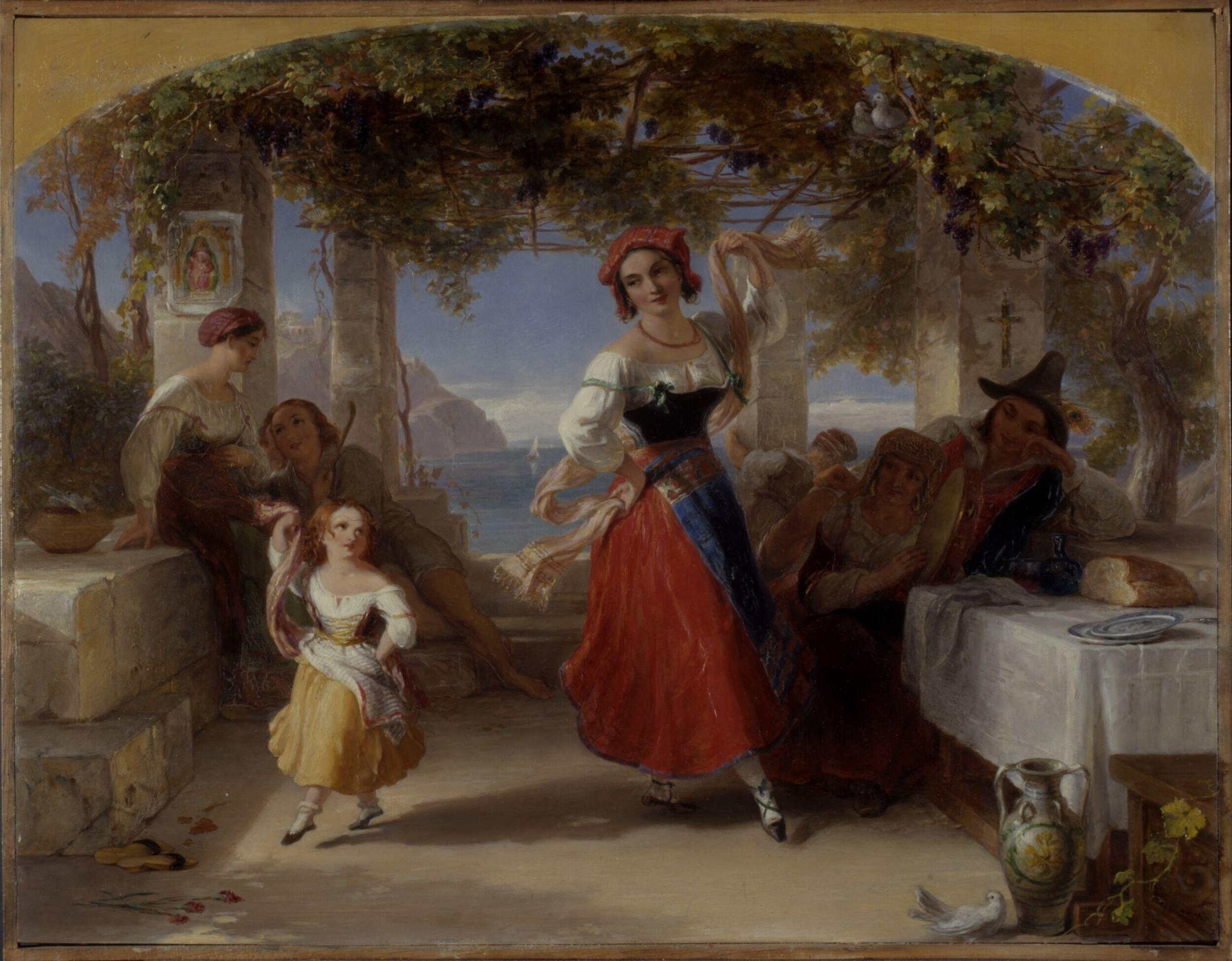
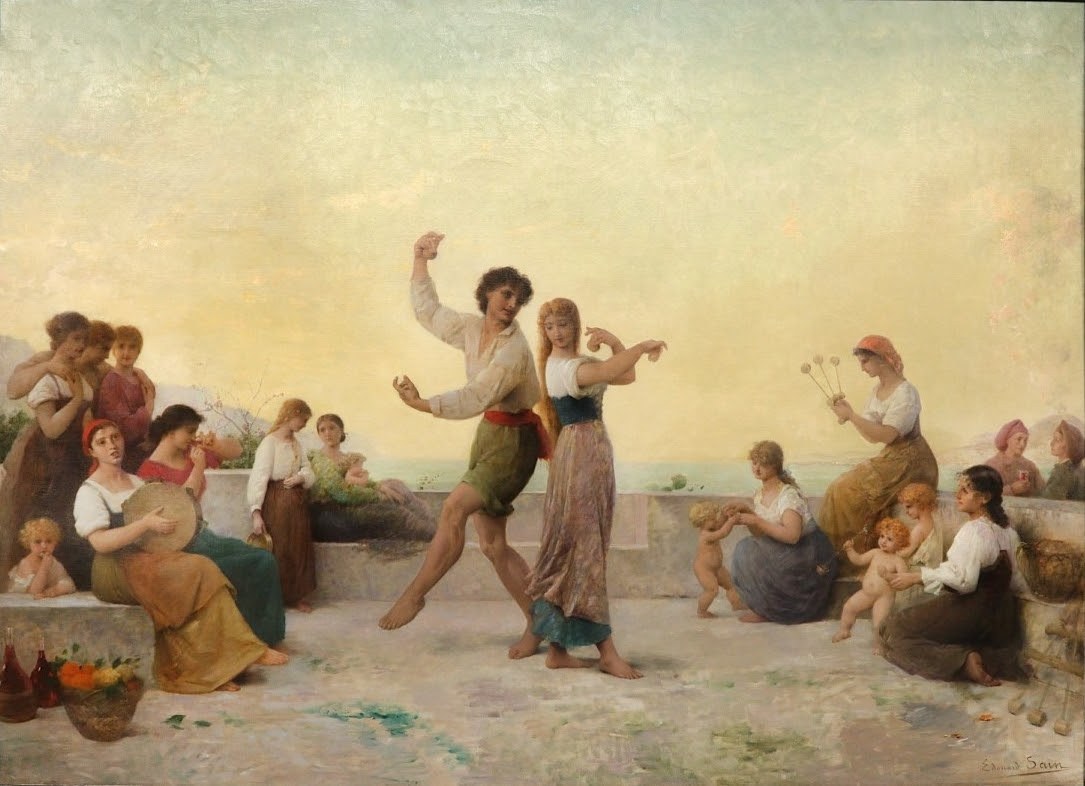
Dancing on the terrace (unknown date), by Édouard Alexandre Sain
Édouard Sain
- Medium:
- Oil Painting
- Dance:
- Folk/Country
- Era:
- 1900-1920 (Ragtime/Early Jazz)
- Source:
- Wikimedia Commons
- Rights:
- Public domain — free to use, share and adapt.
- Recorded as:
- Public Domain
This painting captures the essence of social dance outside the concert hall or ballroom: dance as spontaneous pleasure, embedded in family and community life. For a historian of dance culture, it provides evidence of how folk or popular dance was actually performed, who performed it, and what attitudes surrounded it in this era—information rarely accessible from other sources.
What you are looking at
A leisurely seaside gathering unfolds across a sunlit terrace overlooking the Mediterranean. The composition is anchored by two central figures engaged in an exuberant dance—a man in light shirt and dark trousers, one leg lifted high in a vigorous kick, and a woman in flowing skirt and pale bodice, both with arms raised and bodies animated mid-movement. Around them, arranged in loose groups, are roughly fifteen figures: women in period dress seated on stone benches or standing, some nursing infants, others watching the dancers with apparent pleasure. Children cluster at ground level. The palette is soft and warm—ochres, creams, pale blues in the drapery—with the sea and distant shore rendered in hazy yellows and greens. The light is Mediterranean afternoon light, casting gentle shadows across the terrace floor where scattered flowers or greenery suggest a cultivated space. The mood is one of leisure, intimacy, and domestic social pleasure rather than theatrical spectacle.
The dancing
The two central dancers occupy the full height of their bodies in the frame. The man's weight is clearly committed to his left leg as his right knee drives upward—a vigorous, elastic gesture—while both arms extend outward with relaxed confidence. The woman dances beside him with knees slightly bent, hips engaged, arms also raised and extended, creating a visual conversation between the two figures. Their bodies face toward each other and toward the gathered group, playing to an audience. The surrounding figures are largely stationary, seated or standing in attitudes of repose, establishing the dancers as the focal point of social attention.
The dance depicted
This depicts social or folk dancing in a Mediterranean setting, most likely Italian given the artist's name and the terrace context. The high knee lift and extended-arm posture suggest vigorous popular dancing rather than academic ballroom form—possibly tarantella or a regional Italian folk dance, though the loose, unstructured environment makes precise identification difficult. The gesture is playful and uninhibited, characteristic of recreational social dance rather than performance or competition. The presence of women, children, and mixed ages suggests family or community celebration.
How it was made
Oil painting on canvas, as recorded. The technique is loose and impressionistic in the background figures and landscape, with softer attention to the distant seascape and harder, more modeled focus on the central dancers and the nearest seated figures. The brushwork in the sky and water is feathery and atmospheric; the figures are more decisively rendered. This suggests a work concerned equally with capturing light and leisure as with documenting the specific gesture of the dance itself. The technique is consistent with late-19th or early-20th-century academic salon painting.
About this work
This is an oil painting of social dancing on a Mediterranean terrace, depicting an informal moment of folk or popular dance watched by a gathered community. The work belongs to a tradition of late-19th and early-20th-century European genre painting that celebrates rural or working-class leisure, rendered with the technical finish and soft naturalism of academic practice. The specific dance form cannot be identified with certainty from the gesture alone, but the energy, the setting, and the social context—the terrace, the family gathering, the uninhibited physical expression—mark it as a document of popular recreational dance as it was practiced and understood in southern Europe during this period.
How to look at it
Notice how the artist has frozen the moment at the peak of the dancers' exertion—the man's knee is fully lifted, both figures' arms are fully extended—giving the frozen image a sense of kinetic energy and joy. The composition places the dancers not above the gathered crowd but among it, on the same ground, suggesting this is dance for participation and community pleasure, not for display. The soft, diffuse light and the loose brushwork in the background emphasize the warmth and informality of the moment rather than its spectacle.
The artist
Édouard Alexandre Sain (1830–1910) was a French academic painter known for domestic and genre scenes, particularly those depicting Mediterranean or southern European subjects. He exhibited regularly at the Paris Salon and worked in a realist-impressionist mode, favoring scenes of leisure, labor, and social gathering rendered with technical facility and warm light. His practice was centered on capturing the texture of everyday life among working people and rural communities.
The period
This painting dates to the late 19th or early 20th century, a moment when European academic painters were increasingly drawn to folk and popular subjects as sources of authenticity and vigor, in reaction to rapid industrialization. Dance, in particular, was valued as an expression of unmediated cultural identity—the opposite of the formality of ballroom or classical ballet. At the same time, ethnographic interest in folk practices was intensifying, and such scenes were often coded as documents of disappearing or 'traditional' ways of life. In dance history specifically, this period saw the rise of interest in folk dance as a subject for theatrical adaptation and preservation.
Where it lives
The work is recorded as an oil painting by Édouard Alexandre Sain, dated 1910 in the available record, though the catalogue entry indicates the date is unknown. It is accessible via Wikimedia Commons and its current holding collection is not recorded.
Dance in this work
Questions about this work
What dance are they doing?
The painting does not provide enough anatomical detail to identify the dance with certainty. The high knee lift and extended arms suggest vigorous folk dancing, possibly Italian tarantella or a regional variant, but the informal setting and the artist's apparent interest in the social moment rather than technical precision make definitive identification impossible. The painting documents the spirit and context of the dance rather than its formal structure.
Why is this a painting and not a photograph?
Oil painting allowed the artist to control light, compose the scene, and emphasize certain figures—here, the dancers and their central audience—in ways a photograph could not. It also elevated the subject to the status of fine art rather than mere documentation. The technique suggests this was a salon painting intended for exhibition and sale to educated urban collectors.
Is this a real place?
The terrace and Mediterranean setting are characteristic of southern Europe—likely Italy or southern France—but whether this depicts a specific location or a generalized ideal of Mediterranean leisure is unknown. The composition and lighting suggest the artist's interest in capturing a type of scene rather than a particular event.
More Folk/Country artwork