37 works in this view — arrow keys or swipe to move between them.
Dance in Art · 1910
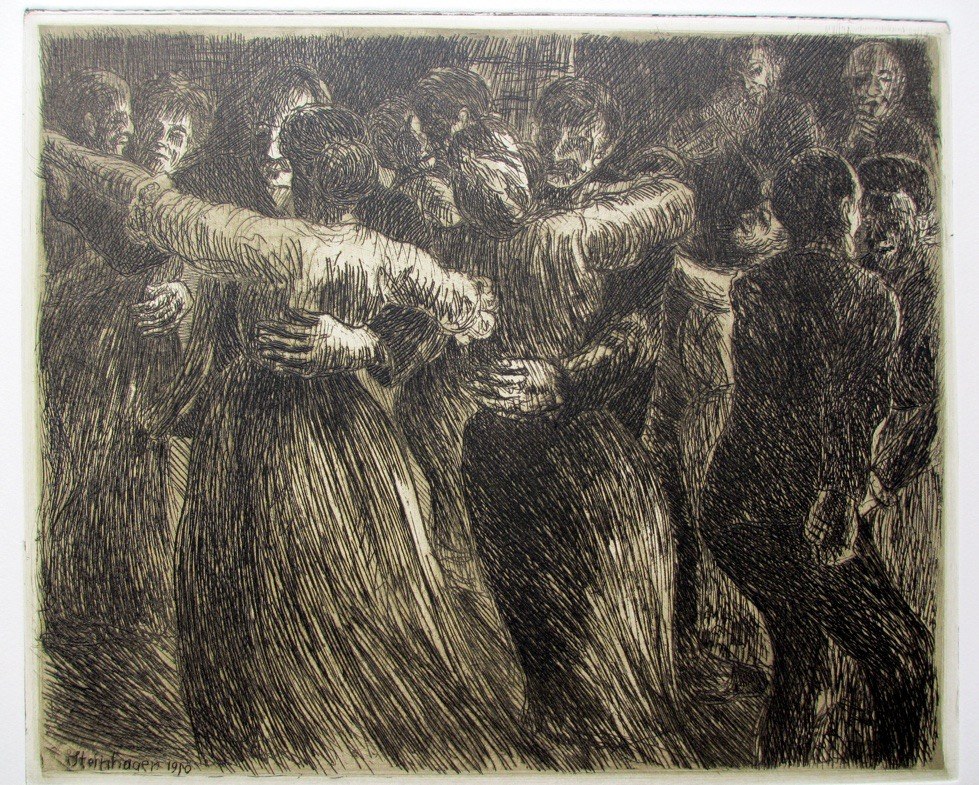
Heinrich Steinhagen - Bauerntanz 1910
Heinrich Steinhagen
- Medium:
- Oil Painting
- Dance:
- Folk/Country
- Era:
- 1900-1920 (Ragtime/Early Jazz)
- Source:
- Wikimedia Commons
- Rights:
- Public domain — free to use, share and adapt.
- Recorded as:
- Public Domain
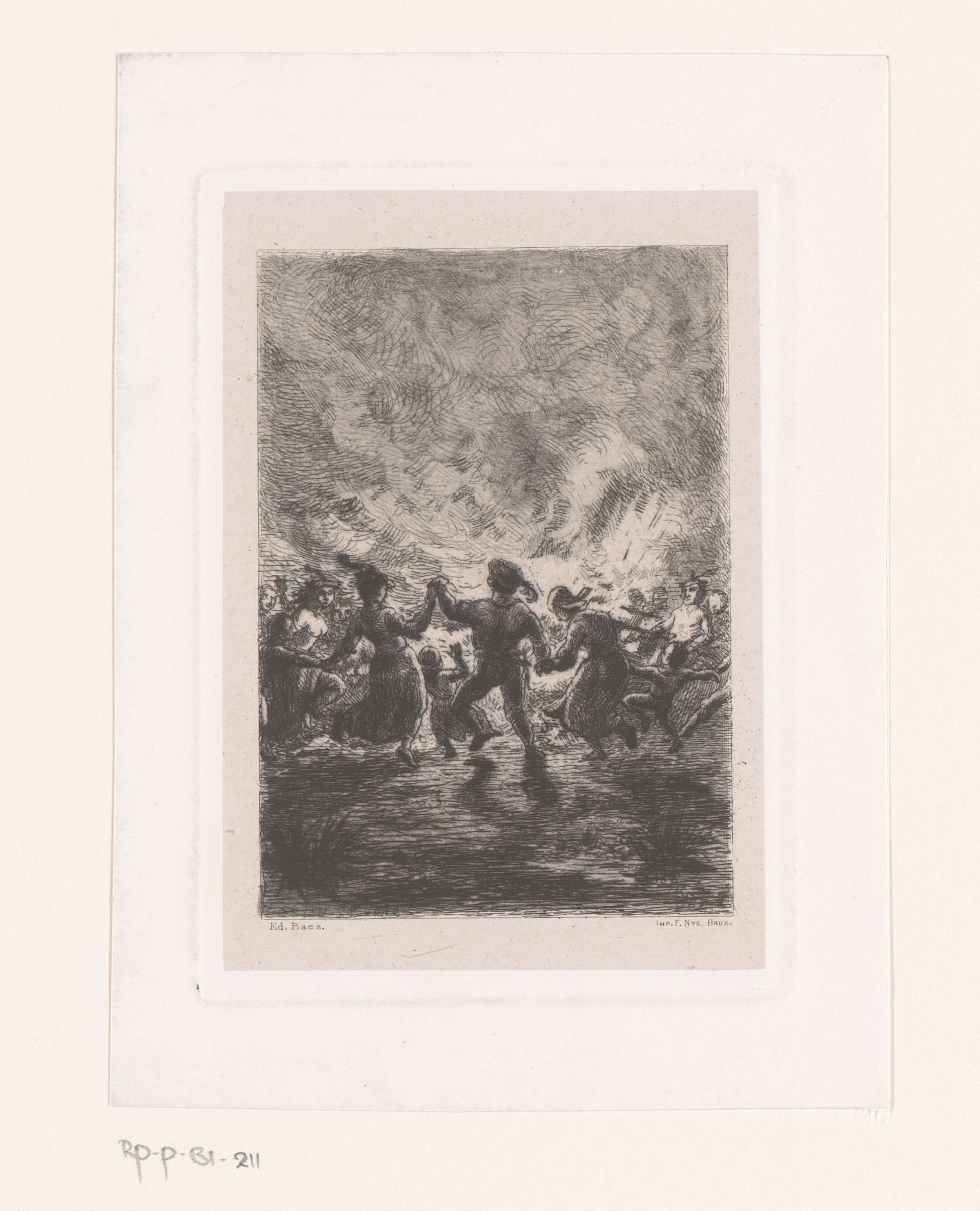
This etching demonstrates how folk dance was understood and valued in early 20th-century artistic practice: not as quaint or historical, but as vital, urgent, and worth recording with serious technical skill. For dance historians, it shows the visual vocabulary that urban artists deployed to represent rural celebration, and how much of that vocabulary emphasized bodily contact, crowd density, and uninhibited movement as markers of authenticity.
What you are looking at
A crowded rural dance scene rendered in bold, dynamic etching lines that convey urgent movement and close physical proximity. The composition is tightly packed with figures in period dress—men in dark suits and women in light-colored dresses with full skirts—arranged in what appears to be an indoor or semi-enclosed space. The central figures are engaged in active dancing, with bodies pressed close together and limbs extended. The artist has used heavy cross-hatching in the background to create shadow and depth, suggesting an energetic, even chaotic festive moment. The foreground shows dancers in mid-motion, their weight shifted and arms raised or extended, while figures in the background are partially obscured by the crowd and shadow. The overall effect is one of vitality and social abandon rather than formal arrangement.
The dancing
The dancers display open, uninhibited posture with raised arms and extended limbs characteristic of folk celebration rather than ballroom restraint. Several figures show weight clearly transferred through the body, with bent knees and forward-leaning torsos suggesting vigorous stepping and turning. The closest dancers are in close proximity but not in formal ballroom holds; instead they appear to be moving freely within the crowd, with some figures reaching toward or away from partners. The women's full skirts are rendered as dynamic masses of fabric that would lift and swing with rapid movement. Men and women appear to dance in rough proximity without the structured positioning of classical dance.
The dance depicted
This is a Bauerntanz (peasant or farmer's dance), a German/Central European folk dance tradition. The etching captures the social dance of rural communities, where courtship, celebration, and community bonding occurred through vigorous partner and group dancing. The absence of formal arrangement and the crowded, energetic composition reflect the participatory nature of folk celebration rather than performance for an audience. The raised arms, close spacing, and apparent rapid movement align with known characteristics of 19th-century Central European country dances, which typically featured turning, stamping, and close partnership.
How it was made
This is an etching—a intaglio printmaking process where the image is incised into a metal plate. The distinctive parallel lines and cross-hatching throughout are characteristic of etching technique; the artist has built tonal depth through line density rather than shading. The signature at lower left ('Steinhagen 1910') is etched into the plate itself. Etching allowed for fine linear expression and was well-suited to capturing movement through directional marks; the technique's inherent linearity actually enhances the sense of motion and energy. As a print, this work would have circulated among educated and middle-class audiences interested in contemporary German art and folk culture documentation.
About this work
Steinhagen's 1910 etching records a moment of rural German social dance with uncommon dynamism and psychological immediacy. Rather than arranging dancers in picturesque poses, the artist has captured the sensory chaos of a crowded celebration—bodies pressing together, fabrics in motion, the pressing crowd creating urgency rather than order. The work sits within early 20th-century German interest in folk culture and authenticity, a period when urban artists and collectors were documenting rural traditions they saw as under threat from modernization. Bauerntanz imagery appears frequently in German and Austrian art of this period, but Steinhagen's approach prioritizes the felt experience of the dance—the crush, the energy, the social release—over ethnographic documentation.
How to look at it
Attend to the etcher's choice to render the crowd rather than individual dancers as the subject. The eye cannot easily isolate single figures; instead it navigates the density of marks and bodies, which mirrors the actual experience of dancing in a crowded country celebration. Notice how the artist uses line direction—the parallel hatching follows no consistent direction but pools and swirls, suggesting physical chaos rather than visual order. The raised arms and forward-leaning postures are the key indicators of vigorous dancing; in folk dance of this tradition, such open positioning and close partnership differ markedly from the structured frames of contemporary ballroom dance.
The artist
Heinrich Steinhagen (1872–1946) was a German painter, printmaker, and illustrator active in the early 20th century. He worked primarily in etching and lithography and was part of the broader German tradition of documenting folk culture and rural life. His work reflects the period's fascination with authenticity and social realism, and he was engaged with both fine art printmaking and applied design. Little detailed biography is readily available, but his output suggests sustained engagement with social observation and the technical possibilities of the print media.
The period
In 1910, German and Austrian artists were actively engaged in Heimatkunst (homeland art)—a movement that sought to document and celebrate rural and folk traditions as repositories of authentic national character. This coincided with rapid industrialization and rural-to-urban migration, creating anxiety about cultural loss. Dance was a central focus of this documentation because it was understood as embodying communal values, regional identity, and pre-modern social bonds. Simultaneously, modern art was experimenting with expressive line and distortion as emotional carriers rather than descriptive tools; Steinhagen's aggressive cross-hatching and dynamic composition reflect these modernist innovations applied to folk subject matter.
Where it lives
The work is recorded as held in an unspecified collection and is known through Wikimedia Commons, where it appears to be in the public domain. It is catalogued only minimally, with the title 'Bauerntanz' and basic date and medium information; the present description attempts to move beyond the bare record.
Dance in this work
Questions about this work
Is this the same as Bavarian or Alpine folk dance?
Bauerntanz (peasant dance) was widespread across German and Central European rural regions, including Bavaria and Alpine areas, but was not confined to them. The term is regional rather than a specific codified style. Rural dances under this broad heading shared characteristics—vigorous turning, close partnership, and social rather than performative function—but local variations were significant. Steinhagen's etching does not provide enough specific costume or musical context to pinpoint a single regional tradition.
Why is the etching so dark and crowded?
The density of line creates both technical and expressive effects. Technically, etching builds tone through line density; more lines create darker areas. Expressively, Steinhagen uses this to convey the sensory overwhelm of a crowded celebration—the press of bodies, the intensity of the moment. This is a deliberate artistic choice that treats the crowd itself, rather than individual dancers, as the subject. The darkness also emphasizes the indoor or dimly lit setting and creates psychological intensity.
How is this different from ballroom dancing of the same era?
Ballroom dancing of 1910 was structured by strict codified holds, frame, and position—think of the waltz, foxtrot, or tango. Folk dancing as depicted here shows uninhibited arm positions, close but unregulated partnership, and movement driven by music and social participation rather than competitive or performance standards. The dancers here are not learning a technique; they are participating in community celebration. The absence of formal positioning is the point—it marks this as folk rather than ballroom.
Can you identify the music or specific steps?
No. The etching shows overall energy and positioning but not footwork detail or specific step patterns. We know from the title and composition that this is a peasant dance tradition, but without additional documentary evidence (musical notation, dance notation, or written description from the period), the specific steps, timing, and musical meter cannot be determined from the image alone. Folk dances of this family were typically danced to folk music in duple or triple meter with strong rhythmic drive.
More Folk/Country artwork