38 works in this view — arrow keys or swipe to move between them.
Dance in Art · 1649
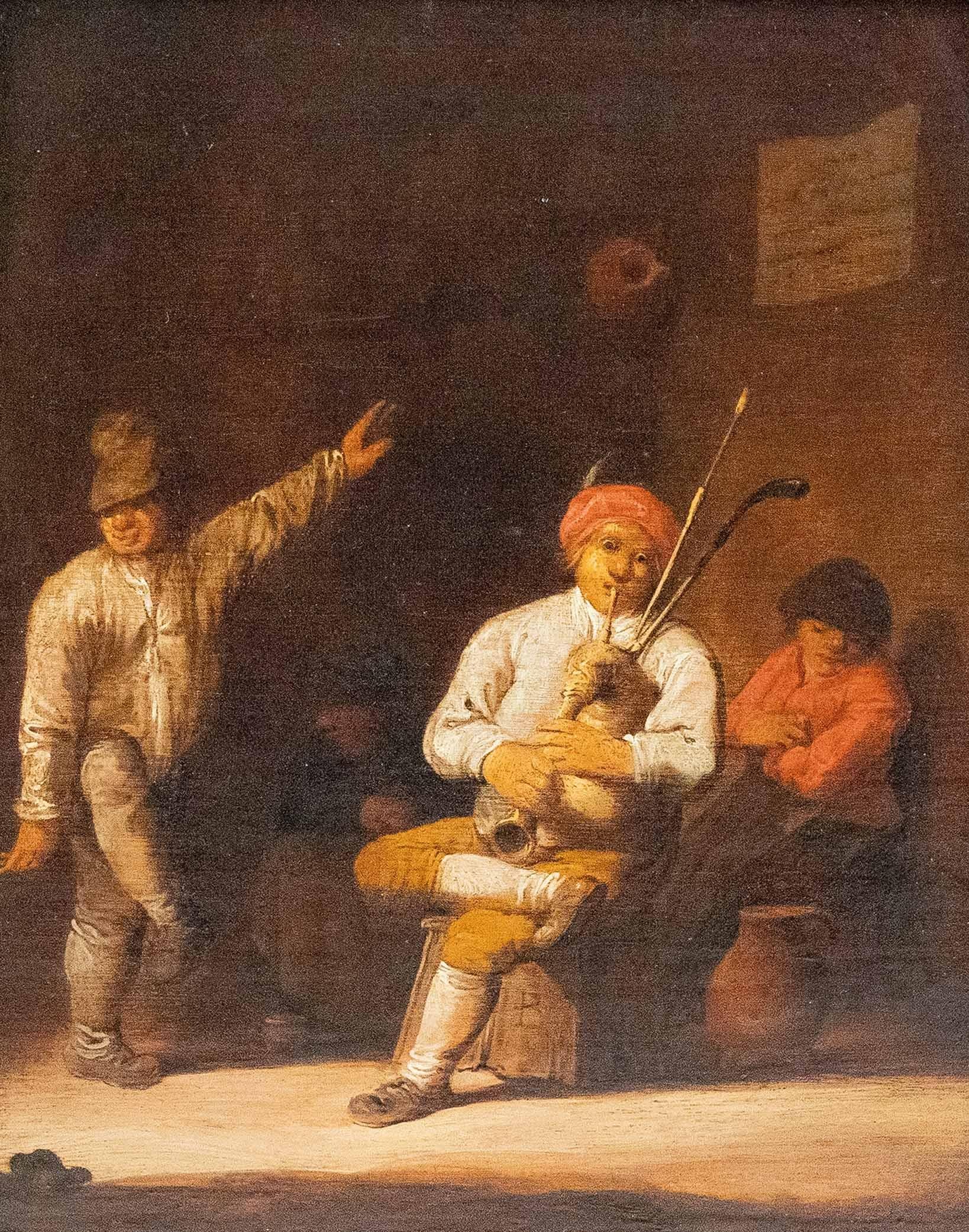
Jan Jansz Buesem Bagpiper and dancing man
Jan Jansz. Buesem
- Medium:
- Oil Painting
- Dance:
- Folk/Country
- Era:
- Pre-1700 (Renaissance/Baroque)
- Source:
- Wikimedia Commons
- Rights:
- Public domain — free to use, share and adapt.
- Recorded as:
- Public Domain
This work provides direct visual evidence of how folk dancing was actually performed in the 17th-century Low Countries—the bodily vocabulary, energy, and social context that formal dance manuals do not record. For dancers and historians, it is a precious document of ordinary people's movement culture at a time when such scenes were rarely thought worth preserving.
What you are looking at
A tavern interior, lit by warm golden light from the right, shows three figures engaged in folk entertainment. A bagpiper sits on a low stool at center-right, dressed in white shirt and breeches with a red cap, playing bagpipes with arms raised. To the left, a man in white shirt and yellow/gold breeches performs a vigorous solo dance, his body angled forward with one arm raised and legs in an active stride, seemingly captured mid-leap or energetic step. A third figure in rust-orange clothing stands to the right, watching. The setting is plain: dark earthen walls, a doorway with golden light beyond suggesting a passage or window, a bare floor. The composition is intimate and informal, the kind of scene that would have played out in taverns throughout the Low Countries.
The dancing
The dancer's posture shows explosive energy: trunk tilted forward, one leg extended, arms asymmetrically raised in a way that suggests vigorous folk movement rather than courtly restraint. His weight appears to shift mid-stride. The bagpiper sits with arms elevated to play, legs extended, anchored to his stool. The watching figure's stance is relaxed, a social observer. The grouping is not a partnered dance but a performance-and-audience configuration typical of tavern entertainment.
The dance depicted
This depicts vernacular folk dancing of the 17th-century Low Countries, almost certainly what would have been danced in taverns and inns to bagpipe music. The soloist's uninhibited posture, the absence of the formal frame or partnering of courtly dance, the tavern setting, and the bagpipe accompaniment all confirm this is folk or country dance—the everyday social dancing of ordinary people rather than trained performers. The movement vocabulary appears energetic and improvisatory, driven by the musician's pipes rather than by dance convention.
How it was made
Oil on wood panel, approximately 26 × 20.9 cm, signed with monogram 'B' on the stool. The small format and wooden support suggest this was a cabinet painting, a luxury object for a collector's display rather than a large public work. The technique is painterly and naturalistic within the Baroque idiom: warm tonalities, careful attention to light and texture, loose brushwork in the background contrasting with sharper modeling of the figures. The intimate scale allowed for close observation of gesture and social interaction.
About this work
This is a tavern scene from 1649 by Jan Jansz. Buesem, a Dutch or Flemish artist, capturing a moment of folk entertainment: a bagpiper and a solitary dancer in a moment of ordinary leisure. It belongs to a wider tradition of 17th-century Low Countries genre painting that found subject matter in the lives of working and ordinary people—their entertainments, their taverns, their music. Within the history of dance imagery, it is valuable as a record of how vernacular dancing looked and was performed: the body posture, the costume, the social context, the music that accompanied it.
How to look at it
Attend to the dancer's body first: the forward tilt, the raised arm, the extended leg, the sense of ongoing motion rather than a posed moment. This is not a ballroom or court stance. Compare it to the bagpiper's anchored, symmetrical position—the musician sustains; the dancer projects outward. Notice the tavern light—warm, domestic, intimate—and how the artist has lit the figures from the side, making the dancer's action legible. The artist has chosen the moment of greatest energy, not of stillness.
The artist
Jan Jansz. Buesem was a painter active in the Low Countries in the mid-17th century, known for small cabinet paintings of genre scenes—tavern interiors, music-making, everyday life. His monogram 'B' appears on the stool in this work. He worked in the tradition of Dutch and Flemish genre painting, a market that had grown during the 17th century as wealthy merchants and burghers collected small, intimate paintings of contemporary life. His practice reflects the values of that market: narrative clarity, warm domestic light, careful observation of costume and social detail.
The period
The 17th century saw an explosion of genre painting in the Dutch and Flemish Low Countries, as a newly affluent merchant class sought paintings of contemporary life and social interaction rather than religious or historical subjects. Tavern and music-making scenes were popular, reflecting both the leisure culture of towns and the painters' interest in light, color, and human expression. At the same time, formal dance was becoming codified—the French court was developing ballet as we know it—but street and tavern dancing remained improvisatory, regional, and largely undocumented in images or writing. This painting sits at that boundary: a record of the dancing that formal dance historians ignored.
Where it lives
The work is recorded in Wikimedia Commons and is known from an existing catalogue, though the current holding collection is not specified in the record. It is catalogued as oil on wood panel, circa 26 × 20.9 cm, signed with the monogram 'B' for Buesem.
Dance in this work
Questions about this work
Is this a couple's dance?
No. The scene shows a solo male dancer performing to a bagpiper, with a third figure watching. This is entertainment performance within a tavern social setting, not a partnered dance.
What kind of music is the bagpiper playing?
The instrument is a bagpipe, which was common in folk and dance music across northern Europe in the 17th century. The exact melody is unknown, but bagpipes typically provided rhythmic, insistent accompaniment for dancing.
Could this be a depiction of a specific named dance?
Unlikely with certainty. The painting shows vernacular folk dancing without enough documentary detail or text to identify a particular regional or named dance form. The bagpipe and tavern setting, and the energetic posture, indicate folk tradition rather than court dance.
Why is this painting small?
It is a cabinet painting, a luxury product for collectors. The small format allowed for intimate display in a private home or collection, and the scene's close observation of gesture and social detail rewards close viewing.
More Folk/Country artwork