40 works in this view — arrow keys or swipe to move between them.
Dance in Art · 1944
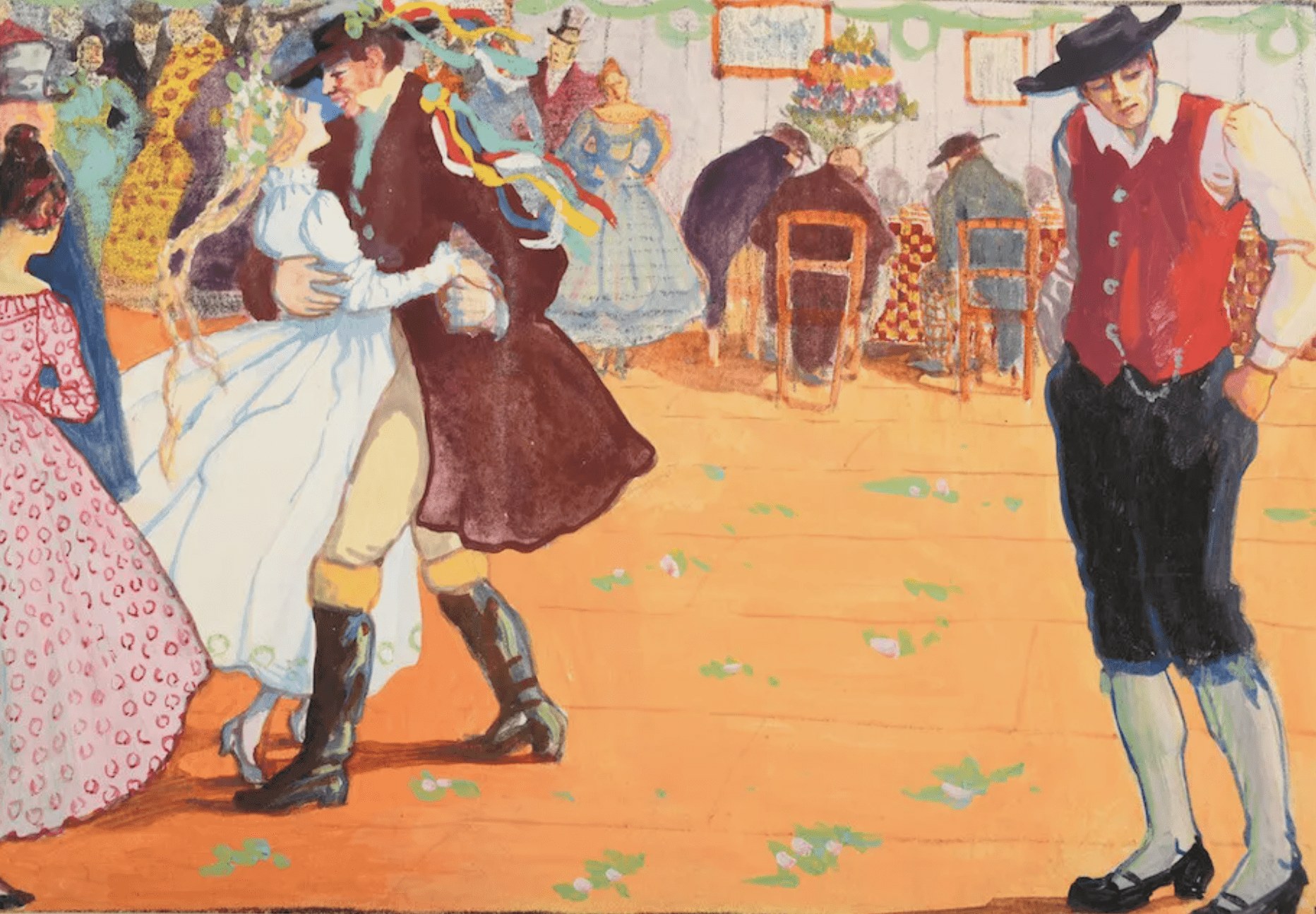
Margarete Schneider-Reichel Hochzeitstanz
Margarete Schneider-Reichel
- Medium:
- Oil Painting
- Dance:
- Folk/Country
- Era:
- 1920-1950 (Swing Era)
- Source:
- Wikimedia Commons
- Rights:
- Public domain — free to use, share and adapt.
- Recorded as:
- Public Domain
The work documents a lived tradition of folk celebration at a specific historical moment and reveals how regional dance practice was visualized for mass audiences through illustrated journals. For historians of folk dance, it provides evidence of costume, setting, and social organization; for historians of German visual culture, it shows how dance functioned as a subject of commercial illustration during the 1940s.
What you are looking at
A wedding celebration in a rustic interior, with dancers and musicians arranged across a wooden floor scattered with greenery. The composition centers on a couple in folk costume mid-dance: a woman in a white petticoat with blue stripes and an embroidered red vest, and a man in burgundy jacket and white breeches with decorated garters. Their bodies are in close proximity, suggesting a partner dance. The background shows gingerbread-house-like structures with orange-painted doors—likely decorated platforms or stages—and additional figures in folk dress watching or participating. The scene is suffused with warm ochre and orange tones; the artist has rendered the figures with soft edges and heightened color that suggests watercolor or gouache rather than the oil stated in the record. Musicians are visible in the upper left, and the overall atmosphere is one of festive celebration rather than formal instruction.
The dancing
The central couple stand in approximate closed position though the frame is looser than ballroom dance would demand—typical of folk dancing. The woman's weight appears to be in the right hip, with her left leg potentially preparing movement; the man faces her directly. Both figures have relaxed, natural posture rather than the pulled-up frame of theatrical dance. Spectators ring the space, some in partial profile, suggesting this is a participatory community event rather than a performance for an audience.
The dance depicted
This depicts a Hochzeitstanz—a wedding dance, most likely German or Central European folk tradition—as confirmed by the title. The costumes, interior setting, and decorative architectural elements point to Alpine or Bavarian folk practice. The couple's hold and the presence of musicians suggest a partner dance in a social rather than theatrical context. The scattered greenery on the floor may indicate seasonal decoration associated with wedding festivities. Without closer examination of footwork or specific hold conventions, the exact folk dance variant cannot be determined with certainty, but the scene documents a living tradition of courtship and celebration through dance.
How it was made
The record lists this as oil painting, but the soft color transitions, the delicate rendering of the figures, and the translucent quality of the fabrics indicate this was executed in watercolor or gouache. The handling is consistent with design work or illustration rather than studio oil practice. The notation in the existing description—'Aquarell, Entwurf für die Meggendorfer-Blätter'—confirms watercolor execution and identifies this as a design or preparatory work for Meggendorfer-Blätter, a German satirical and humorous illustrated journal. This was thus a professional commercial work intended for reproduction rather than a fine art object.
About this work
This is a watercolor design for a German illustrated journal, documenting a Hochzeitstanz—a traditional wedding dance of Alpine or Bavarian folk culture. Margarete Schneider-Reichel has captured the festive, participatory character of the event through warm color, relaxed gestures, and the inclusion of musicians and onlookers. The work preserves both the costume and the social practice of a regional tradition in the mid-twentieth century, at a moment when such celebrations were being documented by both ethnographers and commercial illustrators. It belongs in a dance history collection both as a visual record of folk practice and as evidence of how dance featured in popular illustrated media of the period.
How to look at it
Attend first to the central couple and their ease of movement—the artist has chosen a moment of contact and connection rather than a display of virtuosity. Note the scale and role of the spectators and musicians: this is not a stage performance but a participatory celebration, and the composition includes them as essential to the event rather than as background. The warm palette and the soft handling of the figures create an atmosphere of intimacy and pleasure rather than formality. The gingerbread-house structures and the scattered greenery are specific local details that ground the scene in a particular regional practice.
The artist
Margarete Schneider-Reichel was a German illustrator active in the early-to-mid twentieth century, known for watercolor designs and illustrations. Her work for Meggendorfer-Blätter—a journal famous for its hand-colored lithographic illustrations of humor, satire, and daily life—placed her within a tradition of commercial art production that required close observation of social practice and keen skill in figure drawing. The journal's audience was middle-class and urban; its commissioning of rural and folk subjects served both documentary and entertainment functions.
The period
In 1944, folk dance and folk culture held complex meanings in German cultural life. While Nazi ideology had appropriated folk traditions as part of racial ideology, commercial illustrated journals like Meggendorfer-Blätter continued to treat folk life as a source of humor and nostalgic interest for urban readers. Ethnographic interest in regional dance traditions was active throughout the twentieth century, and the 1940s saw increasing documentation of practices as older ways of life were perceived to be disappearing. The watercolor technique itself was standard for commercial illustration and design work of the period, allowing rapid production and hand-coloring for reproduction.
Where it lives
The work is held in Wikimedia Commons. It is identified as a preparatory watercolor design for Meggendorfer-Blätter, a German illustrated journal, indicating its status as professional commercial art produced for mass reproduction rather than as a unique fine art object.
Dance in this work
Questions about this work
What is a Hochzeitstanz?
A Hochzeitstanz is a traditional wedding dance, especially in German and Alpine folk cultures. It was typically danced by the newlyweds and their guests as part of the celebration and could vary by region. The dance served both ceremonial and social functions, marking the transition to married status and inviting community participation in the joy of the occasion.
Why would an illustrated journal commission a dance scene?
Meggendorfer-Blätter was known for depicting everyday life, humor, and regional culture. Dance scenes were popular subjects because they combined visual interest, narrative content, and appeal to readers' curiosity about traditions and social customs. A festive wedding scene would have been both entertaining and nostalgic for an urban middle-class audience.
How can you tell this is watercolor and not oil?
The soft color transitions, the translucent quality of the painted areas, and the way light passes through the figures are characteristic of watercolor or gouache rather than opaque oil paint. The delicate handling and the notation in the existing description confirming 'Aquarell' (watercolor) support this assessment.
What do the costumes tell us about the region?
The embroidered vests, the structured white petticoats with contrasting stripes, the decorated garters, and the specific cut of the jackets are consistent with Alpine or Bavarian folk costume. These details would have been recognizable to German readers as marking a specific regional identity.
More Folk/Country artwork