42 works in this view — arrow keys or swipe to move between them.
Dance in Art · 1756
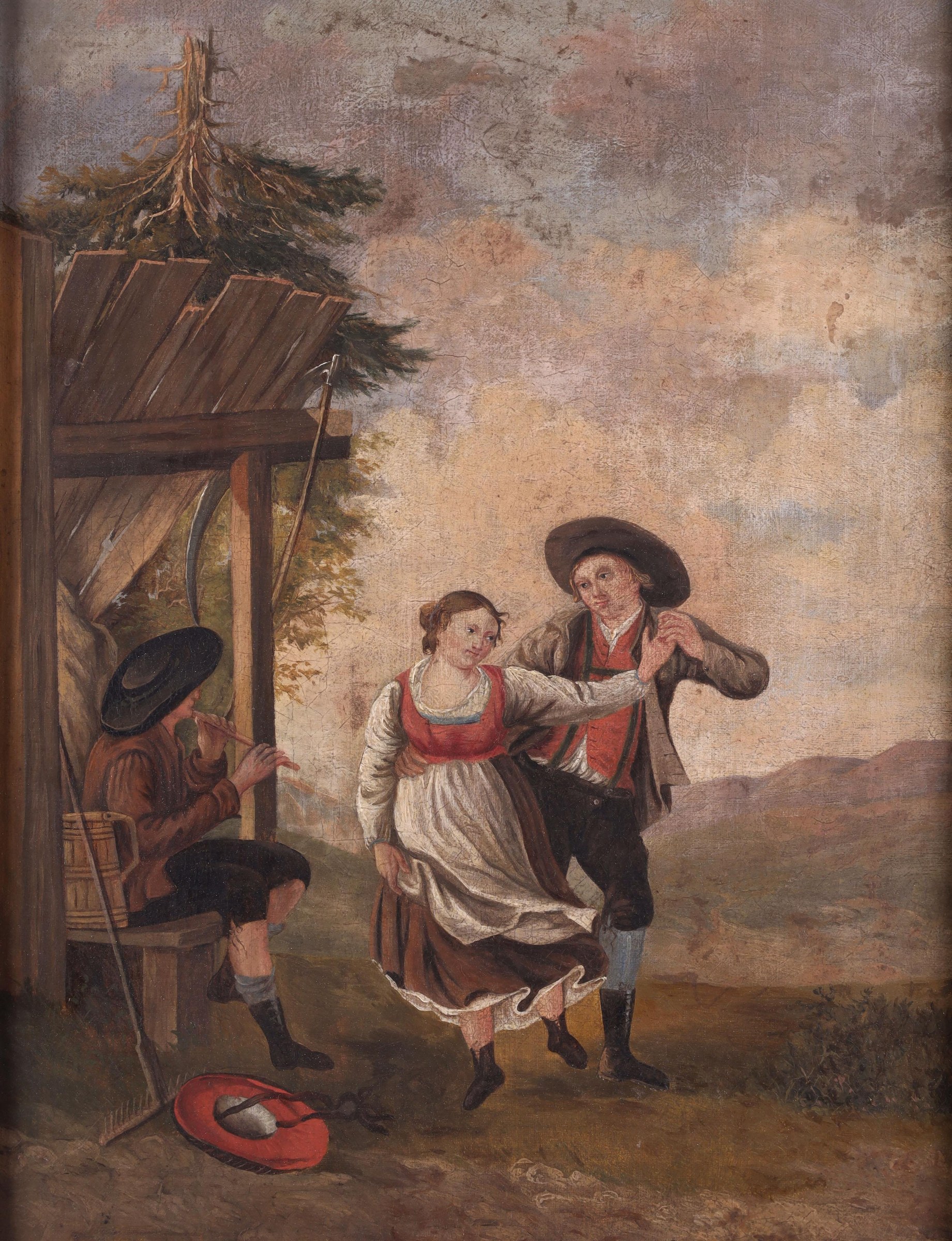
Stefano Ghirardini Bauerntanz
Stefano Gherardini
- Medium:
- Oil Painting
- Dance:
- Folk/Country
- Era:
- 1700s (Enlightenment/Minuet Era)
- Source:
- Wikimedia Commons
- Rights:
- Public domain — free to use, share and adapt.
- Recorded as:
- Public Domain
This painting is a rare direct record of how peasant dance looked and felt in the 18th century, created not by a folk artist but by a trained painter working for an educated audience. It shows the radical democratization of dance as a subject worthy of serious art—a shift that helped establish folk and vernacular dance as objects of cultural value. For anyone studying the social history of dance or the relationship between folk movement and theatrical representation, this work anchors one crucial moment in that conversation.
What you are looking at
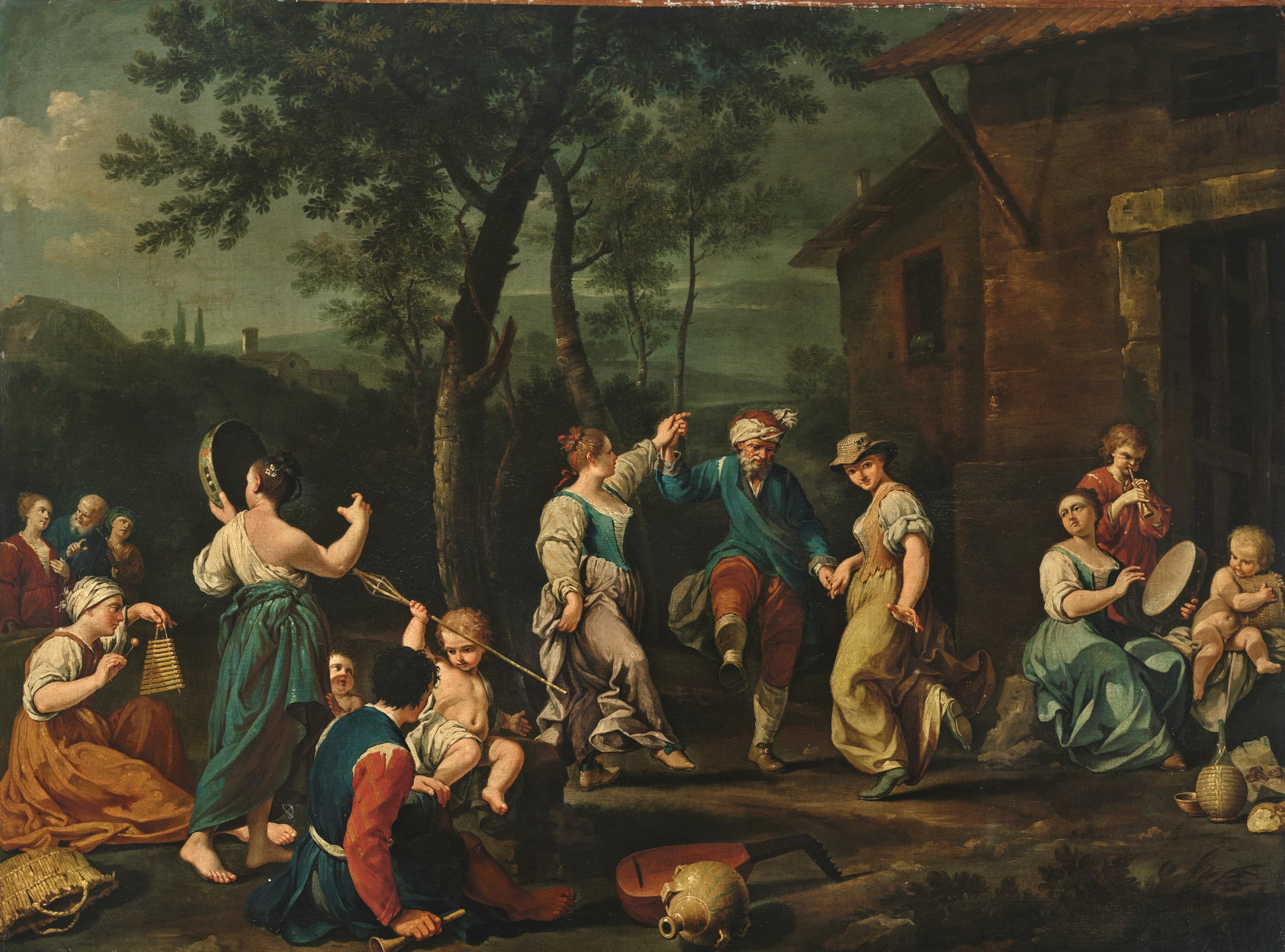
A lively country gathering unfolds in a rustic landscape at dusk. A large group of peasants—men, women, and children—congregate in the foreground near a modest stone cottage with a tiled roof, framed by tall trees. The figures are dressed in 18th-century country clothing: women in full skirts of green, blue, and ochre with white linen shifts; men in fitted breeches, vests, and hats. The composition centers on a group of dancing figures in the middle distance, while others cluster to left and right—some sitting, some standing, some engaged in music-making. A child sits in the lower left holding what appears to be a basket; musicians with pipes or flutes are scattered through the group. The landscape beyond opens to distant hills and a church spire, rendered in soft greens and grays under a luminous evening sky. The scene carries the informal, celebratory character of a village festival or kermess.
The dancing
The central dancers occupy an informal open space, with loose, natural postures rather than ballroom formality. Several figures appear to be moving—one woman toward the left raises her arm with a flourish; a man in the center, wearing red breeches and a green coat, seems to be in motion or gesturing expressively. The dancers do not maintain the closed holds or rigid frames of courtly minuet or country dance, but rather stand and move with the easy, exuberant carriage of folk celebration. Children move freely among the adults. The overall impression is of spontaneous, unschooled movement—bodies responding to music and company rather than following set figures.
The dance depicted
This depicts a *Bauerntanz*, a peasant or country dance of the Alpine and Germanic regions, as the title states. The Bauerntanz tradition encompasses various rustic group dances—spinning, stamping, energetic movements with minimal formal structure. The image captures the essential character: an outdoor gathering, community participation across ages, loose formations, and the unbridled energy that distinguished folk dance from the codified court dances of the same era. The presence of musicians and the outdoor setting confirm this is a moment of celebration rather than instruction or performance for an elite audience.
How it was made
Oil on canvas, 82.5 × 111 cm. The artist employs a warm, naturalistic palette—ochres, greens, and browns dominate—with careful attention to the play of evening light across the figures and landscape. The technique allows for rich texture in fabrics and foliage, and for the subtle spatial recession from foreground gathering to distant landscape. The scale and format suggest this is an easel painting, likely commissioned for a private collection rather than a church or public monument—a work for a patron with interest in rural genre scenes.
About this work
This is an 18th-century oil painting of a Bauerntanz, a peasant festival dance of Alpine Europe. The artist has chosen a moment of community celebration, capturing the informal, exuberant character of folk dance in contrast to the formal codified dances of the court. The painting belongs to a long tradition of European genre painting that took rural life and folk custom as subject matter—a tradition that flourished precisely in the 18th century as aristocratic taste began to romanticize the peasantry and their customs.
For a gallery of dance in art, the work is crucial evidence of how folk dance was understood and valued during the Enlightenment era. It shows not the movements themselves in detail (the artist prioritizes festive atmosphere over anatomical precision) but rather the *occasion* and *social meaning* of dance—its role in binding community, marking celebration, and allowing uninhibited bodily expression. The painting insists that dance is not confined to courts and theaters, and that the lively bodies of peasants deserve the same artistic attention as those of aristocrats.
How to look at it
Attend to the contrast between the loose, energetic postures of the dancers and the careful compositional order of the painting itself. The artist has not frozen a single moment of movement (as a Baroque history painter might) but rather created a scene of *continuous* activity—the sense that music and dancing will go on, that this is a moment in an ongoing celebration. Notice too the distribution of light: the figures in the foreground and middle ground are warmly and clearly lit, while the background recedes into shadow and distance, creating a sense of depth and enclosure. This painterly technique—focusing attention on the human figures and their gathering—was new to the 1750s.
The artist
Stefano Gherardini (1674–1742) was a Florentine painter active in the 18th century, known for historical scenes, religious commissions, and landscape and genre works. He worked during the transition from late Baroque to early Rococo, a period when curiosity about rural life and vernacular subjects grew among educated collectors. His inclusion of a Bauerntanz among his subjects suggests he was responsive to contemporary taste for Alpine and Northern European rural imagery.
The period
The 1750s in Europe saw a flourishing of interest in peasant life as a subject for art and literature—the cult of sensibility and the growth of Romanticism both encouraged artists to valorize the 'natural' life of rural people. At the same time, court dances like the minuet reached their height of elaboration and codification. This painting thus captures a moment of tension: the aristocratic 18th century was simultaneously perfecting formal courtly dance and beginning to aestheticize and collect images of the 'authentic' movement of the people. The Bauerntanz represented everything the minuet was not—unschooled, vigorous, communal, unrehearsed.
Where it lives
The painting was held in a private collection by Major C.M. Sergeantson before entering the auction market (Christie's, London, December 1928, where it was attributed to F. Zuccarelli; Sotheby's, London, July 1991, correctly reattributed to Stefano Ghirardini). It is now in a private collection in Switzerland. The work is not in a public museum collection.
Dance in this work
Questions about this work
How do we know this is a Bauerntanz and not just any country dance?
The title of the work is *Bauerntanz*—'Bauerntanz' is the German word for peasant dance, used specifically for the vigorous, uncodified folk dances of the Alpine and Germanic regions. The setting (outdoor, rustic, mountainous), the informal groupings, and the absence of any courtly dress or formal structure all confirm this identification. The Bauerntanz tradition was well-known enough by the 1750s that a European audience would have recognized it immediately.
What are the musicians playing?
Several figures hold what appear to be wind instruments—pipes or flutes. These are consistent with the folk instrumentation of Alpine dance music in the 18th century. The painter does not render them with great specificity, but their presence signals the importance of live music to the dance event.
Why did an educated artist paint peasant dancers?
By the 1750s, the peasantry and folk culture had become fashionable subjects for European artists and collectors. Enlightenment thinkers and early Romantic writers celebrated rural life as 'natural' and authentic in contrast to the artificiality of court culture. Paintings like this allowed aristocratic viewers to aestheticize and sentimentalize peasant life—to collect and display images of the people while maintaining distance from actual rural communities.
How does this painting relate to how peasants actually danced?
This is an idealized representation created for an educated, urban audience—not a documentary record. The painter emphasizes the festive, communal, energetic character of the Bauerntanz, and captures something true about its social meaning. But the specific movements, rhythms, and techniques of the dance are not depicted with the precision a dancer would use. This is a painting *about* peasant celebration, not a dance instruction manual.
More Folk/Country artwork