49 works in this view — arrow keys or swipe to move between them.
Dance in Art · 1838
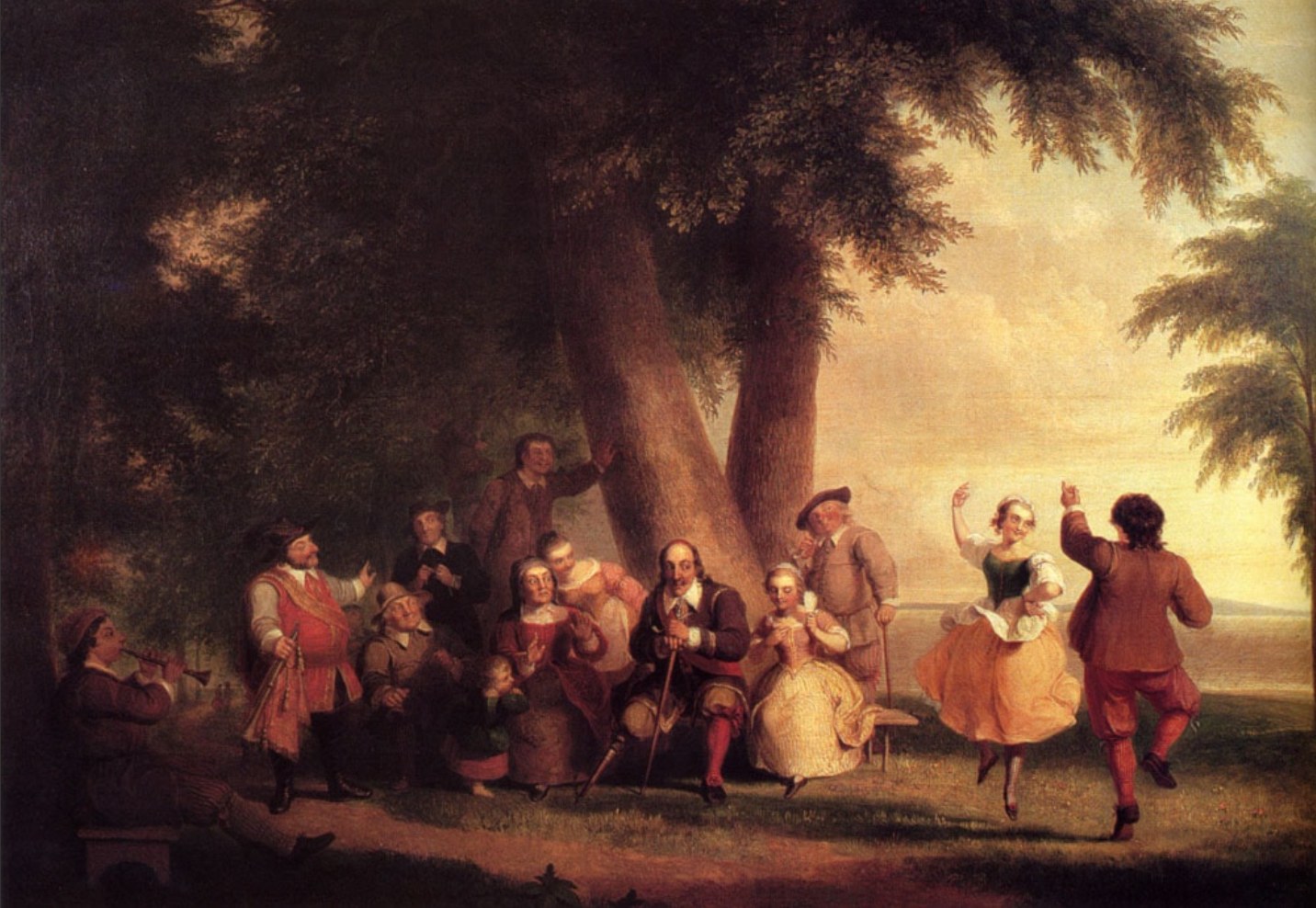
Dance on the Battery in the Presence of Peter Stuyvesant
Asher Brown Durand
- Medium:
- Oil Painting
- Era:
- Mid 1800s (Polka Era)
- Source:
- Wikimedia Commons
- Rights:
- Public domain — free to use, share and adapt.
- Recorded as:
- Public Domain
The work demonstrates how 19th-century American artists understood colonial social practice through the lens of contemporary literary sources and Romantic aesthetics rather than historical documentation. For dance historians, it is valuable precisely because it shows what an educated American painter in 1838 believed colonial social dancing looked like—informal, unformed, and embedded in a wider social landscape rather than constituting a distinct performance event.
What you are looking at
A large group of figures in 17th-century dress gathers beneath a pair of massive trees in an open landscape. The composition is lit from the right, casting the tree trunks in deep shadow while illuminating the middle ground where the figures stand. The group numbers roughly two dozen, arranged loosely rather than in formal lines, and includes men, women, and children in period costume—the women in long skirts and bodices, the men in breeches and doublets. Some figures stand with hands raised or gesturing, others hold walking sticks; one woman in a pale yellow dress appears to be in motion. The setting is a clearing or open ground near water visible in the misty distance, the whole scene suffused with warm golden light that suggests late afternoon.
The dancing
The figures do not exhibit the tight partnering or unified formation of a formal dance. Instead, bodies are scattered and variously oriented: some stand upright in conversation, others lean or gesture outward, a few appear to be in movement with skirts and limbs in play. A woman in pale yellow on the right side shows the most active pose, with her body angled and her skirts suggesting motion. The overall effect is one of social gathering and informal recreation rather than choreographed performance—no closed holds, no line formation, no synchronized footwork.
The dance depicted
The image most likely depicts social dancing or dancing-related activity in a colonial American setting, but the specifics resist certain identification. The title references Peter Stuyvesant, the Dutch governor of New Amsterdam (later New York) in the mid-17th century, and Washington Irving's literary treatment of him. Irving's writings on Stuyvesant included nostalgic scenes of colonial Dutch and mixed-culture festivity. The loose, informal grouping and the apparent mix of observation and participation suggest this may be a moment of public recreation or celebration rather than a formal ball. The dress and setting are consistent with 1650s–1670s New Amsterdam, a period before the formalized waltz culture of the early 19th century, yet the painting itself dates to 1838 and reflects the Romantic era's fascination with colonial American history.
How it was made
Oil painting on canvas, executed in the landscape tradition of Hudson River School painting. The artist uses atmospheric perspective to create depth, with the massive foreground trees anchoring the composition while the figures recede into a luminous middle ground. The warm, golden light is characteristic of Durand's romantic landscape style, and the painting technique—visible brushwork, careful modeling of fabric and shadow—is consistent with mid-19th-century American landscape and genre painting. This scale and medium suggest a work intended for exhibition and a educated audience familiar with both Irving's writings and the conventions of American historical narrative painting.
About this work
This 1838 oil painting by Asher Brown Durand portrays a scene of social dancing or public celebration in 17th-century New Amsterdam, inspired by Washington Irving's literary evocations of colonial American life. The work is a document of how the 19th-century Romantic imagination reconstructed the colonial past, combining historical costume and setting with a landscape aesthetic that emphasizes mood and atmosphere over archaeological precision. The painting captures not a formal dance occasion but an informal, mixed-gender social gathering in which dance and celebration are one element among social interaction and communal leisure. It represents the intersection of American historiography, literary inspiration, and genre painting in the early 19th century.
How to look at it
Attend first to the composition and the treatment of light: the painting is as much a landscape as a genre scene, and the figures are integrated into a romantic natural setting rather than staged in an interior or formal outdoor space. Look at how Durand handles the bodies: none are positioned in recognizable ballroom attitudes or closed holds; instead, they are scattered, variously engaged, some in profile, some frontal, creating a sense of informal, ongoing activity rather than a frozen moment of performance. The woman in pale yellow on the right is the most clearly active figure, but even she is not presented with the precision or clarity that would indicate formal dance training or technique. Consider too what the artist is *not* showing: no musicians are visible, no staged platform or cleared dance floor, no formal line or quadrille formation.
The artist
Asher Brown Durand (1796–1886) was a founding member and president of the National Academy of Design in New York and a leading figure of the Hudson River School. He was trained as an engraver and painter, and his work ranged from portraiture to landscape to historical narrative. He was a contemporary of Thomas Cole and worked in the Romantic landscape tradition that dominated American art in the mid-19th century. His choice to illustrate a scene from Irving's writings on American colonial life reflects the era's deep investment in literary sources for historical and narrative painting.
The period
The painting dates to 1838, a moment when American Romanticism was at its height and when American artists were actively engaged in constructing a national historical identity through visual art. Washington Irving's *Knickerbocker's History of New York* (1809) and his later writings on colonial New York had created a popular, if fictionalized, image of Dutch colonial life as folksy, convivial, and picturesque. The 1830s saw a surge of interest in American colonial and Revolutionary history as subjects for painting. In dance history, this is the era of the Waltz Revolution—the 1830s and 1840s saw the waltz and other couple dances displacing the group dances and quadrilles of the Regency period—yet Durand depicts a much earlier moment and shows no awareness of contemporary dance forms, instead imagining an undifferentiated, community-based leisure activity.
Where it lives
The source record indicates this is an oil painting held in an unspecified collection and known through Wikimedia Commons. The catalogue entry is spare and offers no accession information, exhibition history, or institutional location.
Dance in this work
Questions about this work
What is the connection to Peter Stuyvesant?
Peter Stuyvesant was the Dutch governor of New Amsterdam (later New York) in the mid-17th century. The painting's title and Durand's choice of subject derive from Washington Irving's literary works on Stuyvesant and colonial New York history. Irving portrayed Stuyvesant as a picturesque historical figure, and his writings inspired a wave of 19th-century American historical painting. However, this image is a Romantic artist's imaginative reconstruction of colonial life rather than a historical document.
Is this a waltz?
No. The painting depicts an informal social gathering in which dancing may be occurring, but there is no evidence of the closed-couple hold, partnering, or formation that would characterize a waltz or other formal ballroom dance. The loose arrangement of figures and the informality of their postures suggest community or folk recreation rather than the structured couple dances that dominated ballrooms in 1838.
What does this tell us about how colonists actually danced?
Very little. This is an 1838 painting made by an artist working from literary sources and Romantic artistic conventions, not from historical documentation or eyewitness accounts. It is valuable as evidence of what a 19th-century American artist *imagined* colonial social life to have been like, but it should not be read as reliable historical evidence for 17th-century dance practice.
Why are the figures so loosely arranged?
The loose grouping reflects both the artist's desire to integrate the figures into a landscape composition and the 19th-century Romantic ideal of 'natural' or 'folk' leisure as distinct from the formalized etiquette of contemporary ballrooms. By showing the gathering as unstructured and community-based, Durand emphasizes the picturesque and nostalgic character of colonial life as understood through Irving's writings.
More dance artwork