45 works in this view — arrow keys or swipe to move between them.
Dance in Art · 1897
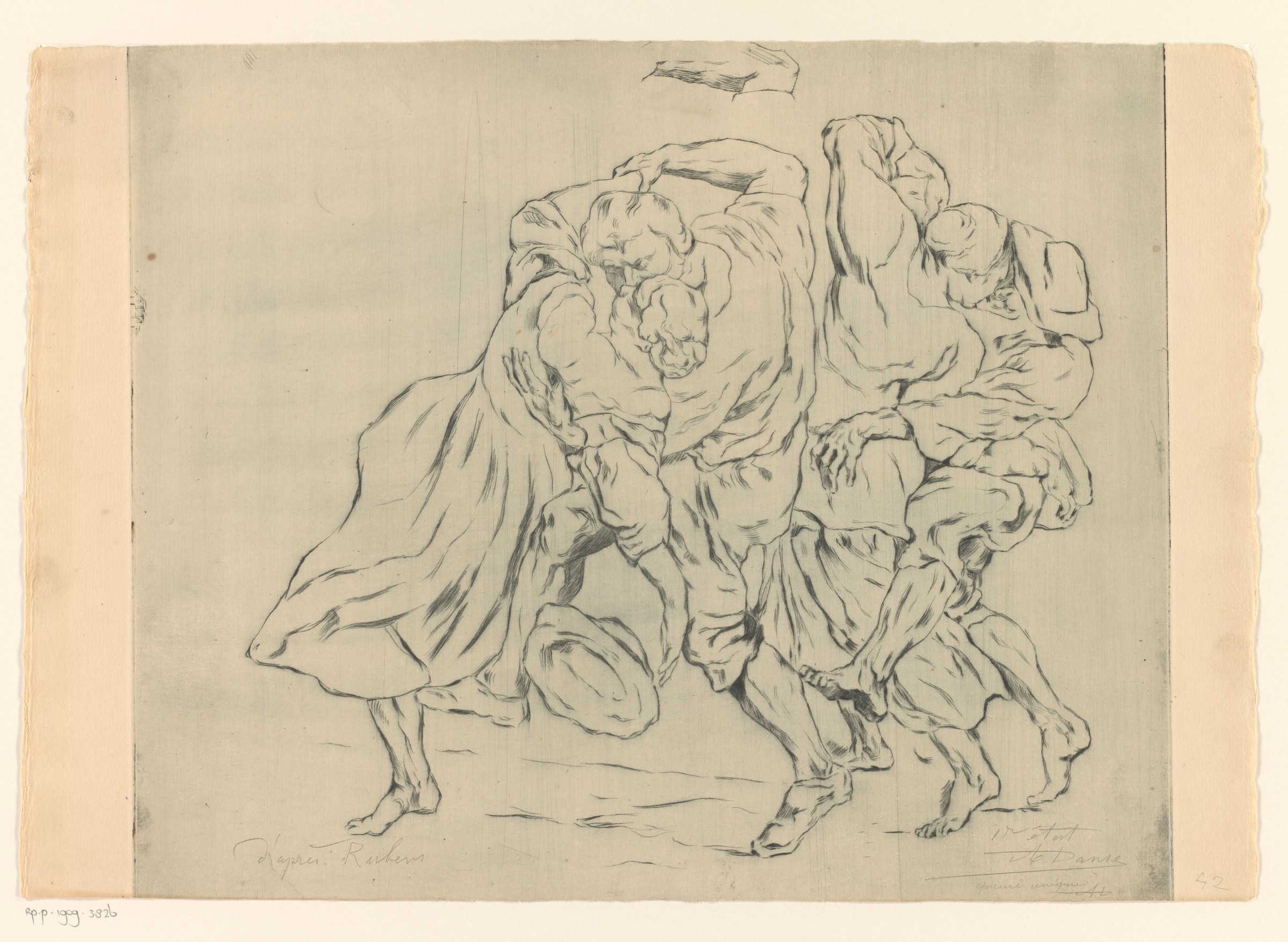
Twee dansende boerenparen, RP-P-1909-3826
Unknown (Rijksmuseum collection)
- Medium:
- Oil Painting
- Dance:
- Folk/Country
- Era:
- Late 1800s (Victorian Ballroom)
- Source:
- Wikimedia Commons
- Rights:
- Public domain — free to use, share and adapt.
- Recorded as:
- CC0
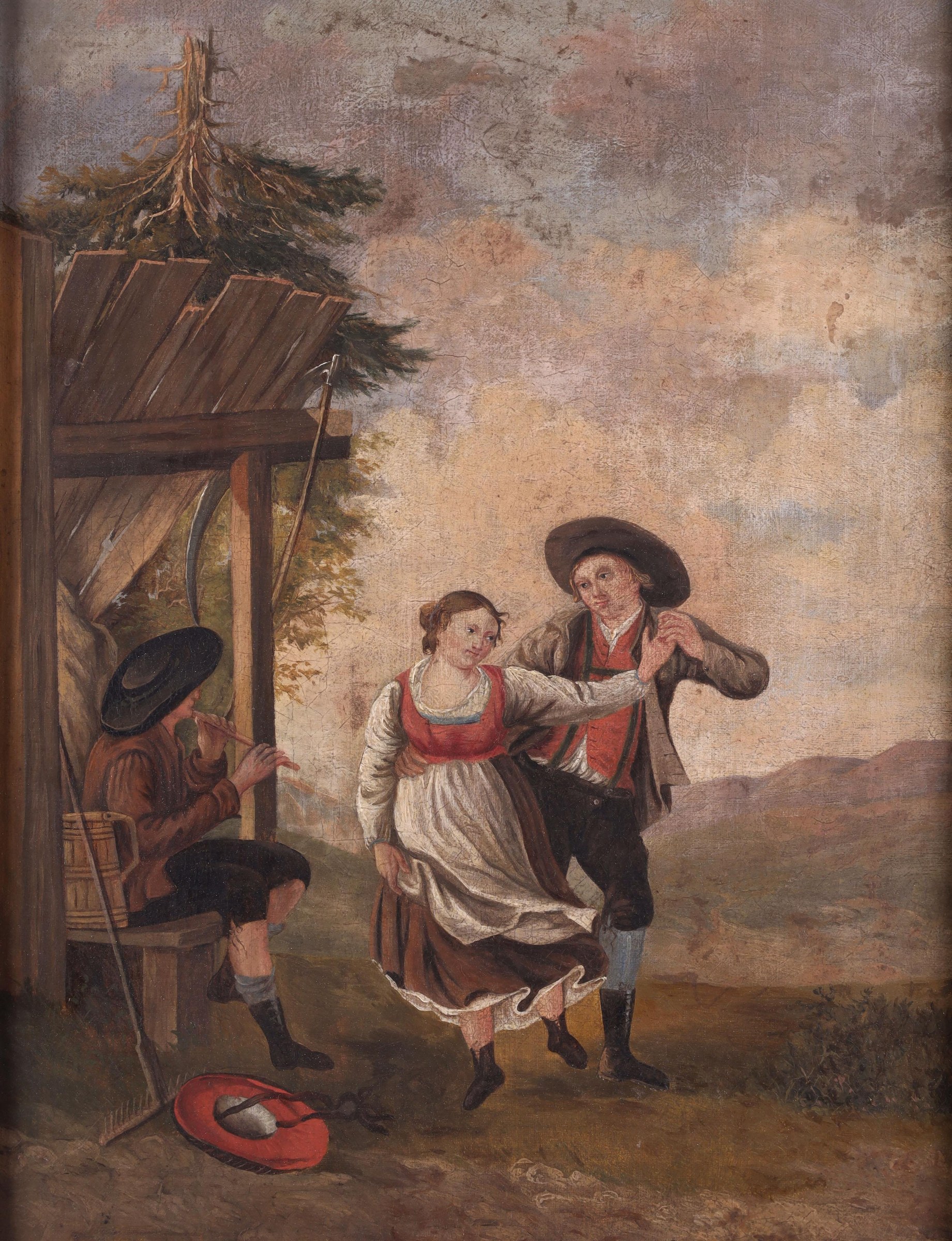
This print provides direct visual evidence of how European peasants danced together in the early modern or modern era—the kind of kinesthetic knowledge that rarely survives in written sources or formal paintings. The artist's close study of bent knees, hand holds, and the physics of swirling skirts shows that folk dance was understood by educated artists as worthy of serious visual analysis, not merely as quaint rusticity.
What you are looking at
A spirited peasant dance rendered in pen and ink, showing two couples in vigorous motion across an undefined interior or outdoor space. The figures are dressed in rustic garments—the women in full skirts and the men in loose breeches and shirts—capturing a moment of uninhibited folk merriment. The composition is dense and overlapping, with bodies twisted and limbs extended in gestures of exuberant movement. The nearer couple dominates the foreground; the woman's skirt billows outward as she turns, while her partner grips her hand or arm in a gesture of partnership. A second couple visible behind them echoes the same energetic pose. The sketch quality of the work—with quick, confident hatching and anatomical contours—conveys spontaneous motion rather than formal choreography. The setting is spare, almost abstract, keeping all focus on the dancers' bodies and their interaction.
The dancing
Four figures arranged in two couples, each pair joined by hand or arm. The dancers' bodies are weighted low and forward, with knees bent and torsos tilted, suggesting vigorous traveling steps rather than turning in place. The women's full skirts extend outward with centrifugal force, their arms raised or extended in the characteristic open-hold position of couple dances. The men lean slightly inward toward their partners, their free arms gesturing or balancing. The poses suggest stomping or stamping footwork, with weight shifting from one foot to the other in a rhythmic pattern typical of peasant couple dances.
The dance depicted
This depicts a peasant couple dance, most likely a German, Swiss, or Low Countries folk dance of the type danced in rural communities and at fairs and festivals. The vigorous, bent-knee posture, the open hold between partners, and the billowing skirts are consistent with dances such as the Schottische, Laendler, or regional variations of country dance popular in the 16th–19th centuries. The image captures not the formal decorum of court dances but the earthy physicality and joy of communal folk celebration. The lack of musicians or specific setting suggests the artist's interest was in the dancers' bodies and their relationship to one another rather than the occasion itself.
How it was made
This is an etching or drypoint—a printmaking technique in which lines are incised into a copper plate, allowing multiple impressions to be pulled. The inscription on the verso ('1er état; épreuve unique') indicates this is a proof of an early state, likely one of very few impressions made. The medium's directness suits the subject: the quick, energetic hatching mimics the movement of the dancers, and the plate allows for fine detail in fabric and anatomy while maintaining the sketchy vigor essential to the work. As a print, this would have circulated among collectors and other artists, unlike a painting, making it a teaching tool and a record of how an artist understood peasant life and movement.
About this work
This print documents a moment from European peasant dance culture, translated into high art through the hand of an engraver or etcher. The work sits at the intersection of genre and movement study: it is at once a celebration of folk vitality and an anatomical investigation of how bodies actually move when dancing together. The inscription and collector's marks indicate it was valued as a fine-art print, circulating in educated circles, yet it preserves without sentimentality the raw energy of communal dancing. For a dance historian, it is precious evidence of the hold, posture, and physical relationships of folk couples at a moment before standardization and notation began to fix these traditions.
How to look at it
Trace the line from the woman's extended skirt to her partner's grip on her hand, and notice how the artist has drawn the moment mid-turn, when fabric and body are at maximum extension. Look at the bent knees and forward-tilted torsos: the artist understood that vigorous folk dancing is not upright but compressed and grounded. The hatching and line weight vary to suggest the volume of cloth and the muscular strain of the bodies beneath, showing that this is not a sentimental sketch but an anatomical study of movement under effort.
The artist
The work is attributed to Auguste Danse (signed), working after a design or composition by Peter Paul Rubens. Rubens (1577–1640) was celebrated for his dynamic figure compositions and his interest in peasant life and celebration, themes he returned to repeatedly in paintings and prints. Danse, working in the 19th century, engaged with Rubens's legacy by translating an earlier compositional idea into his own printmaking practice, a common form of artistic homage and circulation of images in the print tradition.
The period
By the 19th century, European peasant culture was increasingly the subject of romantic and antiquarian interest among urban artists and collectors. Rubens's original compositions, created four centuries earlier, captured peasant festivities with a vigor that appealed to later artists seeking authenticity and vitality in folk tradition. The inscription '1er état' (first state) suggests this print was made as part of a deliberate artistic project, possibly documenting or reviving earlier compositions. The date 1897 places this work near the end of the 19th century, a moment of intense interest in folk preservation and the systematic documentation of regional dance traditions across Europe.
Where it lives
The work is held in the Rijksmuseum collection (RP-P-1909-3826) and is known from a Wikimedia Commons reproduction. The collector's mark on the verso (Lugt 2228) indicates it was part of a historical print collection, and the notation of an early state and unique proof suggests this is a carefully preserved object of print history.
Dance in this work
Questions about this work
Is this based on a Rubens painting?
Yes. The inscription credits Danse as the engraver and Peter Paul Rubens as the designer ('naar ontwerp van'). Rubens created dynamic compositions of peasant dance and celebration that were celebrated and reproduced in prints for centuries after his death. Danse's 1897 etching revisits one of those designs, translating it into his own technique.
What dance is being shown?
The specific dance cannot be named from the image alone. The vigorous bent-knee posture, open hand hold, and billowing skirts are consistent with European folk couple dances such as the Schottische, Laendler, or country dances popular from the Renaissance onward. The artist's focus was on capturing the energy and physicality of communal dancing rather than documenting a particular tradition.
Why is this a print and not a painting?
Printing allowed an image to circulate widely, making it affordable for collectors and artists to study. The inscription '1er état; épreuve unique' (first state; unique proof) indicates this is a rare, early impression—likely one of very few pulled before the plate was worked further or abandoned. Prints were how artistic knowledge and visual ideas spread through European artistic communities.
What does the bent-knee posture tell us?
The low, compressed stance shows that vigorous folk dancing used the full body's weight and muscular strength, with knees bent for power and balance. This was very different from the upright, turned-out posture of formal court dances, and the artist's careful rendering of this difference shows respect for the physical demands of folk movement.
More Folk/Country artwork