46 works in this view — arrow keys or swipe to move between them.
Dance in Art · 1897
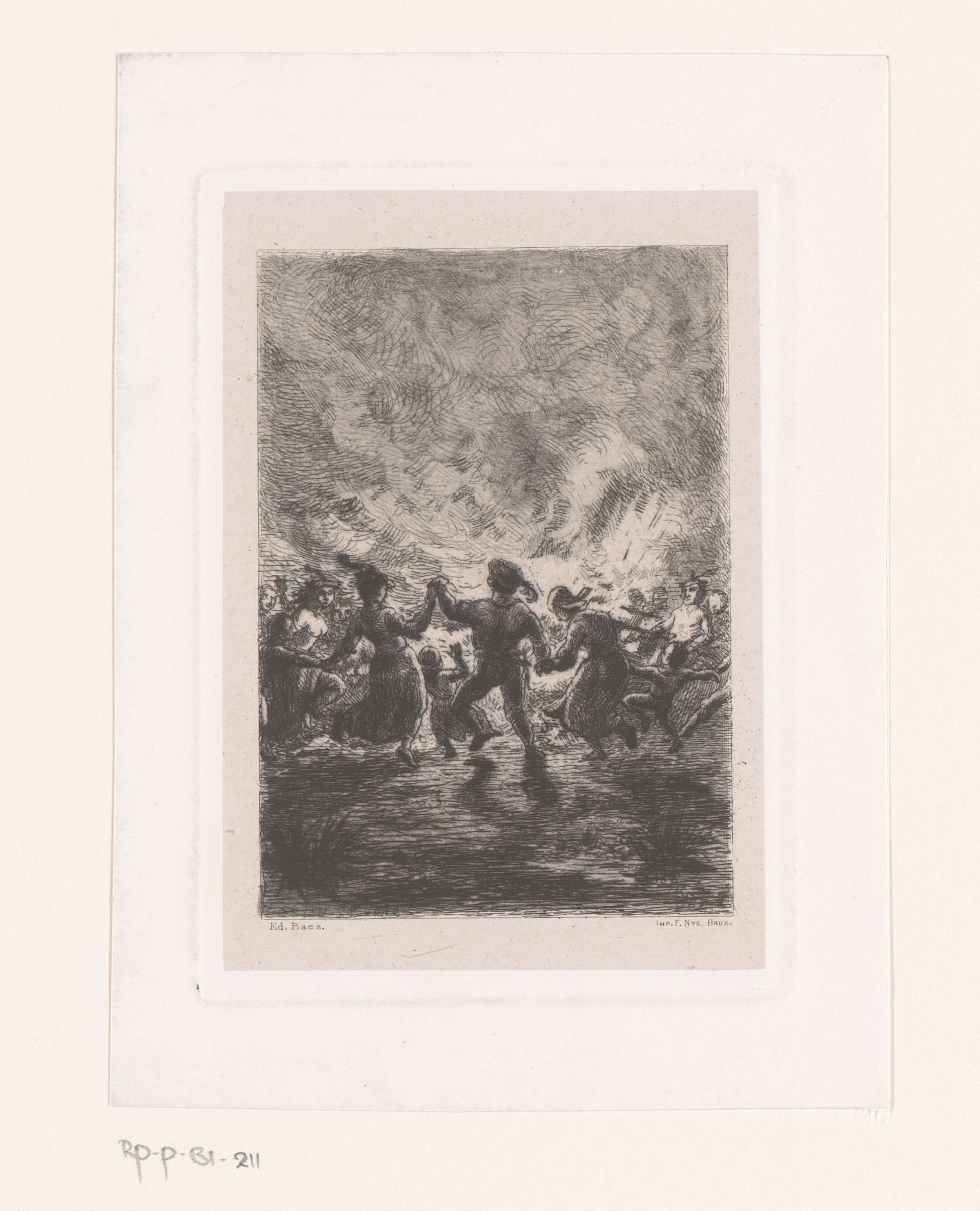
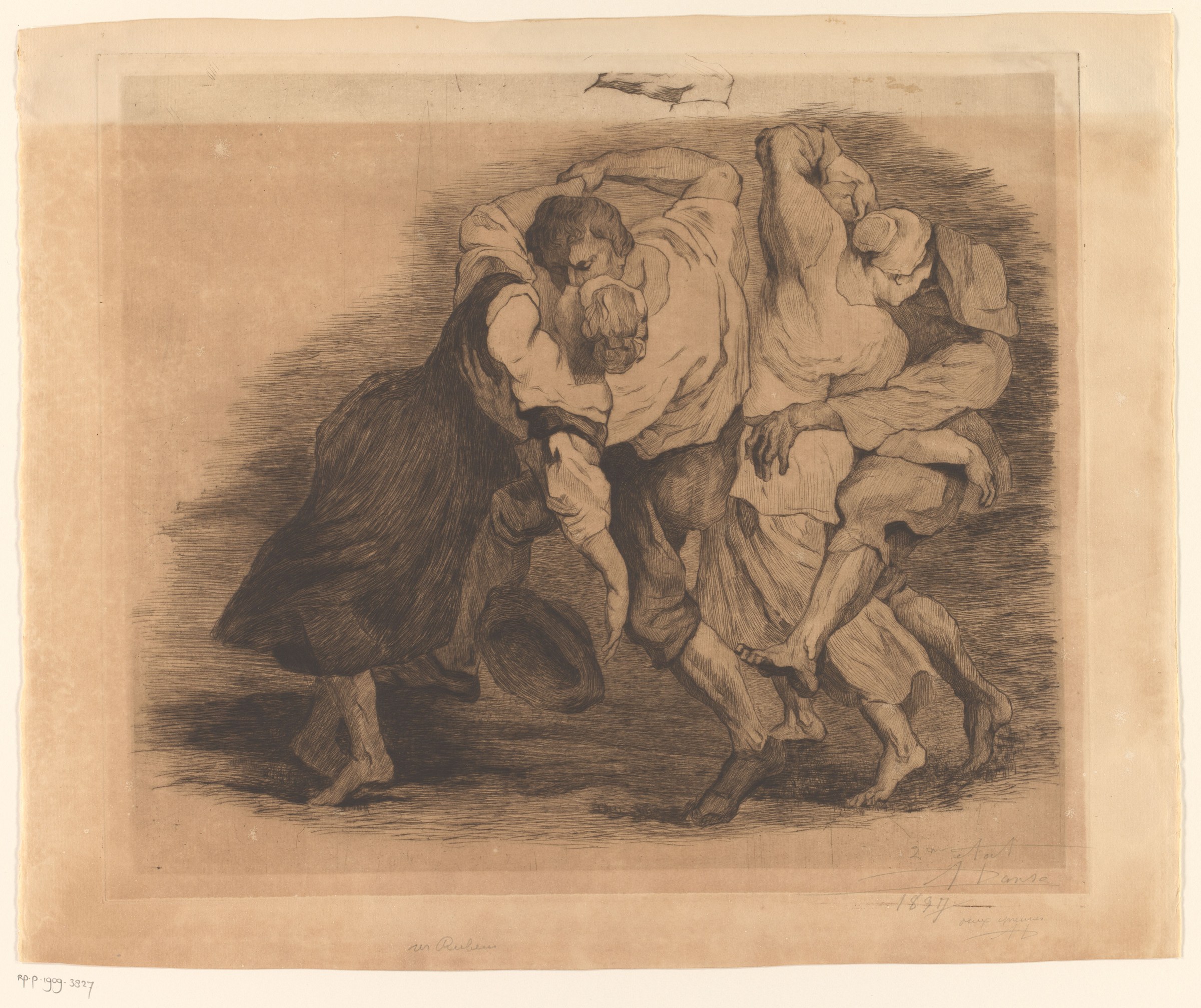
Twee dansende boerenparen, RP-P-1909-3827
Unknown (Rijksmuseum collection)
- Medium:
- Oil Painting
- Dance:
- Folk/Country
- Era:
- Late 1800s (Victorian Ballroom)
- Source:
- Wikimedia Commons
- Rights:
- Public domain — free to use, share and adapt.
- Recorded as:
- CC0
This print preserves a Rubensian design and reveals how Northern European court culture visualized ecstatic movement and sensual encounter as a form of dance or revel. It matters to dance historians because it shows an artist—Rubens—treating physical rapture and erotic abandon as choreography, outside and prior to the ballroom or folk traditions we more commonly study.
What you are looking at
A man in dark clothing dances with three cherubic figures—putti or child-angels—in a composition thick with movement and sensuality. The man, seen from behind and slightly in profile, leans forward with his weight committed, one arm raised and bent at the elbow, the other extended or clasped. The three putti surround and press against him: one reaches upward, one clings to his side, one appears almost to climb him. All four figures are rendered with the full-bodied muscularity of Rubens's preferred aesthetic—fleshy, abundant, vital. The artist has used dense cross-hatching to create deep shadows that pool around the group, isolating them against a pale background. The composition tumbles with diagonal energy; there is no stable ground line, and the figures seem to move as one organism rather than as separate dancers. The work reads as joyful and erotic—a satyr-and-putti scene of the kind Rubens favoured, where adult desire and infantile innocence interpenetrate without apparent conflict.
The dancing
The central male figure carries the weight of the composition: his body bends forward from the hips, his left arm extended and angled upward, his posture one of surrender or ecstatic abandon. The three putti cling and gesticulate around him—one with an arm flung upward, one grasping, one seemingly in mid-leap or mid-climb. There is no formal ballroom hold here; instead, the contact is intimate and chaotic, bodies interpenetrating. The artist renders musculature with Rubenesque abundance, emphasizing fleshy weight and physical presence over linear grace. The composition suggests not a choreographed step but a moment of rapture—a bacchic or erotic encounter rendered as dance.
The dance depicted
This is not a depiction of a named, codified dance style, but rather a mythological or allegorical scene rendered as a kind of ecstatic movement or abandon. The composition descends from Renaissance and Baroque visual traditions in which satyrs, fauns, and putti are shown in states of revelry or seduction. The man's posture and the surrounding figures suggest a Bacchanalian revel—wild, sensual, unrestrained—rather than a ballroom or folk dance. The energy is deliberately uncouth and physical. The work may allude to paintings of nymphs and satyrs or to imagery of desire and fertility common in Northern European court art, though the cataloguers have labeled it as a peasant dance, which does not align with either the mythological content or the Rubenesque execution.
How it was made
This is an etching or dry-point engraving on paper, created by Auguste Danse after a design by Peter Paul Rubens. The catalogue record indicates it is printed, not drawn—the medium allows for multiplication and wider circulation than a unique oil painting would permit. The dense hatching, the deliberate use of parallel lines to model form and shadow, and the precise control of tone are hallmarks of intaglio printmaking. The technique was ideal for disseminating Rubens's designs to a broader public and for creating collections of reproductive prints; the notation on the sheet ('2me état; deux epreuves') indicates this is a later state of the plate, suggesting the artist refined the composition across multiple printings. Engravings after Rubens were enormously popular in the 17th and 18th centuries as a way to own versions of his work.
About this work
This is an etching after a design by Peter Paul Rubens, executed by the printmaker Auguste Danse. The image shows a man in dark garments surrounded and embraced by three putti in a composition dense with movement and physical entanglement. The scene is Bacchanalian or mythological rather than documentary—a celebration of sensual abandon rendered in the soft, fleshy forms Rubens championed. The print belongs to the long tradition of reproductive engraving after Rubens, and it demonstrates how printmaking allowed his designs to circulate widely and to be collected in series. The work is catalogued as a peasant dance, but the content, style, and mythology suggest instead an allegory of desire and revelry.
How to look at it
Attend to the moment of contact: the artist has chosen to freeze the instant of maximum physical entanglement, when the man and the putti interpenetrate as a single mass. Notice the weight distribution—the man leans forward, off-balance, supported by the surrounding figures. The shadows and hatching create a sense of intimate, enclosed space, as if the viewer is looking into a moment of private rapture. The density of the line-work suggests both the fleshiness of the bodies and the intensity of the moment; there is no spare or linear quality to the composition.
The artist
Auguste Danse was a printmaker active in the 19th century, known for reproductive engravings and etchings after Old Masters. His practice was typical of the period: creating editions of prints after celebrated paintings and designs in order to disseminate images and generate income. The inscription indicates that Danse worked from a Rubens design, a common practice; many printmakers of the era made their reputation and livelihood by translating prestigious paintings into multiple states and editions.
The period
The image is catalogued as 1897, but this is likely a late-state or new printing of an older plate—the style and composition are rooted in Rubens and Baroque tradition, not in the 1890s. In the 17th century, when Rubens designed such scenes, court culture celebrated sensuality, abundance, and the human body as proper subjects for art. By the 19th century, when Danse printed or reprinted this work, the taste for Baroque forms had undergone significant shifts, yet Rubens remained canonical and collectable. The print reflects a long history of European visual culture in which dance, revelry, and erotic encounter are visualized as expressions of the same vital force.
Where it lives
This print is held in the Rijksmuseum, Amsterdam (RP-P-1909-3827), as part of their extensive collection of Dutch and European prints. The accession number and the collector's mark (Lugt 2228) indicate it entered the collection in the early 20th century, having been previously held in a private collection. The notation suggests this is the second state of the plate, with two impressions recorded.
Questions about this work
Is this a peasant dance?
The catalogue record labels it so, but the visual evidence contradicts this. The mythological content (putti, Bacchanalian abandon), the Rubenesque bodies and setting, and the composition all indicate an allegorical scene of sensual revelry, not a documented folk or country dance. The confusion may arise from the title 'Twee dansende boerenparen,' which translates as 'Two Dancing Peasant Couples,' but the image shows one man and three child-angels, not two couples.
Who created this image?
The print was engraved or etched by Auguste Danse, a 19th-century printmaker. The design is by Peter Paul Rubens, the celebrated 17th-century Flemish painter. Danse was reproducing Rubens's work for circulation in printed form—a common practice that allowed Rubens's designs to reach a wide audience long after his death.
What is the date of this work?
The catalogue record dates it to 1897, but this is likely misleading. The style, composition, and mythological content are rooted in Baroque tradition and Rubens's designs. The 1897 date may refer to when this particular impression or state was printed, not when the original design was created. Rubens died in 1640; Danse's work is a reproduction.
What does the notation on the sheet mean?
'2me état; deux épreuves' means 'Second state; two impressions.' This indicates that the plate was worked on or refined after an earlier version, and that two prints from this state survive. It is a printer's or collector's note, suggesting this print is a scholarly record of the work's publication history.
More Folk/Country artwork