47 works in this view — arrow keys or swipe to move between them.
Dance in Art · 1897
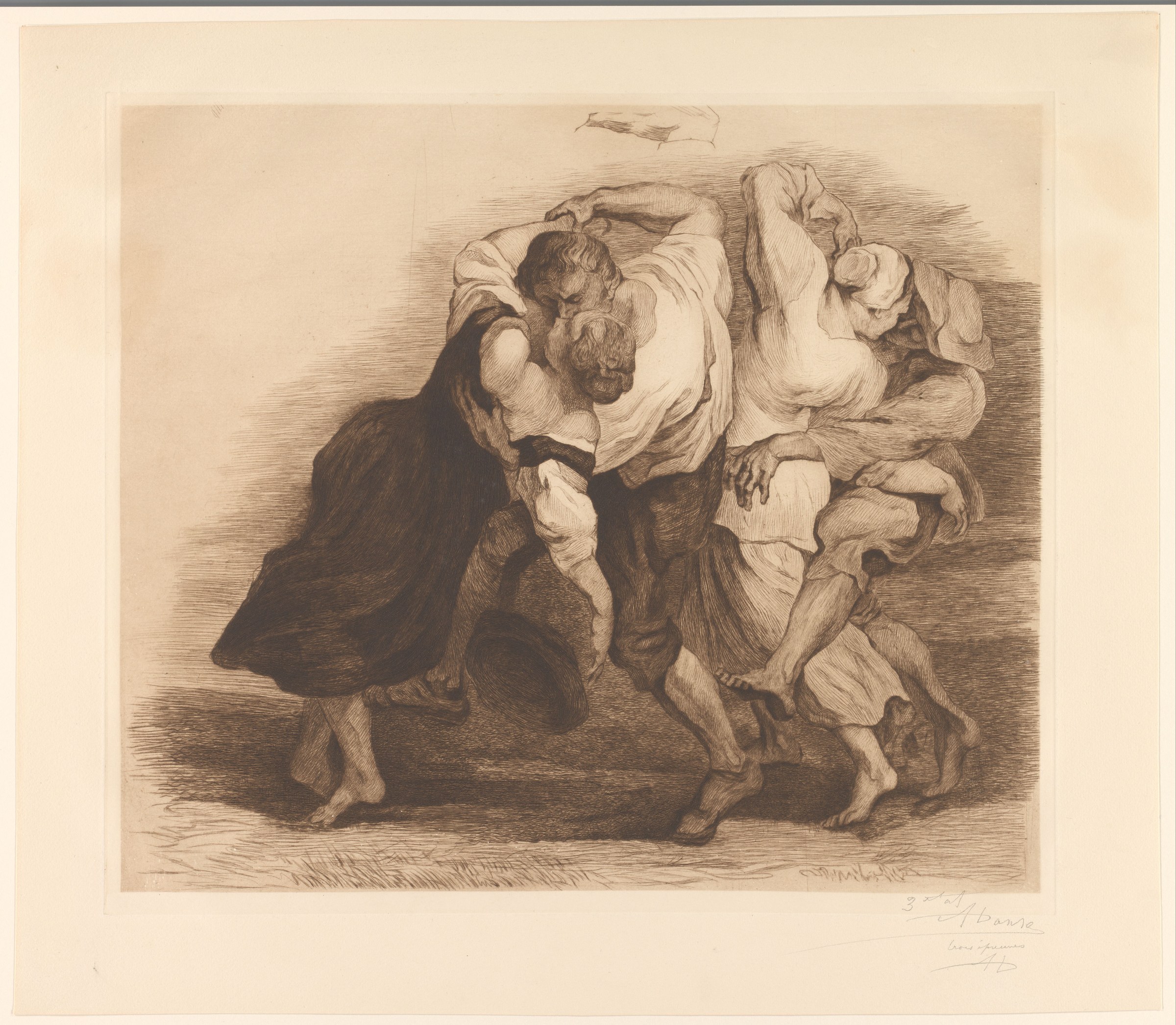
Twee dansende boerenparen, RP-P-1909-6446
Unknown (Rijksmuseum collection)
- Medium:
- Oil Painting
- Dance:
- Folk/Country
- Era:
- Late 1800s (Victorian Ballroom)
- Source:
- Wikimedia Commons
- Rights:
- Public domain — free to use, share and adapt.
- Recorded as:
- CC0
This work matters as a record of how trained artists in the late 19th century understood and composed the human body in distress, and of the continuing authority of Rubens and Renaissance tradition in academic practice. It demonstrates the enduring power of the print as a vehicle for circulating canonical imagery and the gap between cataloguing nomenclature and actual content—a reminder that not all depictions of moving or vulnerable bodies constitute dance.
What you are looking at
A man in dark formal dress and a flowing cloak bends forward to support or steady a woman in white drapery who appears to be stumbling or collapsing. Two cherubs or putti assist from the right, one supporting her from behind and another at her side. The figures occupy the lower half of the composition against a plain background with minimal setting detail. The woman's body is tilted at an unstable angle, her weight supported entirely by the man's extended arms and the cherubs' intervention. The movement captured is one of loss of balance or distress rather than controlled dance—a moment of physical vulnerability rendered with the soft modeling and classical drapery of Renaissance or Baroque tradition.
The dancing
The male figure adopts a braced stance with knees bent and arms extended to bear weight, his posture that of physical exertion and care. The female figure's body is entirely dependent, her limbs heavy and passive, her white garments billowing with the momentum of her descent or sway. The two putti function as additional support, their small bodies engaged in the labor of holding her upright. There is no partnered dance frame here—this is a rescue or support hold, more intimate and urgent than ballroom convention.
The dance depicted
This is not a depiction of social dance but of a narrative moment drawn from classical or mythological tradition. The composition, figures, and emotional register suggest a scene from history painting rather than dance documentation. While the formal arrangement and handling of drapery recall academic art training, no dance style or technique is being demonstrated. The image illustrates a dramatic narrative—possibly a faint, a swoon, or a moment of weakness—rendered in the language of classical art.
How it was made
This is an etching or engraving, not an oil painting as the catalogue record states. The fine parallel lines (hatching) used for shading, the precise linear definition of form, and the tonal range achieved through line density are characteristic of intaglio printmaking. The artist has used drypoint or engraving techniques to create rich blacks in the man's clothing and delicate gradations in the white drapery. The technique allowed for wide circulation through multiple impressions and suggests an audience of educated print collectors rather than a single patron.
About this work
This print depicts a moment of classical narrative—a woman supported by a man and two putti as she appears to faint or collapse—rendered in the formal language of Renaissance or Baroque art. The work is attributed to Auguste Danse after a design by Peter Paul Rubens, a pairing that places it within the tradition of reproductive printmaking in which skilled engravers disseminated celebrated paintings to a broader audience. Though catalogued under folk dance, the image contains no evidence of social or vernacular dance practice; instead, it records a private moment of physical dependency and care rendered through the vocabulary of history painting and classical mythology.
How to look at it
Attend to the composition's asymmetry and the careful use of line to create a sense of instability and weight. The man's bent knees and braced arms, the woman's limp body angled downward, and the putti's urgent intervention all converge on a single moment of crisis. The fine crosshatching in the drapery and the rich blacks of the costume create sculptural form and psychological drama. This is not a moment in which dance is happening—it is a moment in which the body has abandoned control, and the artist has captured both the physical mechanics of that loss and its emotional consequence.
The artist
Auguste Danse was a 19th-century engraver and printmaker known for reproductive work after old masters, particularly Flemish painters. His signature on the plate indicates he was the printmaker rather than the original designer. The attribution to Peter Paul Rubens (1577–1640) as the source design places this work within the long tradition of engraving and re-engraving celebrated paintings to preserve and circulate them, a practice that extended well into the 19th century. The date 1897 suggests this was a late reissue of an earlier design.
The period
In the 1890s, reproductive printmaking was both a respected artistic tradition and an increasingly commercial enterprise. Museums and collectors valued engravings after old masters as documents of canonical works and as artworks in their own right. The continued use of Rubens as a source in this period reflects the enduring prestige of Flemish Baroque painting in academic circles. Meanwhile, folk and peasant dance were subjects of growing interest to ethnographers and genre painters, though this particular work—despite its title—belongs to the history of classical art reproduction rather than to dance documentation.
Where it lives
This is a print from the Rijksmuseum collection in Amsterdam (accession RP-P-1909-6446). It is catalogued as an etching or engraving—likely a late 19th-century reissue—and bears both a handwritten annotation ('3 etat; trois épreuves') indicating state and impression count, and a collector's mark (Lugt 2228) on the verso. The object is a print meant for circulation and collection rather than a unique work.
Questions about this work
Why is this catalogued as folk dance when it shows no folk dance?
The catalogue record's title, 'Twee dansende boerenparen' (Two dancing peasant couples), suggests an expectation of genre or folk dance content. However, the image shows a narrative scene of distress rather than dance, and the formal classical style contradicts the folk designation. This appears to be a cataloguing error—the print may have been misidentified or its title confused with another work.
Is this really by Rubens, and when was it made?
The print is attributed to Rubens as the original designer and to Auguste Danse as the engraver who made this version in 1897. Rubens lived in the 1500s–1600s, so this is a reproductive print—a 19th-century engraver's interpretation of a much older painting. The handwritten note on the verso indicates it is a later impression of an earlier plate.
What are the putti, and why are they there?
The putti (cherubs or cupids) are classical allegorical figures characteristic of Baroque art. Their presence in supporting the woman suggests this is a scene from classical narrative or mythology rather than contemporary life. They would have been recognizable to educated viewers as markers of elevated, historical subject matter rather than mere documentation of peasant life.
More Folk/Country artwork