49 works in this view — arrow keys or swipe to move between them.
Dance in Art · 1897
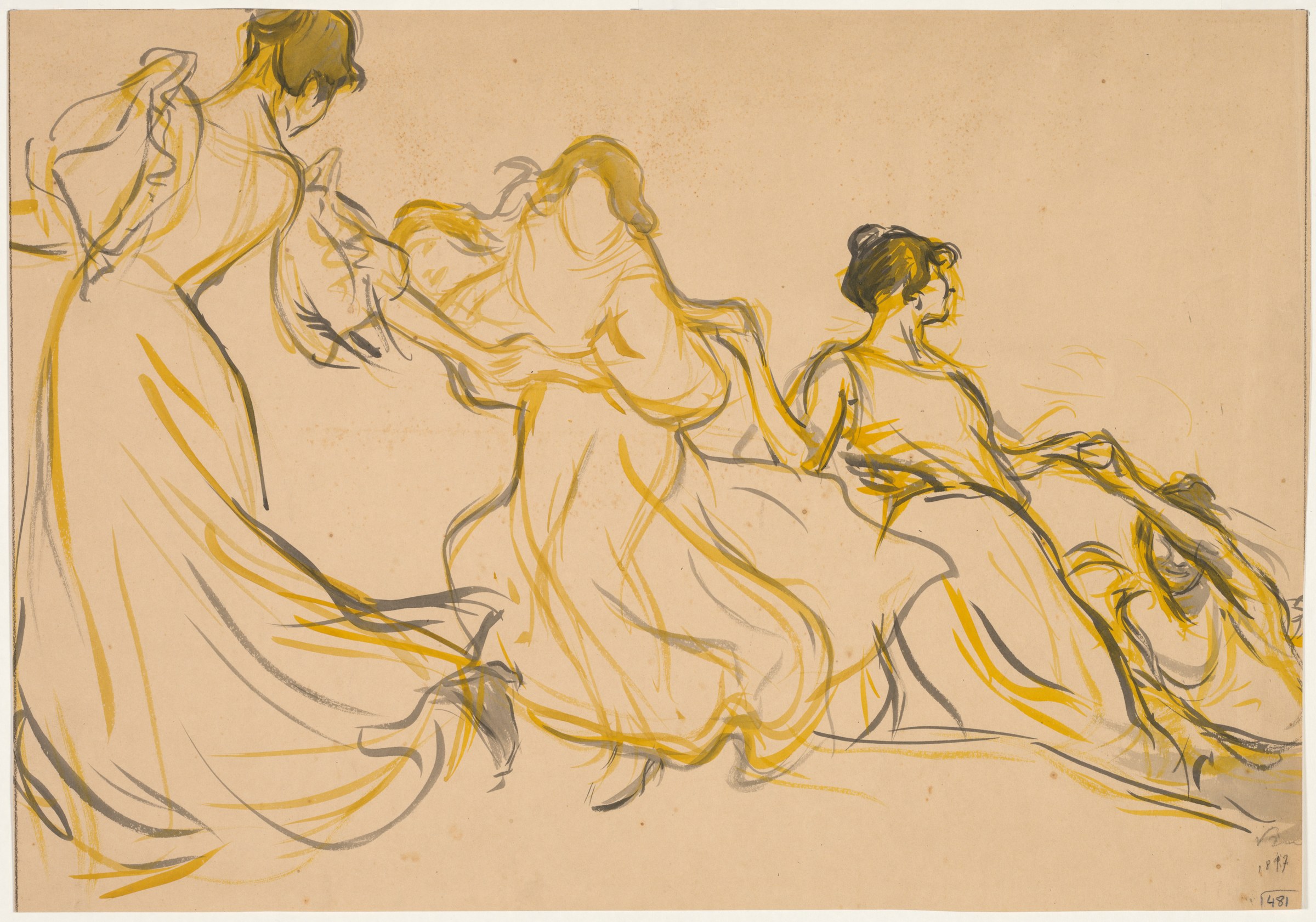
Victor Emile Prouvé - Study for the Decoration for the Salle des Fêtes for La Mairie du 11e arron - 2015.453 - Cleveland Museum of Art
Victor Emile Prouvé
- Medium:
- Oil Painting
- Era:
- Late 1800s (Victorian Ballroom)
- Source:
- Wikimedia Commons
- Rights:
- Public domain — free to use, share and adapt.
- Recorded as:
- CC0
This sketch documents the crucial historical moment when theatrical dance was being liberated from classical ballet's strictures and reimagined as an art form expressive of the human body in its natural grace. For historians of modern dance and late 19th-century aesthetics, the work reveals how even decorative, civic commissions absorbed the era's fascination with flowing movement and feminine beauty. The drawing shows an artist attending closely to how fabric moves with the body—knowledge that only comes from watching dancers and understanding the relationship between clothing, gesture, and the appearance of ease.
What you are looking at
This drawing depicts four female figures arranged in a flowing, processional composition across a warm beige ground. The figures are rendered in a style suggestive of art nouveau, with attenuated bodies and billowing drapery that dominates the composition. Moving from left to right, the first figure is shown in a pose of energetic movement, her body twisted and her long skirts swirling around her legs. The second and third figures progress across the composition with similar sinuous gestures, their bodies curving and their garments creating rhythmic patterns of fold and flow. The rightmost figure, rendered with darker tones in her hair and features, appears to turn or shift direction, her skirts trailing dramatically. The drawing technique employs ink outlines with golden-yellow wash or watercolor, creating a sense of movement and ethereal lightness. The figures seem to move in concert, though without rigid formation—their interaction is suggested through proximity and the parallel directions of their drapery rather than through touch or explicit gesture.
The dancing
The bodies are elongated and sinuous, characteristic of art nouveau figure drawing. The arms are positioned variously—some extended, some held close to the body—but all suggest the kind of natural, unforced positioning associated with interpretive or aesthetic movement rather than technical ballroom dance. The weight of each figure appears to flow through the body and into the cascading skirts; the postures suggest walking, turning, or swaying rather than the strict upright carriage of ballroom dance. Four dancers are depicted, moving individually yet in visual harmony; there is no closed hold or partnership frame.
The dance depicted
The image most likely depicts theatrical or aesthetic dance of the late 19th century—specifically the kind of interpretive movement or classical-inspired choreography that was emerging in avant-garde circles during the 1890s. The loose, naturalistic gestures, the absence of pointe shoes or rigid technique, and the flowing, sculptural treatment of the drapery suggest this is not ballroom dance but rather art-music dance or salon dance of the Gilded Age. The swirling skirts and sinuous arm positions echo the movement vocabulary associated with dancers influenced by Hellenic aesthetics or the early modern dance movement. Without clearer iconographic markers (music notation, a specific theatrical setting, or identifiable music-hall costume), the precise dance cannot be determined, but the drawing conveys the artist's interest in the beauty of female bodies in motion through space, rendered with the sensuality and flowing line characteristic of the fin-de-siècle artistic movement.
How it was made
This is a drawing in ink and watercolor or gouache on paper, rendered in a sketch-like manner that suggests preparatory study or finished independent work. The use of golden-yellow wash over ink outlines creates volume and movement while maintaining the fluidity of line-drawing; the technique is particularly suited to capturing the flowing quality of fabric in motion. The relatively rapid execution visible in the line work, combined with the careful application of color, suggests this may be a study for a larger decorative scheme—which aligns with the catalogue title mentioning a decoration for a municipal hall. This technique would have been reproducible through lithographic transfer if the design were intended for widespread circulation, though we cannot determine from the image alone whether that occurred.
About this work
This is a study in ink and watercolor depicting four female dancers or moving figures in the aesthetic and art nouveau style characteristic of fin-de-siècle France. The work appears to be a preparatory study for a larger decorative commission for the 11th arrondissement's town hall, according to its catalogue attribution. The artist, Victor Emile Prouvé, was working in the art nouveau idiom and in direct conversation with the decorative schemes and theatrical aesthetics of the 1890s.
The drawing captures a moment of aesthetic movement—the kind of interpretive, flowing dance that was gaining cultural currency in theatrical and artistic circles at the moment when classical ballet was being challenged and reimagined. The work belongs in a gallery of dance in art because it documents not a specific technique or ballroom tradition, but rather the avant-garde understanding of the moving body as sculpture and the female form in motion as a subject worthy of serious artistic attention.
How to look at it
Attend to the rhythm created by the repetition and variation of the swirling skirts—the artist has captured the visual pulse of movement through pattern and line rather than through anatomical precision. Notice how the yellow wash defines form and creates a sense of light moving across fabric; the technique mimics how light actually plays across silk or gauze in motion. The composition moves from left to right with gathering energy, and the rightmost figure's darker coloring suggests depth or a turn that draws the eye back into the space. This is a work that rewards viewing as a study in the appearance of movement—the artist is not documenting steps but rather capturing the visual impression of bodies in graceful, flowing motion.
The artist
Victor Emile Prouvé (1858–1943) was a French decorative artist, painter, and designer closely associated with the art nouveau movement. He was known for his involvement in decorative schemes, furniture design, and mural work, often in collaboration with his father, the craftsman Victor Prouvé. He worked extensively on public commissions and was engaged with the aesthetic concerns of the Symbolist movement, particularly the representation of grace, beauty, and the female form. His practice centered on the integration of fine and decorative arts, and he was invested in bringing modernist aesthetics into civic and public spaces.
The period
This drawing dates to 1897, a moment of significant ferment in both theatrical dance and visual art. In France, the aesthetic movement and symbolism were at their height; artists were actively reimagining the possibilities of the moving body as subject matter. The 1890s saw the emergence of performers like Loïe Fuller, whose serpentine dances in flowing skirts and under shifting light created new possibilities for the visualization of dance. Simultaneously, the classical ballet tradition was entering a period of revision, with new choreographers experimenting with less rigid forms and more naturalistic gesture. In the visual arts, art nouveau was crystallizing as a dominant aesthetic, with its characteristic emphasis on flowing line, organic form, and the idealization of the human figure. Prouvé's sketch sits directly in this context: a decorative work that treats dance not as a technical discipline but as a manifestation of grace and natural beauty.
Where it lives
The work is held in the Cleveland Museum of Art (accession 2015.453) and is documented as a study for a decoration commissioned for the Salle des Fêtes of the Mairie of the 11th arrondissement of Paris. The sketch suggests it is a preparatory work for a larger decorative scheme, though the extent of the final realization is not clear from this image alone.
Dance in this work
Questions about this work
Is this a study for a finished mural or decoration?
The catalogue title indicates this is a study for a decoration for the Salle des Fêtes (festival hall) of the town hall of Paris's 11th arrondissement, suggesting it was preparatory to a larger work. However, the image alone does not show whether the final scheme was executed or what form it took.
What kind of dance is this?
The drawing does not depict a specific named dance technique. Instead, it captures the aesthetic movement or interpretive dance style that was emerging in the 1890s—the kind of flowing, graceful movement associated with art nouveau aesthetics and with performers like Loïe Fuller. The emphasis is on the beauty of bodies and fabric in motion rather than on technical steps.
Why are the figures drawn with such flowing, exaggerated drapery?
The billowing skirts serve multiple purposes: they create visual rhythm and movement on the page, they demonstrate the artist's interest in how fabric responds to the body's motion, and they embody the art nouveau aesthetic of organic, flowing line. The exaggeration emphasizes grace and fluidity over anatomical accuracy.
Who was Victor Emile Prouvé?
Prouvé was a French art nouveau designer and decorative artist known for public commissions, mural work, and the integration of fine and applied arts. He was working during the height of the art nouveau movement and was invested in bringing modernist aesthetics into civic spaces.
More dance artwork