49 works in this view — arrow keys or swipe to move between them.
Dance in Art · 1912
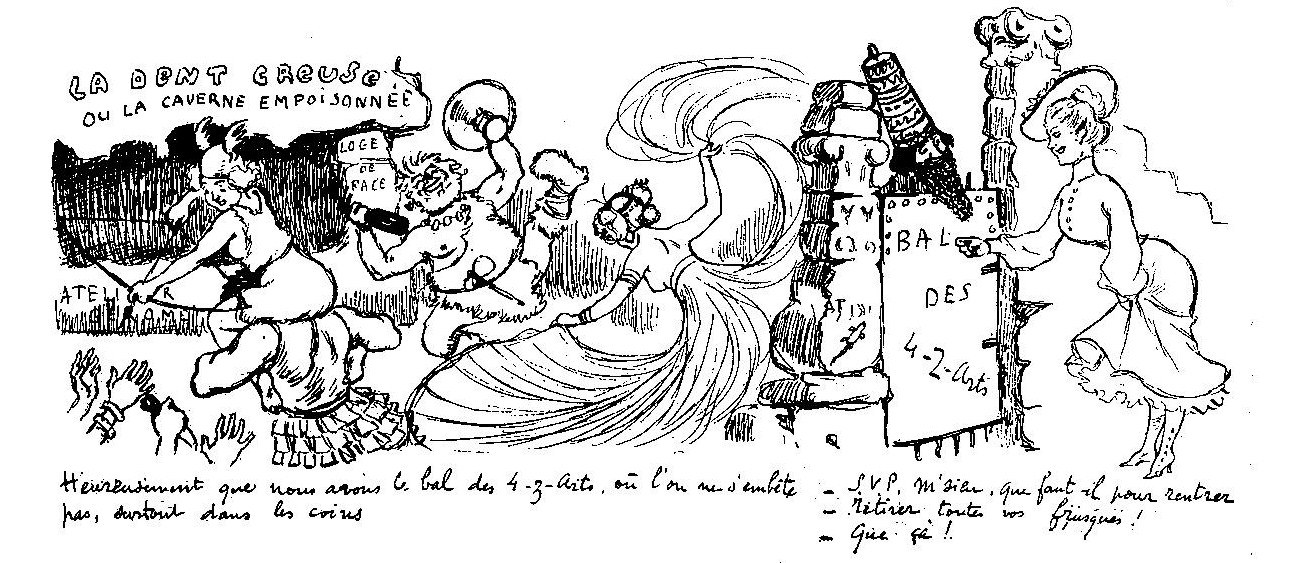
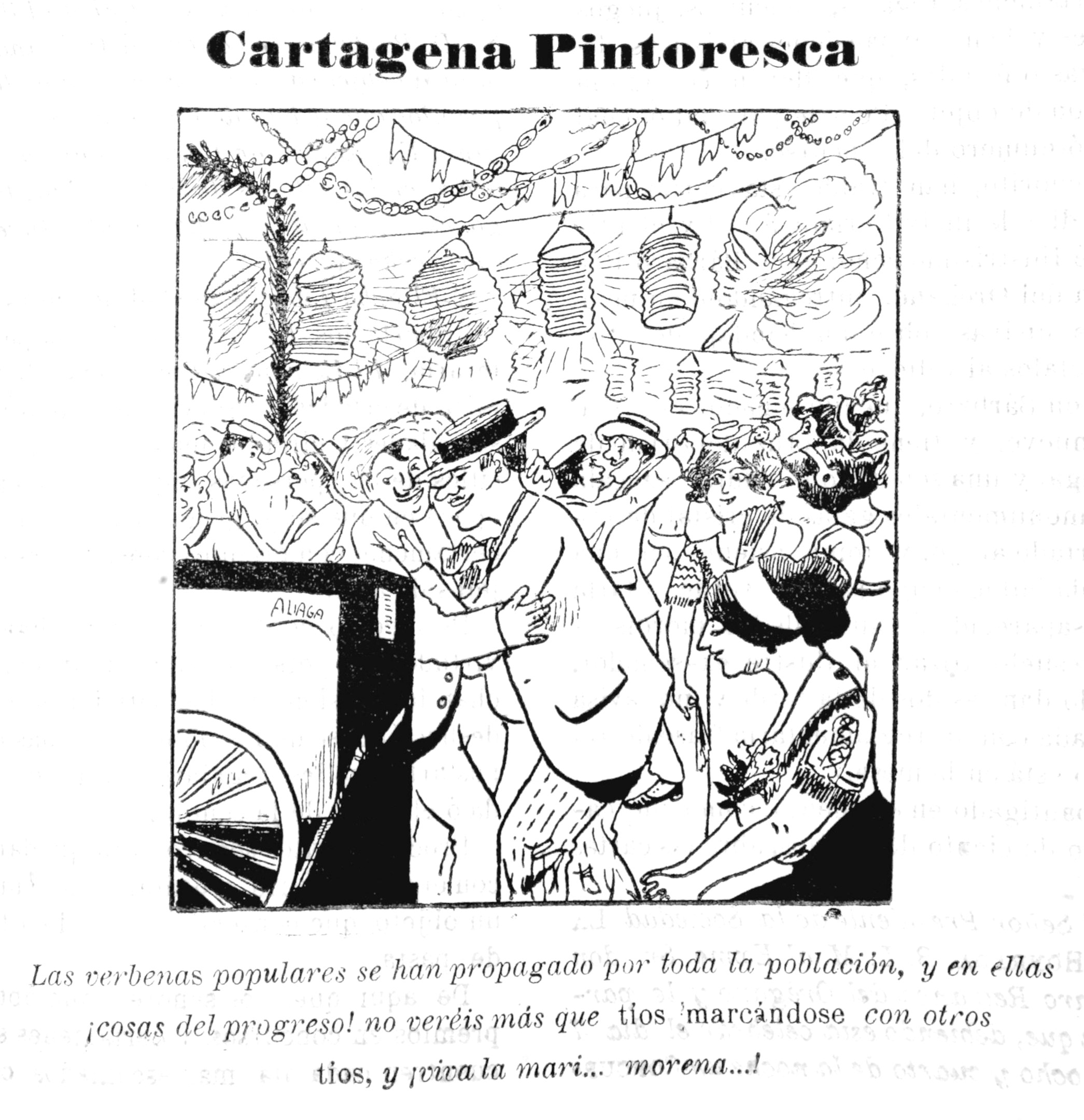
Cartagena pintoresca (Don Cándido, 19-07-1912)
Aliaga (Unknown)
- Medium:
- Oil Painting
- Era:
- 1900-1920 (Ragtime/Early Jazz)
- Source:
- Wikimedia Commons
- Rights:
- Public domain — free to use, share and adapt.
- Recorded as:
- Public Domain
This image is rare documentary evidence of working-class Spanish dance culture in the early 1910s, capturing the verbena as a living practice rather than a staged or codified form. More importantly, it is early visual evidence of homosocial male dancing as a visible social phenomenon that provoked moral panic, and of the connection between dance, gender transgression, and public controversy—a pattern that would recur throughout twentieth-century dance history.
What you are looking at
This is a satirical cartoon from the Spanish weekly Don Cándido depicting a verbena (open-air street dance festival) in Cartagena. The scene is crowded and festive, with paper lanterns and bunting strung overhead, creating a carnival atmosphere. In the foreground, several men in suits and hats dance together in pairs, while women in dresses stand around the edges of the scene, largely excluded from the dancing. The composition is deliberately crowded and chaotic, with figures overlapping and the perspective compressed to emphasize the density of the gathering. A palm tree appears on the left, establishing the coastal Spanish setting. The artist has used heavy cross-hatching and bold line work typical of period newspaper illustration, with deep blacks contrasting sharply against white space to create visual drama and readability at small reproduction size.
The dancing
The male dancers are shown in close proximity to one another, some with arms around shoulders or at waists in a partnered hold. Their body language is animated and social rather than formally trained—they lean toward each other, their postures casual and informal. The women, by contrast, are depicted as static observers: they stand, watch, or gesture with apparent disapproval or resignation. The artist has exaggerated masculine features on the male dancers and used distinctive period costume—bowler hats, suits—to anchor the scene firmly in the 1910s urban setting. No trained ballroom technique is suggested; this is vernacular social dancing.
The dance depicted
The verbena was a popular, informal public celebration in Spanish towns, combining music, dancing, and socializing in open-air settings. This image documents the verbena as a working-class social ritual rather than a staged theatrical form. What makes this cartoon significant—and what triggered its satirical caption—is the prominence of male-male dancing partnerships. The accompanying text (cut off in this reproduction) expresses moral disapproval of the scene through sarcasm, specifically attacking the visibility of male homosocial bonding ('mariquería'). The dance itself cannot be precisely identified as a named style; it is recorded social dancing of the moment, notable for its transgression of contemporary gender norms.
How it was made
This is a line-drawn editorial cartoon or illustration, almost certainly a wood engraving or steel engraving reproduced for newspaper publication in Don Cándido. The technique—bold outlines, strong tonal contrasts, dense cross-hatching—is characteristic of turn-of-the-century newspaper graphics designed for small-format reproduction and quick reading. The style allowed the cartoonist to convey social narrative and moral commentary through exaggeration and compositional choice. The sheer clarity of the image despite its complexity suggests professional engraving work, implying this was a major weekly publication with adequate resources.
About this work
This is a satirical newspaper cartoon documenting and condemning a popular Spanish street dance festival. The image captures a verbena in early 1910s Cartagena, but uses the occasion to ridicule what the artist and publication saw as moral transgression: the visible participation of men dancing with men in public. The cartoon is simultaneously a record of vernacular dance practice and evidence of the anxieties that practice provoked in conservative publishing circles. It belongs in a dance archive because it documents how communities actually danced, and because it shows dance becoming a vehicle for social and sexual transgression—a role it has played repeatedly in modern history.
How to look at it
The viewer should note the deliberate compositional choices: the women positioned passively at the edges while men occupy the center and foreground, and the way the artist has packed the scene with overlapping figures to create visual chaos and moral disorder. The exaggerated suits and hats are period markers but also visual shorthand for masculine identity. The bunting and lanterns above frame the scene as festive, but the cramped composition and harsh line work undercut any sense of joy. Look at the facial expressions—what does the artist convey about the dancers' feelings versus the observers' responses? The work succeeds as satire precisely because it documents the actual social practice while simultaneously condemning it.
The artist
The artist is credited only as 'Aliaga' in the catalogue record and remains otherwise unknown. The professional quality of the engraving and the confident social satire suggest a skilled illustrator working for an established publication, but no further biographical information has been recovered. The work should be understood as the product of Don Cándido's editorial team and sensibility rather than as an independent artist's vision.
The period
The verbena was a centuries-old Spanish festive tradition that remained vital in working-class communities into the twentieth century. By 1912, Spain was experiencing rapid urbanization and modernization, but traditional street festivals persisted alongside newer forms of entertainment and dance. The cartoon's date coincides with broader European anxieties about masculinity, sexuality, and urban modernity in the years before World War I. In the same period, Spanish theatrical dance was being shaped by flamenco codification and the growth of café-theater performance, but street dancing like the verbena remained largely outside that sphere.
Where it lives
This work is reproduced from Wikimedia Commons and is identified as an illustration from Don Cándido, a Spanish satirical weekly. The holding collection is not recorded. The work should be understood as part of Don Cándido's weekly editorial output rather than as a standalone fine art object.
Dance in this work
Questions about this work
What is a verbena?
A verbena is an open-air street festival or dance celebration, traditionally held in Spanish and Latin American towns. It combines music, dancing, food, and socializing, and typically involved working-class participants. The tradition dates back centuries but remained common in the early twentieth century, particularly in smaller cities and towns.
Why is this cartoon satirical?
The caption (partially visible) mocks the verbena for being a site where men dance with other men rather than with women. The artist and publication treat this as evidence of moral decay and social disorder—a sign that 'progress' has corrupted traditional values. The sarcasm in the accompanying text ('¡cosas del progreso!'—'things of progress!') makes clear the satirist's disapproval.
What does this image tell us about dance history?
It documents vernacular dance practice at a specific moment and place, showing how ordinary people actually danced in public. It also reveals that homosocial male dancing was visible enough in 1912 to trigger moral anxiety and journalistic ridicule—suggesting it was not uncommon, even if it was controversial.
Who is the artist?
The artist is credited only as 'Aliaga' and remains otherwise unidentified in available sources. The professional execution suggests a trained illustrator working for Don Cándido, but no biographical information has been recovered.
More dance artwork