49 works in this view — arrow keys or swipe to move between them.
Dance in Art · 1900
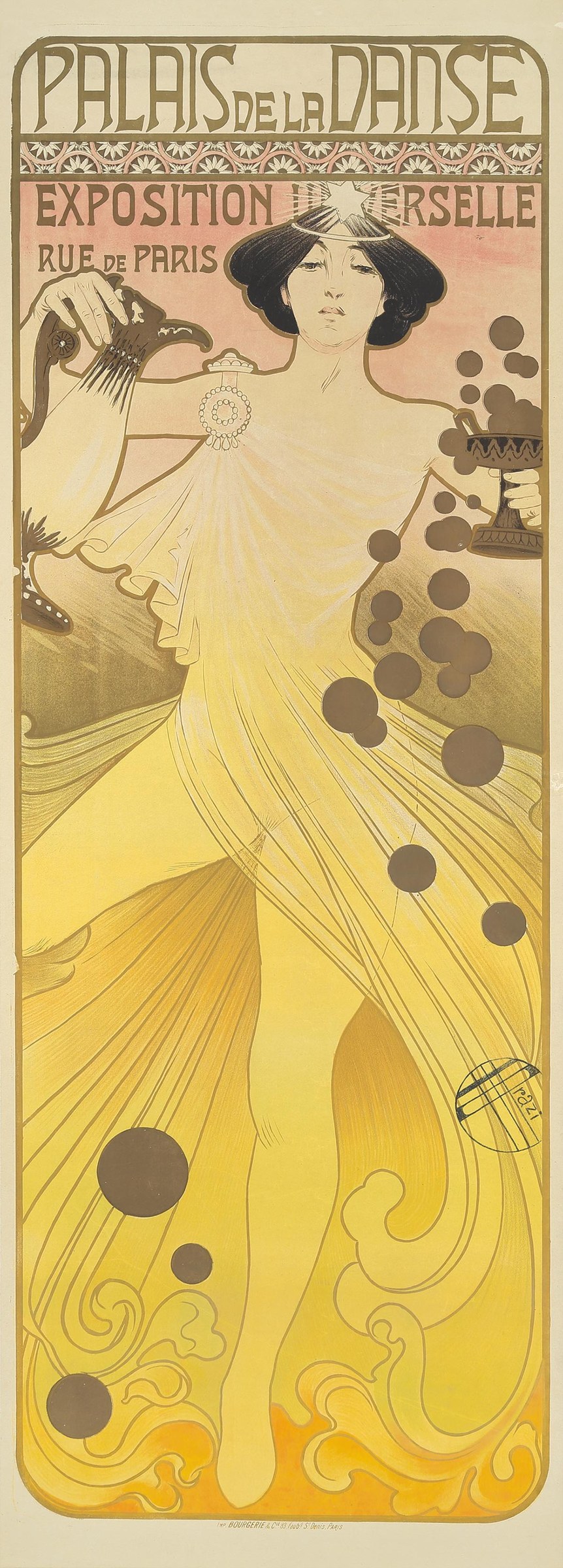
Danse orazi
Manuel Orazi
- Medium:
- Oil Painting
- Era:
- 1900-1920 (Ragtime/Early Jazz)
- Source:
- Wikimedia Commons
- Rights:
- Public domain — free to use, share and adapt.
- Recorded as:
- Public Domain
This poster reveals how dance was understood and marketed at the highest level of cultural prestige in 1900: as an allegorical ideal rather than a specific practice, and as central to France's self-presentation at the world's fair. For dance historians, it is a primary source on the gap between contemporary dance practice (which was diverse and evolving) and how elite cultural institutions chose to symbolize dance to a mass audience. For art historians, it is canonical Art Nouveau, demonstrating the style's dominance in commercial and theatrical design at the century's turn.
What you are looking at
A tall, elegant female figure dominates a vertical composition, rendered in the Art Nouveau style characteristic of turn-of-the-century French theatrical posters. The woman wears a flowing, diaphanous yellow-gold gown that drapes and swirls around her body in sinuous curves, with rich ochre and orange tones deepening toward the hem. She holds a stringed instrument—possibly a lyre or ancient harp—in her left hand, raised toward her face in a gesture suggesting both musical contemplation and classical allusion. Her right arm extends downward, its gesture trailing into the fabric of her dress. The composition is dominated by decorative organic forms: the dress itself becomes landscape, with swirling Art Nouveau flourishes and a cascade of dark spheres (possibly pearls or berries) descending the right side of the figure. The background is minimal and atmospheric. At the top, an ornamental banner reads 'PALAIS DE LA DANSE' in elegant lettering, with a decorative frieze below it. Text lower on the image reads 'EXPOSITION UNIVERSELLE' and 'RUE DE PARIS', identifying this as promotional material for a pavilion at a world's fair. The entire work is rendered in warm earth tones with strong linear definition, typical of the lithographic poster technique.
The dancing
A single standing female figure, idealized and elongated in the Art Nouveau manner, occupies the entire frame. Her posture is neither fully frontal nor in profile but subtly twisted, creating an S-curve of the torso. The weight appears to shift slightly to one side; her stance is graceful but stationary rather than dynamic. Her left arm is raised to shoulder height or slightly higher, cradling the stringed instrument; her right arm hangs or floats at her side, its hand dissolving into drapery. The body is slender and ethereal, emphasizing elegance and refinement over athletic capability. There is no sense of rapid movement or exertion; the pose reads as contemplative and statuesque.
The dance depicted
This is not a representation of recognizable social or theatrical dance in motion. The figure may represent a muse, a classical or allegorical figure of dance or music itself, or the spirit of entertainment rather than a specific dance practice. The pose—holding a lyre and contemplating—evokes classical antiquity (Apollo, Orpheus, the Muses) rather than contemporary dance technique. If there is dance content, it is conceptual and allegorical rather than documentary. The work functions as a symbol of 'La Danse' (Dance itself) as an ideal and an attraction, rather than depicting an actual choreography or social dance form that would have been performed at the pavilion.
How it was made
This is a color lithograph, a technique that dominated artistic poster production in the 1890s–1900s. The warm palette, the bold linear outlines, and the integration of decorative typography are all characteristic of the lithographic process, which allowed for rich color gradations and fine linear detail suited to commercial distribution. The work's size and formal presentation—it is clearly a framed and composed poster object—indicate it was intended for public display, likely in Paris and at the Exposition Universelle venue itself. Lithography's ability to produce multiple high-quality impressions made it ideal for promotional and decorative arts applications during this period.
About this work
This is an Art Nouveau poster for the Palais de la Danse pavilion at the Exposition Universelle in Paris, created around 1900 by Manuel Orazi. Rather than depicting a specific dance in action, the work presents an idealized allegorical figure—a muse or embodiment of Dance itself—posed in a graceful, contemplative stance with a classical lyre. The image is a masterpiece of the Art Nouveau style, with its characteristic emphasis on sinuous curves, elongated forms, decorative organic detail, and integrated typography. It exemplifies how dance was represented in high artistic and commercial contexts at the turn of the century: not as a social or athletic practice, but as an ideal of beauty, refinement, and cultural aspiration. The work is both a historical document (evidence of what the Exposition presented as 'dance') and a significant example of poster art and the visual culture of the Belle Époque.
How to look at it
Attend to the stillness of the figure: this is not a moment frozen mid-movement but a posed, almost sculptural presentation. The viewer should trace the S-curve of the body and how the artist used drapery and decorative elements to create a sense of graceful flow without actual motion. Note how the classical lyre—an instrument associated with ancient Greece and myth—grounds the figure in high culture and timelessness rather than contemporary entertainment. The integration of the figure with the ornamental design (the spheres, the swirling hems, the decorative border) shows how Art Nouveau dissolved boundaries between the figure and its decorative surround. Finally, observe how the poster's typography and the figure are composed as a unified whole, with the text becoming part of the visual design rather than mere label.
The artist
Manuel Orazi (1860–1909) was an Italian-born painter and designer who became a major figure in Parisian poster and theatrical design in the 1890s–1900s. He was closely associated with the Art Nouveau aesthetic and created numerous posters for theatrical productions, exhibitions, and cultural events. His work combined painting technique with graphic design, and he was known for elegant, allegorical compositions featuring idealized female figures. He contributed significantly to the visual culture of the Belle Époque and was actively engaged in Parisian artistic circles during the period of the Expositions Universelles.
The period
At the turn of the 20th century, dance in Paris existed in multiple forms: classical ballet was being revived and reformed; modern experimental choreography was emerging; social ballroom dancing remained popular; and music-hall and cabaret entertainment (which included dance and spectacle) thrived. However, when elite institutions like the Exposition Universelle presented 'dance' to a general audience, they often chose to allegorize it rather than depict actual contemporary practice. The Art Nouveau movement itself (1880–1910) was deeply invested in idealization, nature-inspired form, and the integration of fine and decorative arts. Orazi's poster sits at the intersection of this artistic movement and the specific moment when French culture was being packaged and displayed for international consumption at the world's fair.
Where it lives
This work is identified in the catalogue as associated with the Palais de la Danse pavilion at the Exposition Universelle and is documented in Wikimedia Commons, a digital collection of publicly accessible cultural works. It is a color lithographic poster, a commercial art object designed for public display and distribution.
Questions about this work
Is this showing a real dance or a real dancer?
No. This is an allegorical representation of Dance itself—a classical muse or ideal figure rather than a depiction of contemporary dance technique or performance. The figure's pose is elegant and graceful but static, not captured mid-movement. The lyre and the classical allusions suggest the artist was representing dance as part of high culture and ancient tradition rather than as a living practice.
What was the Palais de la Danse?
The Palais de la Danse was a pavilion at the Exposition Universelle in Paris, the world's fair held to showcase French culture and achievement. Such pavilions typically featured exhibitions, performances, and entertainment. This poster was designed to advertise and promote the pavilion to visitors.
Why does she hold a lyre?
The lyre is a classical Greek instrument associated with Apollo, Orpheus, and the Muses. By placing a lyre in the figure's hands, the artist linked dance to ancient Greek culture, high art, and timeless beauty. This was a common way for 19th-century European artists to elevate dance from a popular entertainment into a form of refined culture.
What is Art Nouveau and why does this matter?
Art Nouveau (1880–1910) was a major artistic movement that emphasized organic forms, elegant curves, and the integration of fine and decorative arts. This poster is a canonical example of the style applied to commercial art. It shows how advanced artistic practice of the time shaped how dance was visualized and promoted in public culture.
More dance artwork