45 works in this view — arrow keys or swipe to move between them.
Dance in Art · 1937
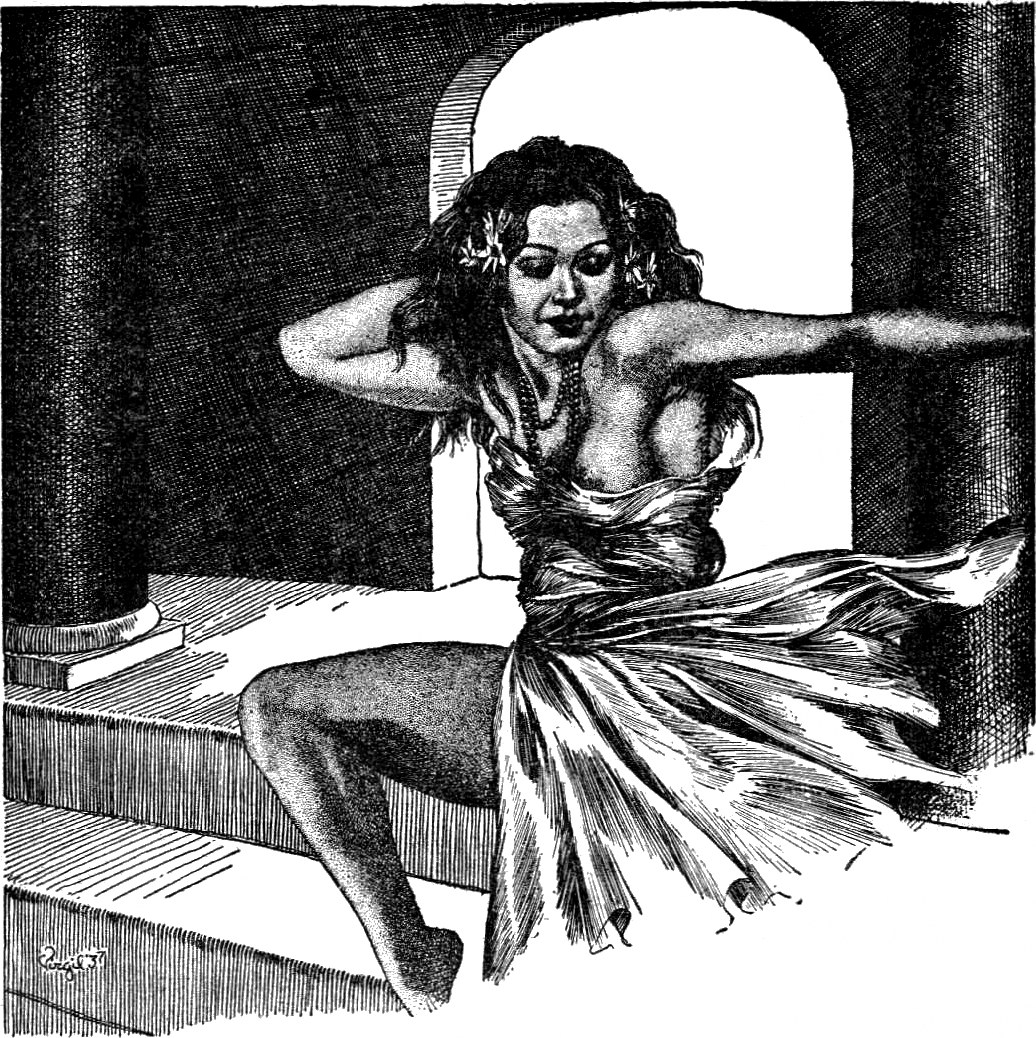
WeirdTalesv30n4pg459 Lake of Life
Virgil Finlay
- Medium:
- Oil Painting
- Era:
- 1920-1950 (Swing Era)
- Source:
- Wikimedia Commons
- Rights:
- Public domain — free to use, share and adapt.
- Recorded as:
- Public Domain
This work is significant as evidence of how dance aesthetics and the classical female body pervaded popular visual culture in the 1930s, even in contexts far removed from the stage. The image shows how orientalist fantasy and classical poses were marketed to a mass audience through inexpensive pulp magazines, reflecting broader cultural investments in exotic and otherworldly feminine beauty.
What you are looking at
A woman reclines on a stone bench in a vaulted stone chamber, one arm raised behind her head in a languorous pose. She wears a diaphanous wrapped garment that falls loosely across her body, exposing her shoulders and limbs. The fabric cascades dramatically across the bench and onto the floor, its folds rendered with fine linear detail. The setting is austere—thick stone walls and arches create a cavernous interior lit by a single bright rectangular opening (perhaps a window or doorway) behind her, rendering the far wall in stark white while the foreground remains in shadow. The composition emphasizes the contrast between the woman's soft, curved form and the geometric severity of the architecture. The entire image is executed as a precise line-work engraving or lithograph, creating rich tonal variation through hatching and cross-hatching.
The dancing
A single female figure dominates the frame, reclining in a pose that privileges display and leisure over active movement. Her weight is supported by the bench; her raised arm and tilted head suggest relaxation or reverie rather than dance. The extended leg visible beneath the wrapped fabric and the sinuous curve of her torso are rendered with anatomical attention. This is a posed figure in a state of repose, not in motion.
The dance depicted
This image does not depict dance in the conventional sense. The figure is stationary and recumbent, positioned to be viewed rather than to move. While the draped fabric and the classical pose might echo the aesthetic of Romantic-era theatrical dance—particularly the languid positions favored in mid-19th-century ballet and orientalist fantasy scenes—the absence of movement, partnering, or any indication of choreographed action places this outside dance representation. The image is closer to academic life study or theatrical figure design.
How it was made
The record lists this as an oil painting, but the image itself strongly suggests an engraving or lithograph: the uniform linear hatching, the crisp tonal separation between light and shadow, and the fine precision of detail throughout are characteristic of print media rather than paint. The technique allows for precise reproduction and wide circulation, consistent with its role as an internal illustration in a pulp magazine. The formal engraving process, with its demand for exact linear control, suits the dramatic chiaroscuro effect here.
About this work
This is an interior illustration from Weird Tales, a mass-market pulp fantasy magazine, created for a story titled 'The Lake of Life.' The image depicts a woman alone in a stone chamber, reclining in a pose that blends classical aesthetic conventions with the orientalist and supernatural fantasy themes that defined the pulp genre. The work is formally accomplished—the artist demonstrates confident control of perspective, anatomy, and tonal rendering—but it is primarily illustrative rather than a finished independent artwork. It belongs in a dance gallery not because it depicts dance itself, but because it captures the visual culture and costume conventions of interwar theatrical fantasy, and because the draped, classical female form was a recurrent motif in dance imagery of the 1920s–1940s era.
How to look at it
Attend to the precise control of light: the artist has frozen the moment of maximum repose, with the figure positioned to be gazed upon rather than to act. The raised arm and tilted head create a serpentine curve along the body, a pose familiar from academic life drawing and classical ballet lineups. The dramatic chiaroscuro—the sharp contrast between the illuminated back wall and the shadowed foreground—is typical of theatrical lighting design from the same era. Notice how the fabric of the garment emphasizes the body's contours while remaining loose and ethereal, a visual convention borrowed from both classical sculpture and stage costume.
The artist
Virgil Finlay (1914–1971) was a prolific commercial illustrator and one of the most accomplished visual artists working in the pulp magazine field during the 1930s and 1940s. He was celebrated for his technical mastery of line-work and tonal rendering, and his distinctive style—combining precise neoclassical anatomy with dramatic lighting and fantastical subject matter—made his work instantly recognizable. Finlay was in high demand for Weird Tales and other pulp publications, and his career demonstrates how serious artistic skill could be deployed in service of popular entertainment.
The period
The 1930s saw both the height of Romantic ballet's influence in concert dance and the consolidation of the pulp magazine industry as a dominant form of popular entertainment. Theatrical dance, particularly the American ballet boom following the 1933 Chicago World's Fair, was associated with classical beauty and often orientalist or fantasy scenarios. Simultaneously, pulp magazines offered affordable illustrated narratives to a working- and middle-class audience. Visual representations of women in languorous, classical poses—often draped in loose fabric and set in exotic or supernatural locations—circulated across both highbrow theatrical contexts and lowbrow magazine illustration, indicating a shared aesthetic vocabulary.
Where it lives
This illustration was published in Weird Tales magazine (October 1937, vol. 30, no. 4, page 459) as the primary illustration for the story 'The Lake of Life.' It is one of hundreds of Finlay illustrations created for the pulp press and demonstrates the high level of finish and technical accomplishment expected even in mass-market magazine work of the period.
Questions about this work
Is this actually a dance image?
Not in the strictest sense—the figure is stationary and reclined, not moving or performing choreography. But it belongs in a dance history context because it documents the visual aesthetic and costume conventions that shaped dance representation and fantasy in the 1930s. The classical draped pose and orientalist setting were visual languages borrowed directly from theatrical dance.
What is 'The Lake of Life' story?
The record identifies this only as an illustration for a story of that title in Weird Tales. Weird Tales stories were typically short fantasy or horror narratives, often featuring supernatural elements and exotic settings. The image's vaulted stone chamber and mysteriously posed female figure fit the pulp genre's taste for the eerie and otherworldly.
Why was the record call this an oil painting?
The catalogue record may reflect either a misidentification or a broader classification of 'finished illustration' as painting regardless of medium. The visual evidence—the uniform hatching, precise line-work, and tonal separation—strongly suggests engraving or lithography rather than oil paint.
Who was Virgil Finlay?
One of the finest illustrators working in pulp magazines during the 1930s and 1940s. He was known for combining technical mastery of line and shadow with fantastical subject matter, and his work appeared regularly in Weird Tales and other publications. He elevated the visual standard of pulp illustration to a level of sustained professional accomplishment.
More dance artwork